
.Dl7BAwhJ_bSbwe.webp)
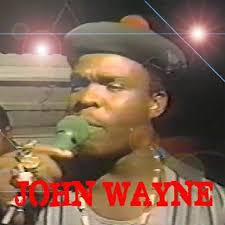
John Wayne was never a big name in the dancehall scene, except for one week in 1985, when 'Call The Police', his version of 'Sleng Teng', was released. But then, in those days, who didn't have a version of 'Sleng Teng'? So he wasn't a legendary singer, like some (albeit) specialised media reported, but rather a one-hit wonder with a riddim that has spawned at least 100 hits.
John Wayne was part of the Waterhouse posse, sometimes also called Firehouse in headier days. The Waterhouse sound was primarily characterised by the lingering vocals and sound improvisations ('Toetoetweng!) of Michael Rose, Hugh Mundell, Don Carlos, Junior Reid and Yami Bolo. But Wayne was a straightforward toaster, even quite monotonous, barely distinguishable from lots of forgotten colleagues. In my collection he shines once: on Sugar Minott's 12" 'Jamming In The Streets', released on the Wackies label.
In 'Dancehall – The Rise Of The Jamaican Dancehall Culture', the benchmark book by Beth Lesser, there are only pictures of John Wayne, one with Junior Reid, another on his bike in front of King Jammy's loudspeakers. He's sporting yellow shorts, a sleeveless shirt with red and white stripes and a round , red cap with a black pompom 'pon top. The real John Wayne would probably call him a queer, but then he's never been in Jamaica.
One more thing: it's not clear if the Jamaican John Wayne was really named John Wayne, but there's a good chance he was. The 'real' Clint Eastwood once took the Clint Eastwood of General Saint fame to court, but was not proved right. It turned out that a Jamaican Clint Eastwood really existed, not a gunslinger but a toaster.