





.Dl7BAwhJ_bSbwe.webp)
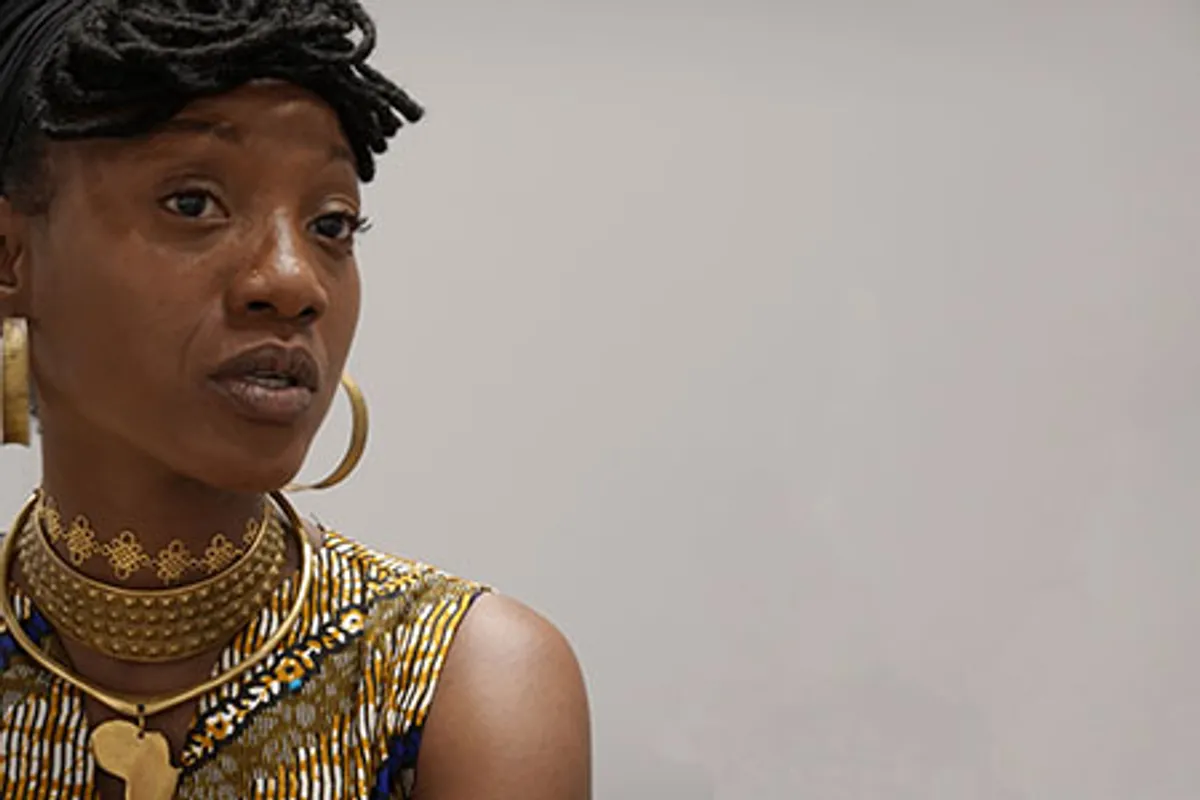
Hempress Sativa: "It was very important for me to talk about things like this, and create this album, speaking from the perspective of a woman!"
door Jah Rebel
Op de voorbije editie van het Afro C Festival in Bredene, zorgde Hempress Sativa voor één van de muzikale hoogtepunten van de dag. Wij zagen daar bovendien de kans om haar nog even aan de tand te voelen over haar recente album 'Woman'!
Hempress, today I would mainly like to focus on your new album, 'Woman', which you described as: "…a challenge to the narrative, long distorted by patriarchal design…" and "…an offering to women all over the globe…". Do you consider this album primarily like a conversation with women, or is it also directed to older white men like me?
Hempress Sativa: "It's an album for everyone, but more so to highlight women, coming from a woman's perspective, speaking on all topics. It's definitely an album for everybody, but my intention was to focus on liberating women through the word sound of the album."
The title track of the album mentions several names of relatively obscure black women. How did you come across them?
Hempress Sativa: "I'm someone who's hungry for knowledge and I live by the creed that you never stop learning. Growing up in a Pan-African oriented, Rastafari household, these things were always emphasized, always taught to us. It's something that was paramount in my household. As I grew older, I took the initiative to expound and expand and learned about some of these women. Others I wasn't aware of until I decided on creating this album and doing more research. I came across a bunch of other African queens that were not really highlighted and found it was an opportunity for me to bring them to the forefront and give people an opportunity to investigate for themselves."
The track also reminded me of 'The Woman King' (a 2022 fictionalised historical drama depicting the Agojie, the all-female regiment in the West African Kingdom of Dahomey, red.). Did you see it, and what did you think of its Hollywood interpretation of historical facts?
Hempress Sativa: "I'm not really someone who watches a lot of movies about Africa, as I much rather watch documentaries. But they are always insightful and useful. Everything stands a purpose. Because even with 'Woman King', I'm sure it kind of enlightened a lot of people. And brought a new name and information to them that they weren't even privy to. So, it's good. But for me, you know, like when I think about Empress Taitu on the front line. With Menelik II. And people don't understand that it was actually Empress Taitu who organized the whole battalion. Yes, Menelik II was commander overall. And it was her military strategies that allowed them to defeat them on the Battle of Adwa, the Italo-Ethiopian War. So yeah, it was very important for me to just bring this knowledge to people. Because a lot of times there's this narrative that women are just emotional and we're weak and we're underling. And I don't think it's fair for we to be the portal of life and carry children for nine months within our womb. And our organs are shifting and we go through this immense pain. And to bring forth life, I think a lot of value and respect should be placed on us, as we're very important to the continuity of the human race! The system was constructed by men, and men benefit a lot from it But, it's not man versus woman. It's the fact that we're not being highlighted. Take the opportunity to know more. I mean, inform yourself. This narrative, like how they speak about women, it's unfair. Every person has a mother. Don't you respect your mother? Respect all women! We're vital to humanity! Everybody has the divine feminine and masculine within them. I wanted to be very specific and say: women, this is for you! Stand up, be empowered, be enlightened. Take your role, take charge, come to the forefront. You're honoured; I respect you because I respect myself. And I know the experiences that I have. So, it was very important for me to talk about things like this, and create this album, speaking from the perspective of a woman."
With a statement like 'Woman', the obvious question - cliché as it may sound - is: do you consider yourself a feminist?
Hempress Sativa: "I don't consider myself a feminist. I grew up in a Rastafari household. And we've always understood the perfect balance between the male and the female. We know both play a vital role. How would you have a child if you don't have a man? I'm not pushing the narrative of feminism. That's not my charge. Like I said, I grew up in a Rastafari community. Men value women, women value men. When His Imperial Majesty Emperor Haile Selassie was crowned on November 2nd, 1930, he took the initiative to be crowned alongside his wife, breaking with Ethiopian tradition. He wanted to make a point: it was no longer about patriarchy or masculinity alone. It was about recognising that both forces are needed to work in unison. The divine feminine and the divine masculine are, as they say, immutable axioms; you need both for any life force to be created. So, why would I be dishonourable to the creation of life and just focus on one thing? It's a balance. It requires two parties to work together in unison. And I think it's very important for us to stop pushing this narrative about women versus men, men versus women. That's problematic. We need unison, we need unity, we need men and women to work together as one!"
In a previous interview, we talked about your father. So, in the context of this album it seems only fitting to talk about your mother, Doris Ricketts. What can you tell us about her?
Hempress Sativa: "My mom is an amazing woman; she's a queen and the first example of a perfect woman in my eyes. My mother joined a Rastafari tribe when she was a very young girl and started having children when she was about 15 or 17 years old. She didn't get the opportunity to experience her own life. She spent all her life making sure that myself, my siblings, and even other people, were taken care of. In my eyes, my mom is a perfect angel. If anybody has shown me any means of compassion and how to be a kind human being, I would tell you it's my mom. I remember how people used to come to our house, knock on the gate and say: "I'm hungry!". She would always give them a meal, but I'd be like: "What are you doing? We need that food!", and she'd reply: "Angels come in all different kinds of forms. You should always be kind to people, because you never know when it's going to be your turn to need someone's kindness." That is something that always stuck with me. To this day she sends me a voice note every day. My mom is also the reason why I write the way I write. I used to grow up and read my mom's journal full of hymns and psalms and praises. She taught me that words can be sacred. She's a true wordsmith in her own right, so my ability to write lyrics definitely comes from her, when my overall love for music, is something I inherited from my father. So, big respect to both of my parents!"
I've read somewhere that your sense of style was influenced by your mother, to the point that you would sometimes borrow - or even steal - her clothes.
Hempress Sativa: "(laughs) It's true. I used to steal my mom's dresses. Since they were too big for me, I used to stitch them in the back and wear her shammas (traditional Ethiopian and Eritrean lightweight, white cotton shawl worn by both men and women, red.) over my shoulders to hide the stitches! My mom is a beautiful, stylish woman, and I always loved her jewellery and clothes. I've carried that with me and incorporated it into my own style. I tell you, she was the first goddess I ever knew, the first queen I ever saw, and the first woman I looked up to as an example of perfection. I can't tell you anything bad about my mother, nothing at all! If it wasn't for my mom, I don't think I would ever have this style, and I've been dressing like this since 2007, when I first started!"
Ten years ago, you collaborated with Paolo Baldini for the first time on 'Boom (Wah Da Da Deng)'. What made you want to work with him again for this album?
Hempress Sativa: "When we did 'Boom (Wah Da Da Deng)', Baldini didn't speak any English, so, it was difficult to converse. was kind of like a conflict for me to even say, hey, let us collaborate and do an album. Because how would I be able to converse it? And he's like, I learned English just to make sure I could speak with you. So, it was a great opportunity because, you know, we did 'Boom' ten years ago and everybody loved it. But we never had an opportunity to perform it together. So, I, you know, not before the time. Now, the time finally presented itself, and I guess we made the best use of it and just created an entire album and did a little tour together."
You travelled to Italy to record this album. How would you compare recording in Jamaica with recording in Europe?
Hempress Sativa: "I went to San Quirino and stayed with Paolo and his family. I stayed in San Foca. We spent about three to four weeks creating the album. I don't see any difference… Well, to be honest, when I'm in Jamaica, I think I'm dealing with musicians who are automatically in tune with the authentic Jamaican sound. Paolo gives his interpretation of what that Jamaican sound is. So, there's still a little bit of difference, but it's not that far off, as he's been doing it for so many years. I feel I've collaborated with somebody who understands reggae music, loves reggae music and knows how to create the sound that I want to hear!"
Paolo is also a big dub fan. Can we expect a dub version of the album?
Hempress Sativa: "I'm not sure as yet if we're going to do a dub version, because I've already started working on another album. That being said, it doesn't take much, so we can still sit down and figure out how to get that going."
There are also two combination tunes on the album. Let's start with 'Ganja Spliff' with Jalifa. Was this your first collaboration?
Hempress Sativa: "Actually, she and I were supposed to have done a collaboration earlier, but we never got around to doing it. I decided to reach out to her for 'Ganja Spliff', and it took her about 30 minutes to an hour to send me back a verse. She's efficient! The delivery is on point, she has a unique sound and personality, and what I really love about her is that she's a strong Rastafari woman that staying true to her roots and culture. She's not diluting her personality just to fit in. I think it was very important for me to include her on the album, because as an artist, I understand what it means to be supported. If I see a female artist that is amazing, it costs me nothing to say: "Hey, let's collaborate!". We're part of a very male-dominated field where men easily get a pass and a blight even for nonsense. So, when I come across women who are lyrically inclined, have the delivery and have the presence, I think it's important to make other people aware of them too."
The second artist featured on the album is Tiken Jah Fakoly. How did you first connect, and how did this collaboration come about?
Hempress Sativa: "I've never met Tiken! I just felt that for 'Rastaman A Chant', it would be amazing to collaborate with a Rastafari man. Going through my options, I was like: "Wait, I could just ask Tiken!". My management team reached out to his agency, and without hesitation, he agreed. He sent me his verse, and it was amazing. I'm very grateful, as I feel it's a good unification between Jamaica and Africa. We're really one people, separated by a body of water. It was a great opportunity for us to showcase each other's audience, exchanging fan base, and just unite under the guise of reggae music."
My favourite track on the album is 'Rinse Me Dub', a classic sound clash tune. How important has sound system culture been in your life?
Hempress Sativa: "My father was one of the purveyors of sound system culture, playing Jah Love Sound System. For me, it's important to make sure that I keep the sound system, culture alive and create songs that help to do just that. Because that's all I know. As a little girl I used to sleep underneath the console while people were playing. Jah Love Sound System would play at the Twelve Tribes headquarters on Hope Road every Friday, and even though we were only children, we'd still attend. But these weren't the type of derogatory dances where people were singing lewd lyrics. We're talking conscious music, music giving homage and praise to his imperial majesty; music that made an impact and positively enlightened people's minds! That is what Jah Love Sound System stood for. I am glad that I had the opportunity to experience and see that firsthand. This is the reason why for me it's very important to preserve the grassroots foundational sound of Jamaica. At the end of the day a lot of these new songs are just regurgitations of the same old school roots rock reggae. So, what are we running from? Why not honour, respect and preserve it? Because we're still using drizzles and bits of influences of it in our music. So why are we deviating from it? With new artists dropping a new song every two seconds, we tend to easily forget the grassroots because everything moves so quickly! I recognize that the foundational sound is still prevalent even in the new music, so I will never depart from preserving that sound. You will always find a song in honour and homage to sound system culture on an Hempress Sativa album!"
Over de auteur
Jah RebelMeer Minder
Lag samen met Jah Shakespear aan de basis van Reggae.be; eerst als recensent en interviewer, en vanaf eind 2014 ook als hoofdredacteur. Verdeelt zijn tijd tussen zijn twee passies: muziek en Haile Selassie.
Genres
Gepubliceerd
13 september 2026