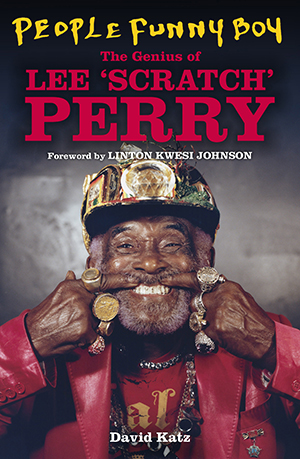
Back in 1987, at Thameside Studio, Rotherhite (UK), David Katz was asked, say commissioned, by Lee Perry himself to write his biography, to literally become his ghost writer. A silver ring with a winged skull was to seal the deal. For decades, Katz meticulously devoted himself to that seemingly insurmountable task. Just listing the more than thousand song titles and their versions must have been a veritable monk's work. For us, at least, countless pieces of the puzzle have fallen into place. Katz mentions the original version of almost every tune, even when it concerns covers of non-reggae songs. That in itself provides an aha-erlebnis every so often, especially if, like me, you have been wondering for years which tune belongs to which original. And then there are the ground-breaking B-sides of all those singles, often insane dubs and remixes, which fortunately almost all can be found on YouTube, and sometimes on one of the many Upsetter compilations.
The latter, by the way, is a recurring theme: how come Lee Perry's oeuvre is so fragmented, and housed by dozens of different major and minor record labels (most of which have since gone bankrupt)? It has to do with vindictive wives, a lack of binding contracts and the fickle mind of The Upsetter himself, who, incidentally, has actually "upset" a lot of people in that way. Many of the privileged witnesses David Katz has spoken to over the years point to the cocktail of excessive alcohol and ganja consumption to explain Perry's tantrums and delusions. Throw that into the mix with a strong spiritual enthusiasm and an unconditional belief in Rastafari, only then can you begin to understand why Lee Perry thought, worked and lived the way he did.
Or you can try reading The End of the Universe, thirteen pages filled by Scratch himself in the hermetic, home-brewed jargon he so readily debated in his later work and interviews. It's about King Alpha and Queen Omega, God and the devil, the Third World and trillions of dollars and pounds, black supremacy and poop and piss, God and Mother Nature, Garvey and Selassie, history, mystery & prophecy. It's an almost unreadable text but you will recognise a lot of the lyrics in it that Perry unleashed on the world between 1961 (!) and 2020, from Bible proverbs to obscene language and gibberish.
Lee Perry has collaborated with just about every major, minor and forgotten hero in reggae music history during that half-century. Producers: Coxsone Dodd, Bunny Lee, King Tubby, Mad Professor, Adrian Sherwood... Artists: far too many to mention but names like Bob Marley, The Congos, Max Romeo and Junior Murvin now all have their high-ranking place in de Reggae Hall of Fame. Musicians: from the Barrett brothers to The Gladiators, together with Lee Perry they helped lay the foundations of dub and roots reggae, the music that is more popular today than ever. All these figures are also featured in this book, often telling their story in their own words. There are short and long quotes from pop and rock artists Perry influenced: Brian Eno (finally I know why I liked Roxy Music's first four albums so much), Paul and Linda McCartney, Robert Palmer, Tom Tom Club... The techies and studio wizards among you are not forgotten either: David Katz names just about all the equipment Scratch worked with in his Black Ark studio.
In the past 20 years, Perry himself has hardly been behind the controls, but he has stepped into all kinds of projects as a vocalist, mostly set up by rabid fans who could only dream of one day collaborating with their idol. Pura Vida in Belgium, Danny Boyle in England, Subatomic Sound System in the States, Dubblestandart in Berlin... Lee Perry took frequent and long holidays, in Jamaica or in Switzerland (where he had his permanent residence since 1990), but was otherwise almost constantly on the road between the different continents. It is amazing how many concerts he still gave as a 60-, 70- and 80-something, with the most diverse backing bands or just on sound. David Katz lists almost all of them. In between, Perry dived his time between studios everywhere and collaborated on more or less successful productions, it didn't even have to be dub or reggae. Glad we get to list all those collaborations as well, AND that Katz mostly agrees with my own impressions of some records.
And what would a biography be without stories about family, partners, and children? The author takes us to Kendall, in northwest Jamaica, and Miss Ina, Perry's mother. He tells at length about his partner Pauline Morrison, who played a crucial role in the sale of tunes and rights to many different record companies. We learn how Lee's children fared: Omar and Sean grew up the in the heyday of the Black Ark, their father's legendary studio, and they also hung around there for years, in the end left on their own. Omar emerged stronger from that and built a new life in Europe, with his own half-Belgian children. Sean became addicted to crack and never got his life back on track.
Of course, Mireille Rüegg is also discussed at length, the woman with whom Lee Perry spent the last 30 years of his life (when they were not fighting). She gets credits in this book as a reggae promoter and psychiatrist, who previously had an affair with Max Romeo, and a house in Montego Bay. Mireille Perry (they were married!) still cherished big plans for Perry, such as building a kind of LSP dream park. Puraman Bregt De Boever drew another visionary picture of it with Scratch.
Whether that Perry paradise will ever come about remains to be seen in Jamaica, where in the shadow of Bob Marley there is little room left for a visible tribute to other artists, however genius and innovative they may have been. In the 1970s, Lee Perry was highly regarded on the island but his name did not ring a bell with many Jamaicans until a few years ago. While his name and fame only grew abroad, and he was honoured and believed worldwide after his death. A few months later, 'People Funny Boy' was released, as if it was meant to be. Even the funeral is in the book, still in full corona time and attended by barely a handful of people. The great genius of reggae deserved a nicer farewell.
'People Funny Boy - The Genius of Lee 'Scratch' Perry', David Katz, 667p
Published by White Rabbit









.Dl7BAwhJ_ZJXLLF.webp)