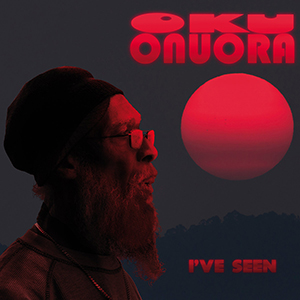
After all these years, the father of Jamaican dub poetry has taken to the studio again and, with the help of a Swiss band, made a record that withstands the comparison to his classic album 'Pressure Drop' (1984).
Oku Onuora's previous album, 'A Movement' (2013), sorry to say so, passed by unnoticed, at least in my musical wanderings. So it's been 35 years since I heard a new release from the man who put dub poetry on the map in Jamaica, together with Mutabaruka and Michael Smith. Their big role model was of course Linton Kwesi Johnson (LKJ), the "inventor" of the genre, who migrated to Great Britain. But the Jamaicans write poetry in a completely different state of mind, with a totally different background.
When Oku Onuora (Orlando Wong) released his first album in 1979, he already had a whole life behind him. In 1970 he was sentenced to 15 years in jail after he had robbed a post office, Robin Hood style. The loot was to be used for building a school in a poor community. Oku escaped from prison twice (and was hit by bullets five times), he triggered a prison uprising, campaigned for prison reforms, and was the first inmate ever to be allowed to perform with a reggae band, Light of Saba. Oku Onuora considered himself a political prisoner and was released early in 1977 under pressure from the media. By that time the poetry that he'd had smuggled out of prison had been published in the Daily Gleaner newspaper. The prosecutor himself was reportedly a poet, and pardoned his "colleague".
Like LKJ, Oku Onuora first published a collection of poems, only then to set them to music. The excellent 12inch records 'I A Tell/Reflection In Red' and 'Wi A Come/Wat A Situashan' were recorded in Tuff Gong with a handful of top musicians (Aston and Carlton Barrett, Nambo, Skully, Cedric Brooks, Ibo Cooper...). In 1984 the LP 'Pressure Drop' was released with the occasional band AK7. With the exception of a few obscure dub projects, Oku Onuora has since completely disappeared from the limelight, allegedly disgusted by the music business.
Fortunately, for every Jamaican artist of his generation there is a band or DJ somewhere in the world who wants to get him out of oblivion. In this case, the Swiss producer/musician Doctor T (Thomas Lautenbacher) and his band The 18th Parallel, who also made an album with I Kong in 2016. They create the perfect musical landscape that Oku Onuora needs for his unabatedly militant poems, contemporary reggae in the tradition of the golden '70s, with an excellent horn section and fresh instrumental injections on synths, organ, melodica and other keys.
On the best track of the album, 'Fuel For fire', the late Rico Rodriguez shines once more, in wonderful interplay with dub and poetry. 'Can't Breath' says Onuora, not in the slave ships, not on the plantations, not under colonial pressure and not today because of pollution. For all that bigotry, persecution, ignorance and brutality there is only one solution: a total destruction of the current institutions. An irresistible drum roll provides the energy for this fiery protest.
'If Not Now' also floats on anger and indignation. Built on a Cuss Cuss-like riddim, laden with echoes and news samples, the poet wonders when forced migration, wasteland, shock and awe and nuclear war will finally come to an end. The raw lead guitar strengthens the apocalyptic vibe.
The most beautiful, most poetic poem is perhaps the opening track of the album, 'I've Seen', classic reggae with beautiful horns. "No matter how many moons I've seen", says Onuora, I'm still there, conscious and ready to fight with words. Blue moon (a reference to the French label that released his first LP 'Pressure Drop'), mystic moon, moons on every continent: none of these moons have been able to get him off his path.
In 'Don't Like', interspersed with police sirens and news items about street violence, Onuora states that he doesn't fight against flesh and blood but against spiritual wickedness, hypocrites, backbiters and backstabbers. Once again an exquisitely arranged production.
'Madda' is a tribute to the mother, by definition a very strong woman. The uptempo dub is colored with royal horns. In 'Dubword Warrior' (the title says it all) Oku Onuora honours himself and dub poetry in general, an expression of pure consciousness. In 'Still' he wonders what would happen if Malcolm and Martin were to return today, Biko, Nanny and Bogle... Would all those freedom fighters be satisfied with the progress that's been made? This poem, too, is hurried top ranking horns and an energetic dub. "The truth must be told", is the last sentence Onuora screams out.
More accolades in 'Jamaica', to everything that makes the country so beautiful. Love it or leave it! With fine siren singing from a K'sangel.
In between the eight dubtracks there are as many short poems, sometimes embellished with some atmospheric sound. LKJ is without a doubt the better poet and Mutabaruka the better ambassador of dub poetry. But in the work of Oku Onuora you also feel the primal power of the shaman, the obeah man, the old rastaman, the sufferer. Give thanks, Doctor T, to hoist this man on the shield once more.






.Dl7BAwhJ_ZJXLLF.webp)