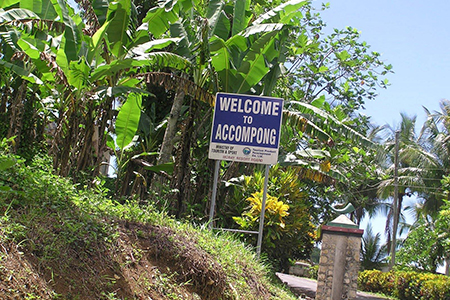
It wasn't a warm welcome that awaited us in the capital of the Maroons. I once visited Moore Town, the Maroon village in Portland, and, as tradition dictates, there we were welcomed by the Colonel; his office decorated with was the Ghanaian flag and a picture of Kwame Nkrumah, the first president of the first sub-Saharan country to rid itself of the yoke of colonization. Nowadays, some call Ghana the second Jamaica, because so many Jamaicans live there. Their ancestors often came from the Gold Coast, as the region around Ghana was still called then. Repatriation, the rastaman seh! The return to the motherland: Africa. Most Maroons were descendants of the Cromanti, slaves who had passed through the fortress of the same name on the Gold Coast, and who were known for their rebellious nature.
Back then in Moore Town, we could just walk around freely. A man told a story about Nanny, leader of the Windward Maroons, who mainly lived in the Blue and John Crow Mountains in the east. Nanny is one of Jamaica's five national heroes, even though the role of the Maroons in the slave era is not entirely undisputed as some of them collaborated with the British ruler to bring escaped slaves back to the plantations. According to our man in Moore Town, Nanny could shoot bullets with her intimate cannon, and he pointed to the mountain from where she would have done so at the time. In short, it was an instructive and informal introduction to Maroon culture, extended in the local open bar, where we witnessed a noisy game of ludi, a kind of Caribbean domino. Nobody took notice of us but of course that's exactly what made it so authentic.
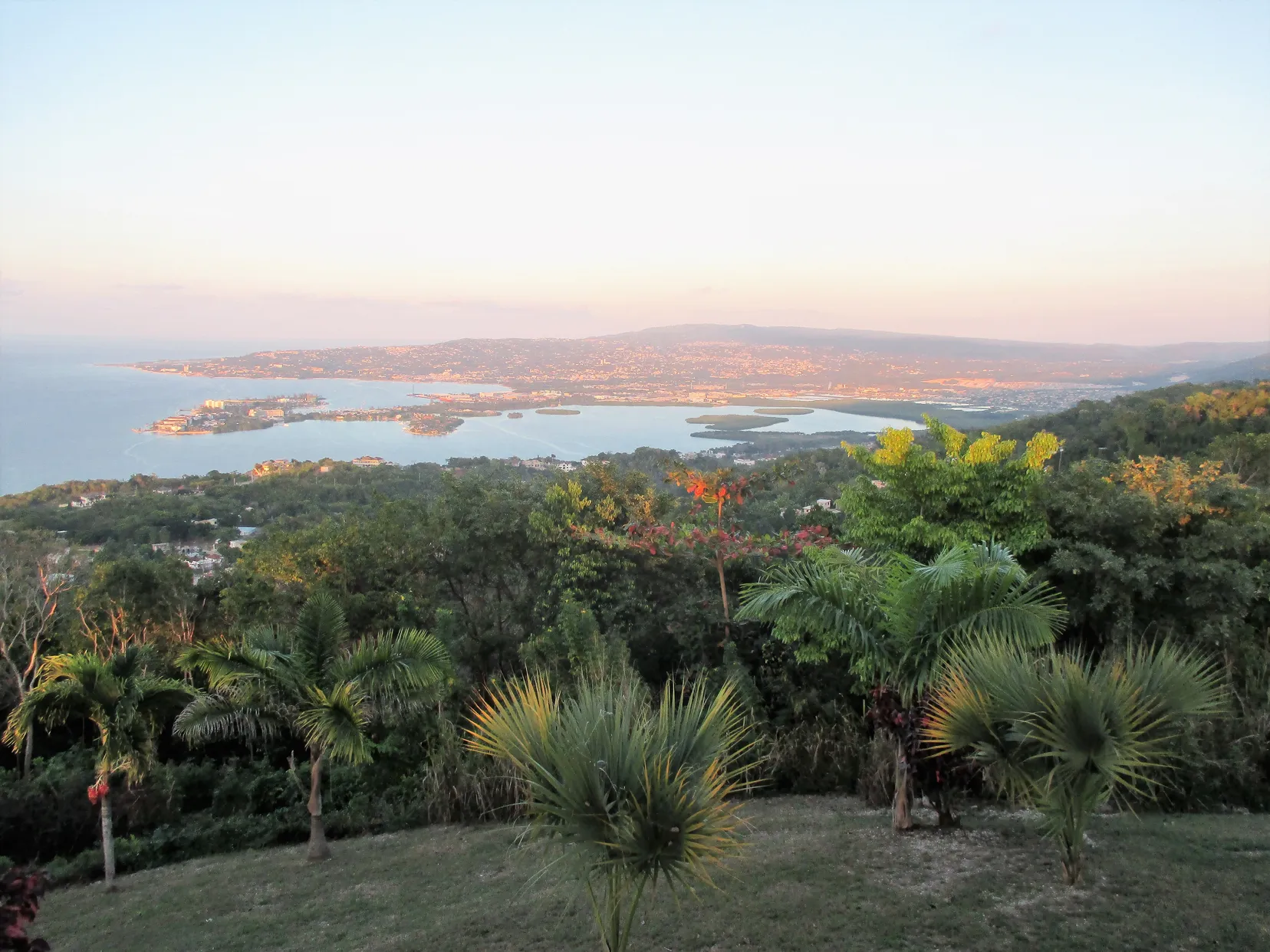
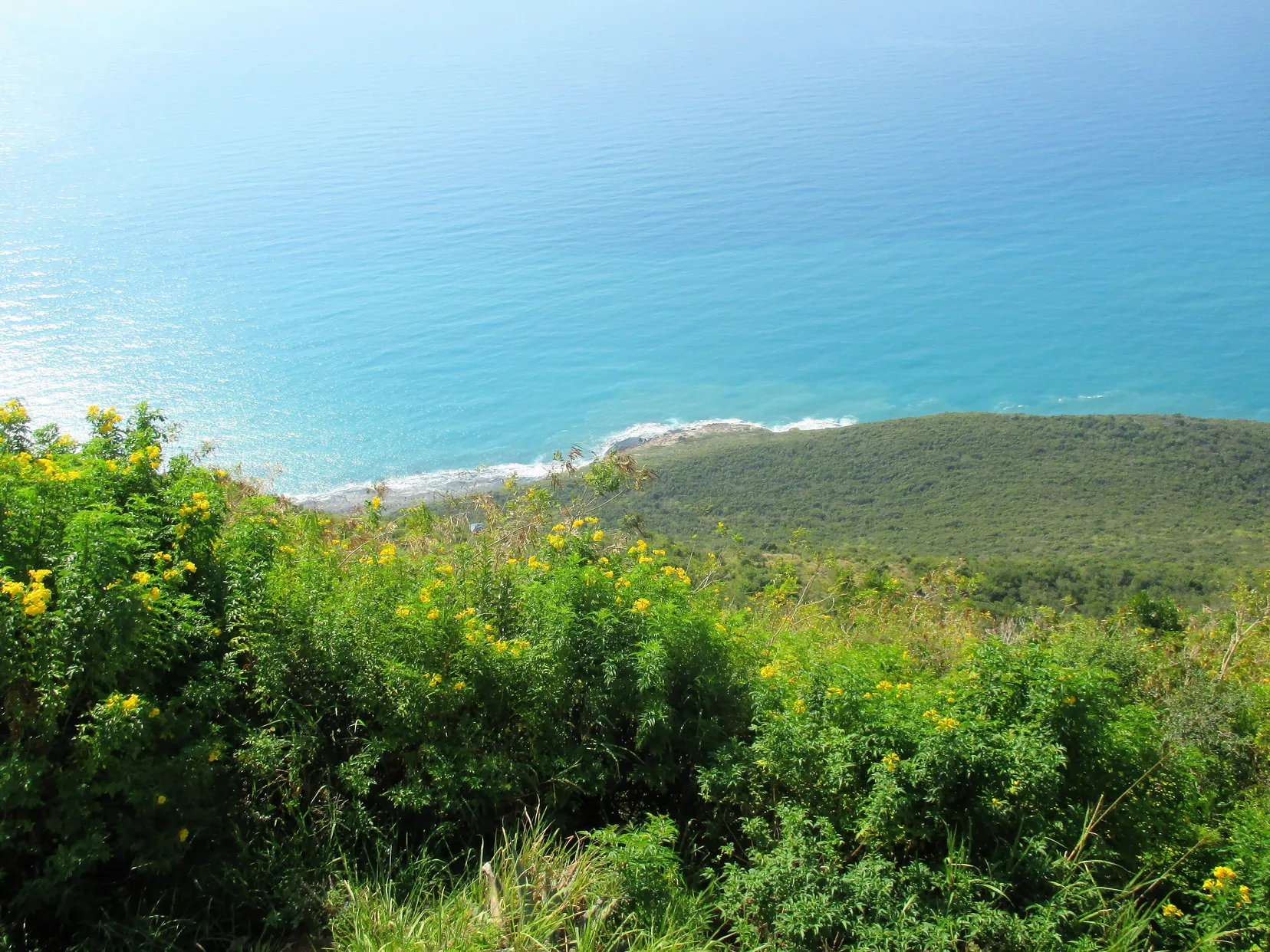
In Accompong too we'd have to ask the Colonel for permission to enter the village. From Montego Bay we drove for over 2.5 hours over endless winding roads with beautiful views over the hills and mountains of the Cockpit Country, taking us higher and higher, and further than you would ever suspect when you see the map of Jamaica. We didn't have a GPS but our friend and driver Commander didn't seem to care. To him the whole country is one big Google Maps, the locals being his signposts; just a pity that the last man he addressed sent us over some kind of jungle path instead of the normal road, making the ride take even longer. I almost lost my patience and intended not to accept the proposals of the local tour guides who (according to The Rough Guide) were probably waiting for us. We wanted to be home before dark and I'd read so much about the Maroons I felt I didn't need another tour, or so I thought…
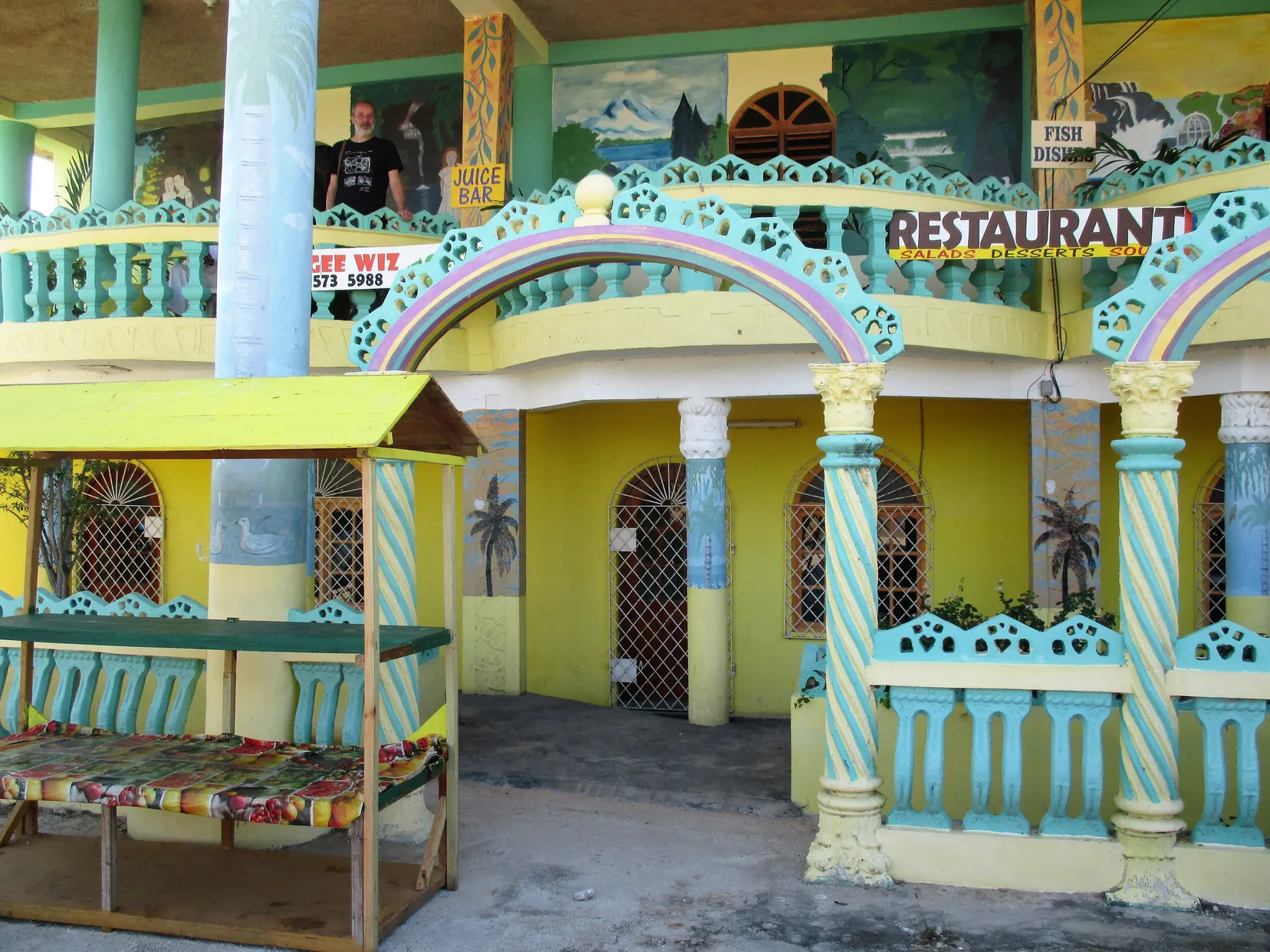
At first sight Accompong didn't differ much from the other villages we drove through, Retirement, Springfield, Jointwood, Niagara are but a few of the most striking names. Slightly bigger maybe, spread out more, but also grown organically, expanding from a central point, with large pieces of greenery, uncultivated land and unfinished buildings. Two shops in a wooden shack, a few small bars, a sober restaurant. Men hanging around, young and old, most of them with a deep dark skin colour. Here the African genes were clearly less mixed with European and Asian ones.
We hadn't even gotten out of the car yet, or a man started talking to us. "I'm the Chief," he says. "Are you the Colonel?", I ask. "No, I'm the Chief. No Colonel. Tour costs 5000 Jamaican dollars!". Then he looked at Commander, threatening: "But first I need money to buy rum. Give me a thousand!"
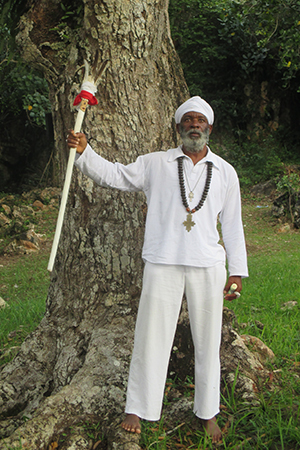
You should know: Commander is a special figure; always impeccably dressed in white, including the turban on his head, and an impressive pit necklace around his neck holding a large Ethiopian cross. He also carries a long, white-painted stick, with a primitively painted head and feathers like hair on top. Commander calls it his African stick, which he uses to attract positive and reject negative energy. Everywhere we go, people recognize a true Elder in Commander, a rastaman who has mastered a deep spirituality and deserves the highest respect, without compromising his open and cheerful personality. Foremost, Commander is a typical Jamaican, in the best sense of the word.
But in Accompong he was suddenly met with some kind of resistance. The Chief stood right in front of him, staring Commander straight in the eyes. He mumbled something I couldn't understand, Commander keeping his silence. I'd never seen him behave so seriously. They remained motionless for a few minutes, in a silent face off. The young man who was sent away by the Chief with my 1000 JA returned with a small bottle of rum, giving me 200 in change. The Chief told us to joing him, a few meters onwards, removed from the other men who'd had started to show up in the meantime. Commander followed, still in a kind of angry, submissive trance. The Chief took a sip and spat the rum in Commander's face, sprinkling the rest of the bottle over his head, his arms, his legs, his crotch, his neck, while he mumbling something unintelligible sounding remotely African again. In Haiti and New Orleans they would call it voodoo, here it's obeah.
"Say freedom!", ordered the Chief. "Freedom!", said Commander. "Louder!" Commander repeated the word a little louder. "Louder!" Commander regained his strength and roared: "Freedom!" The Chief made a concluding gesture and addressed us, more dutifully than with true conviction. We also got sprinkled a bit of rum in our necks and over our arms, making us smell of alcohol for the remainder of the day; not really one of my habits.
"The tour costs 5000 Jamaican dollar!", the Chief repeated while he emphatically held his hand open, with the other one urging a man to come to us. "Your guide!", said the Chief. At that moment a car with some other white visitors, a man and two women, stopped. Apparently they had made an appointment because a third man immediately joined them and started the tour. We soon realized that he was the real tour guide, explaining the history of Accompong. Our man seemed ignorant, something he acknowledged himself, without shame or scruples. We just joined the other (Czech) company, feeling a bit swindled. Yes, I paid that 5000 JA, even though I swore I wouldn't. But what was the alternative? Visiting the village in a hostile atmosphere? Of course everyone would immediately know if you hadn't paid, the Maroons don't need social media to know that. Or else having been driven away, but that would have been a pity after the long drive it took to get there.
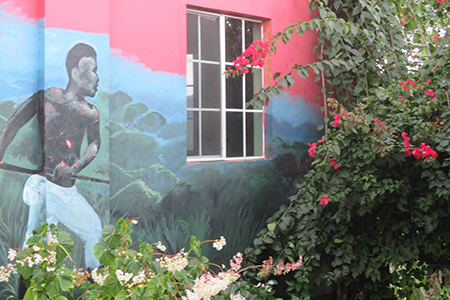
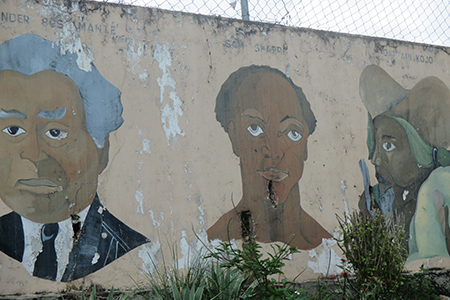
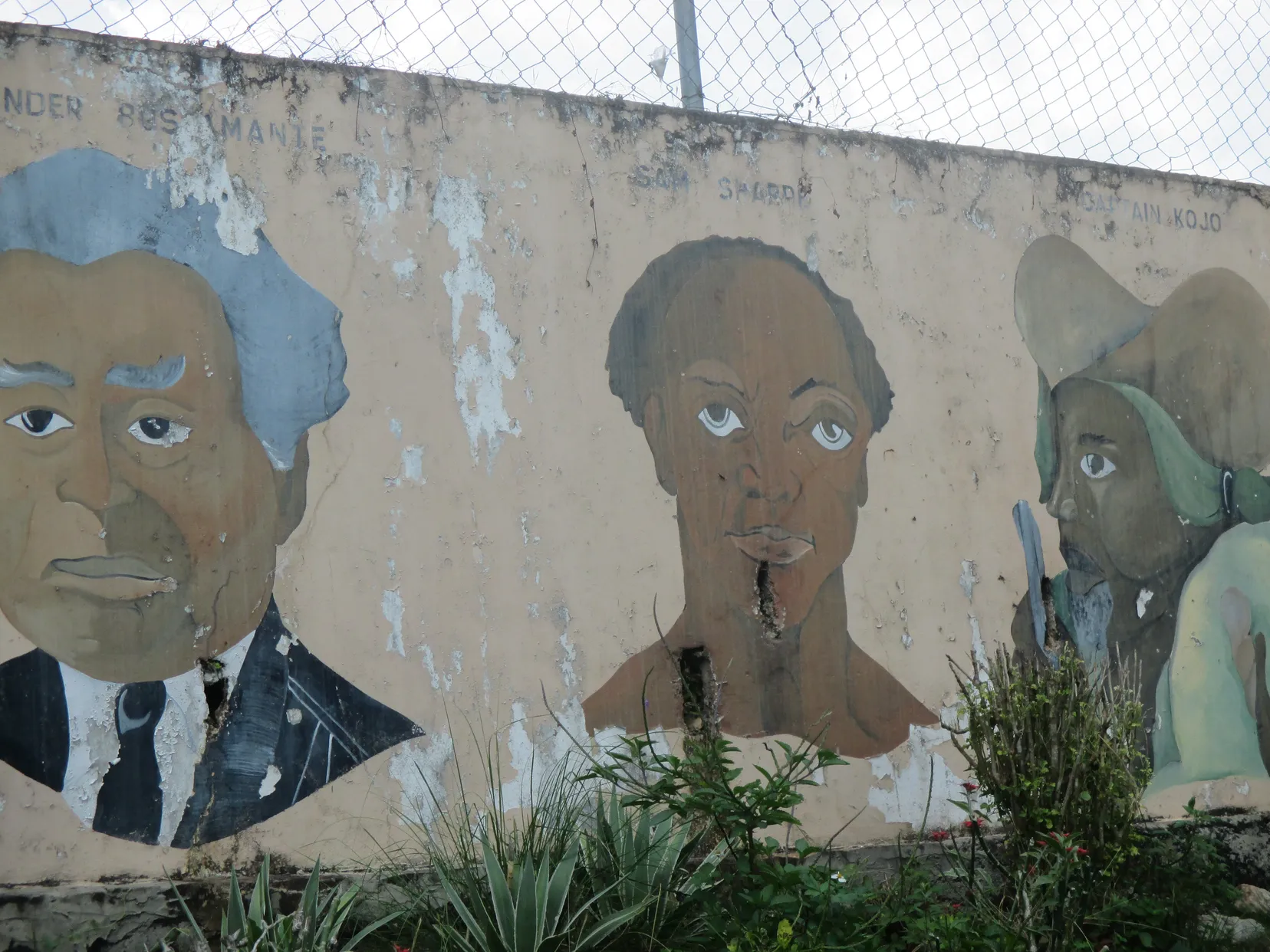
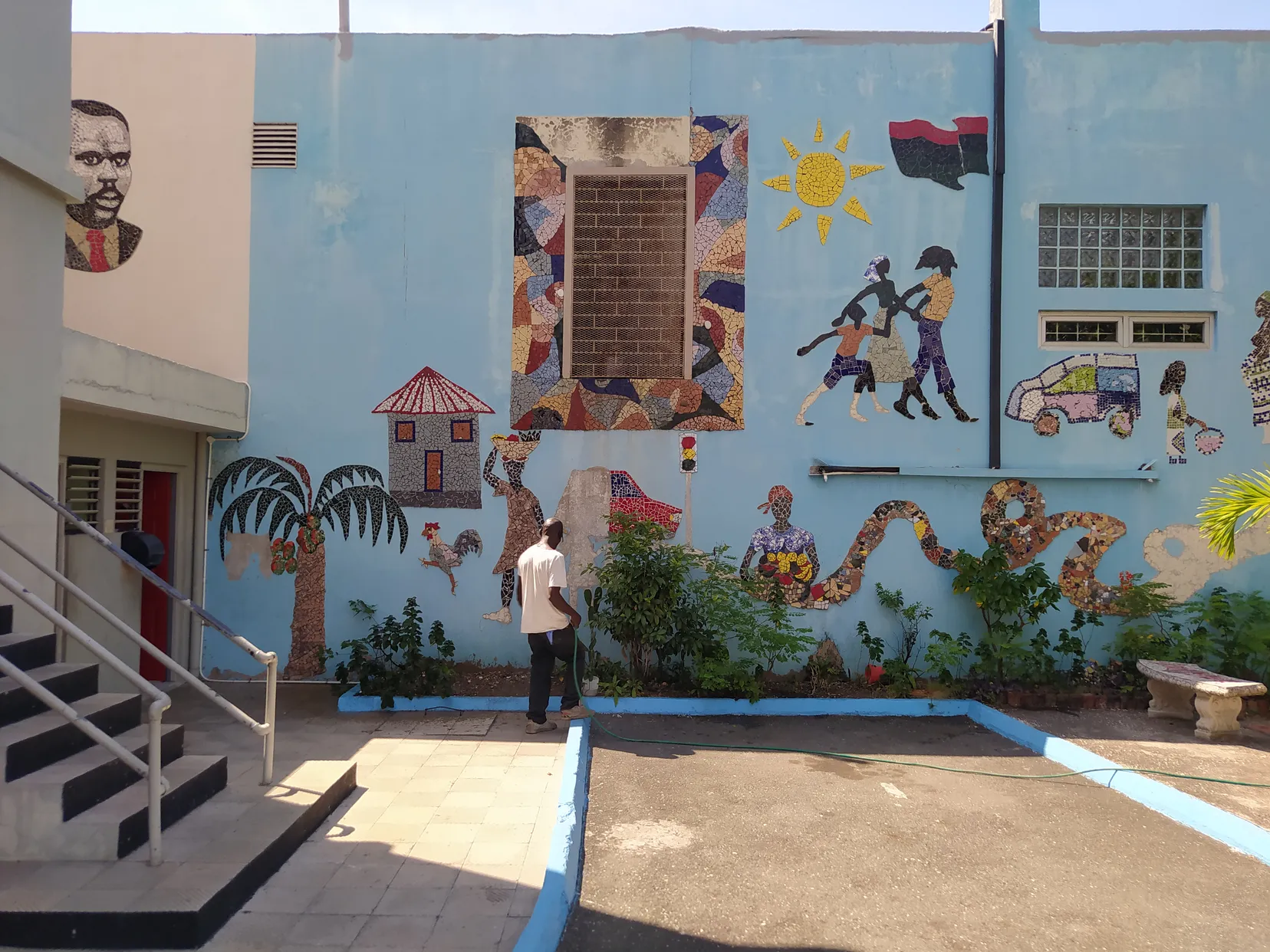
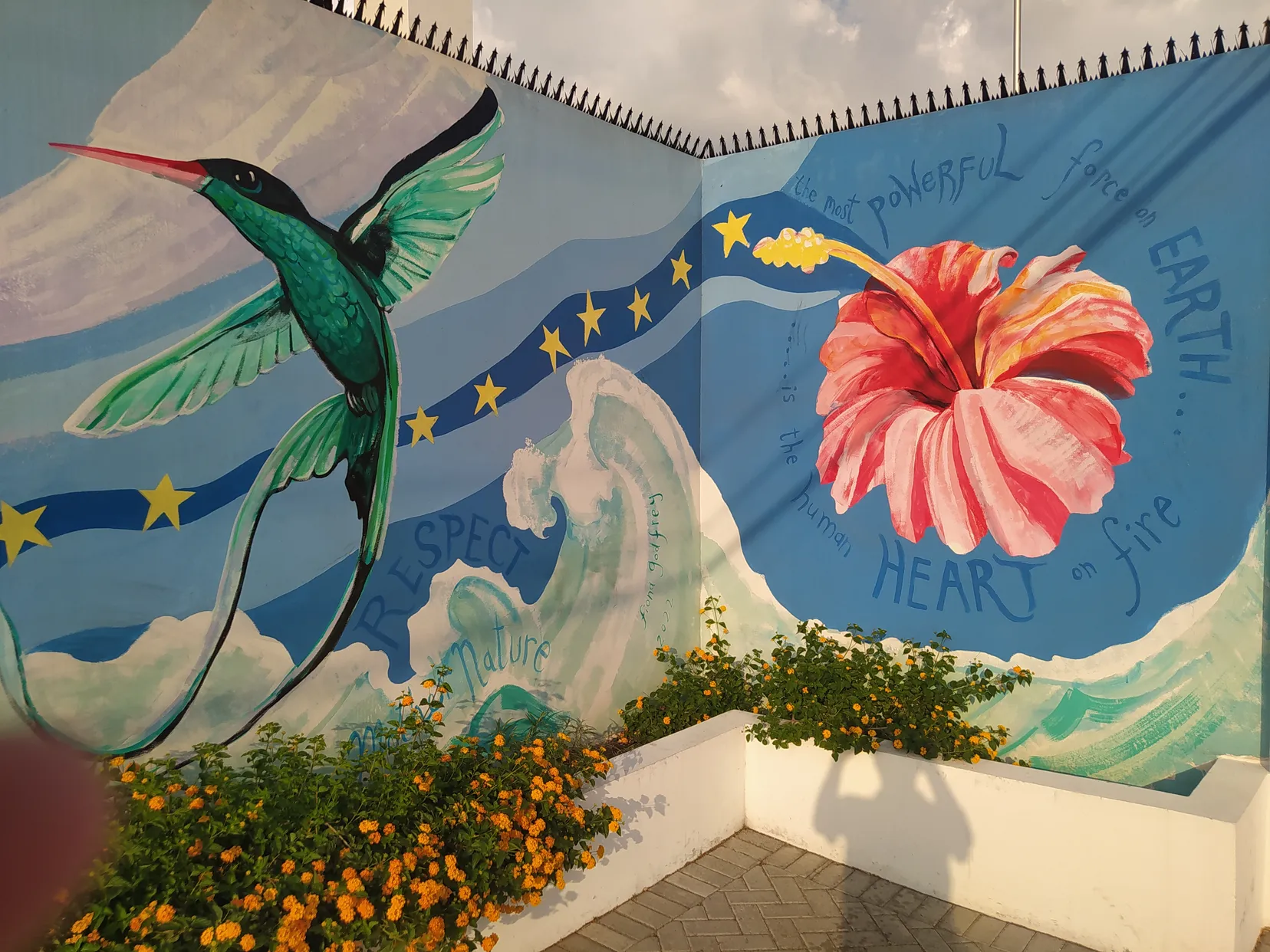
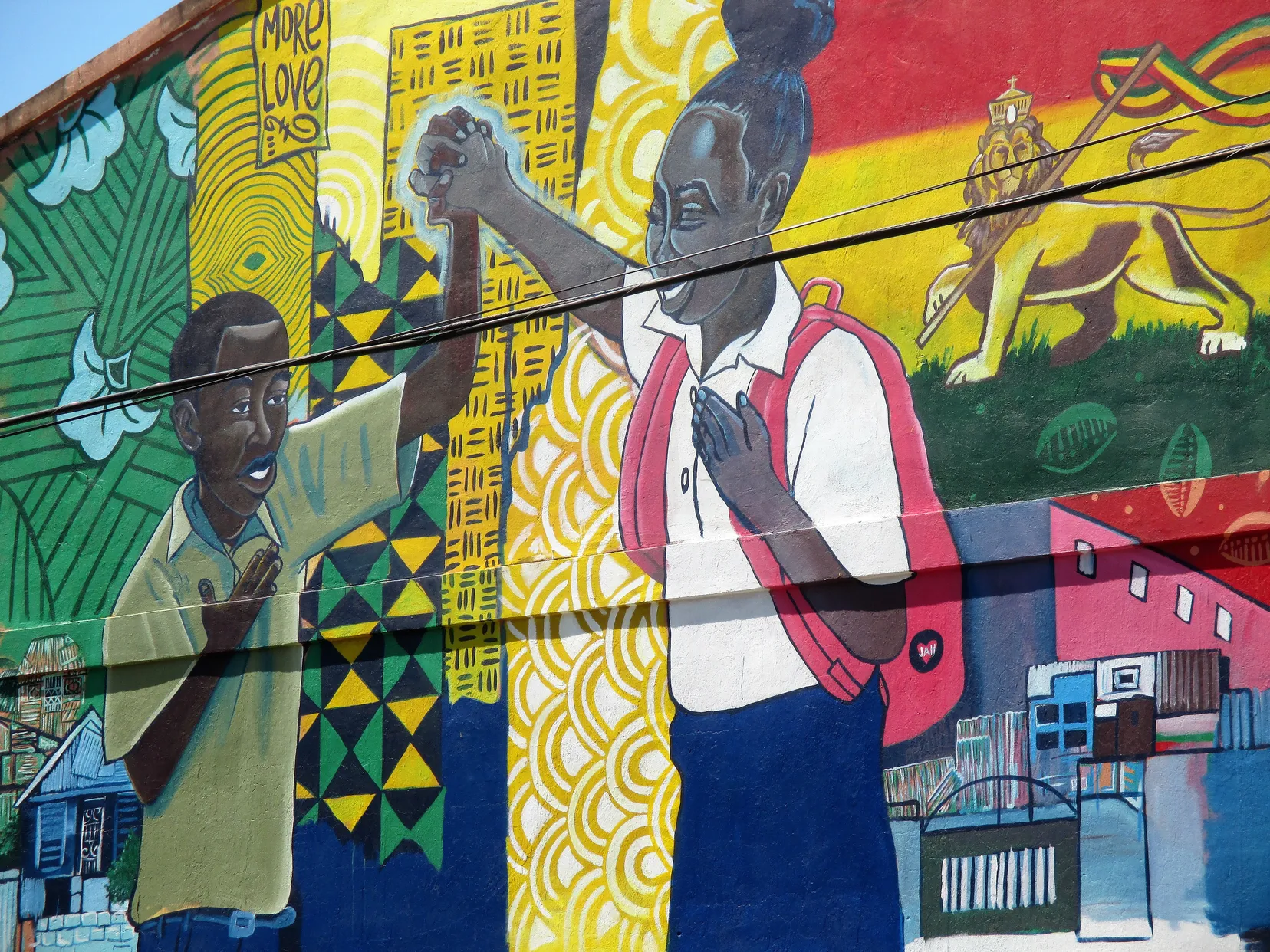
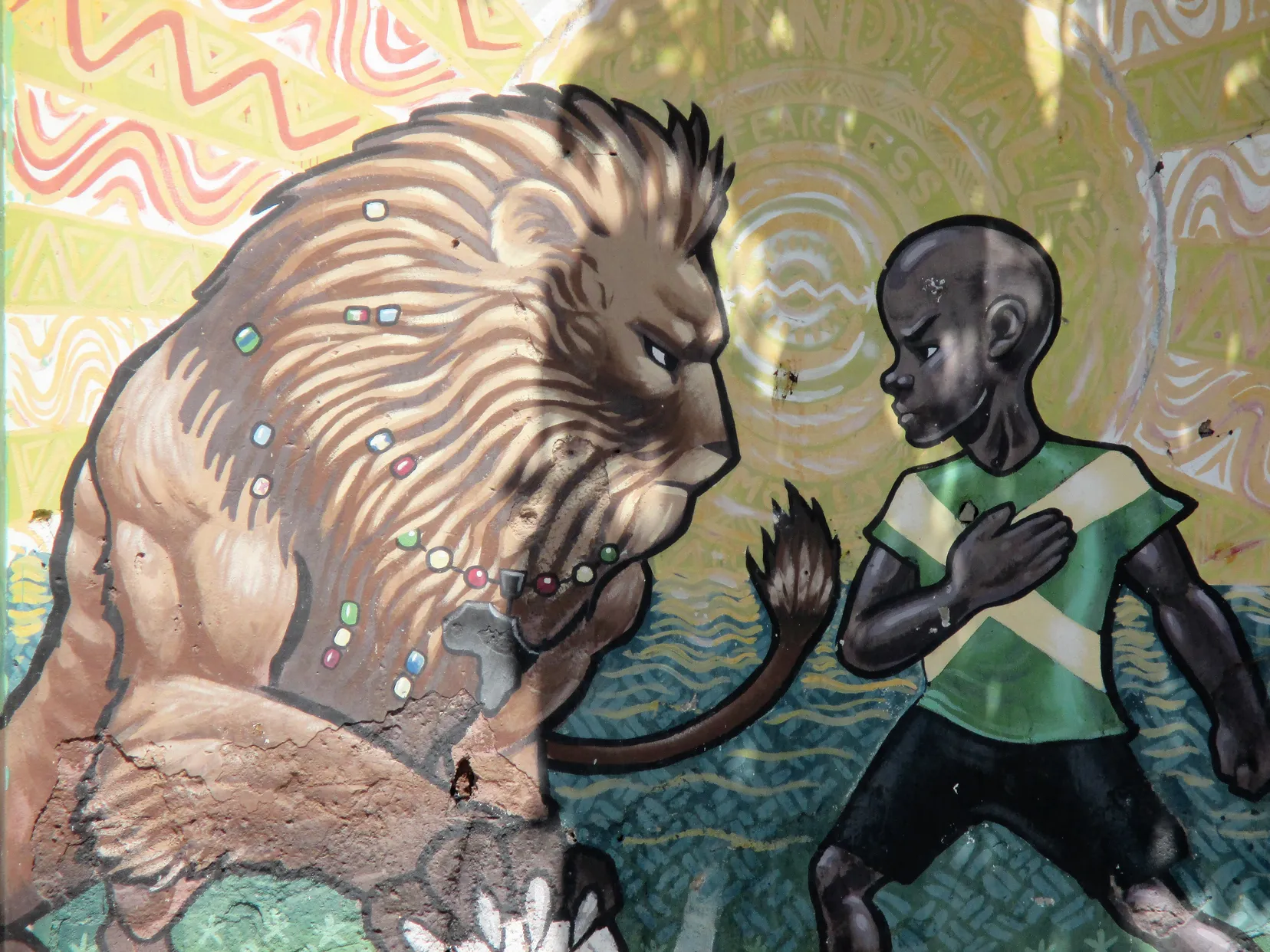
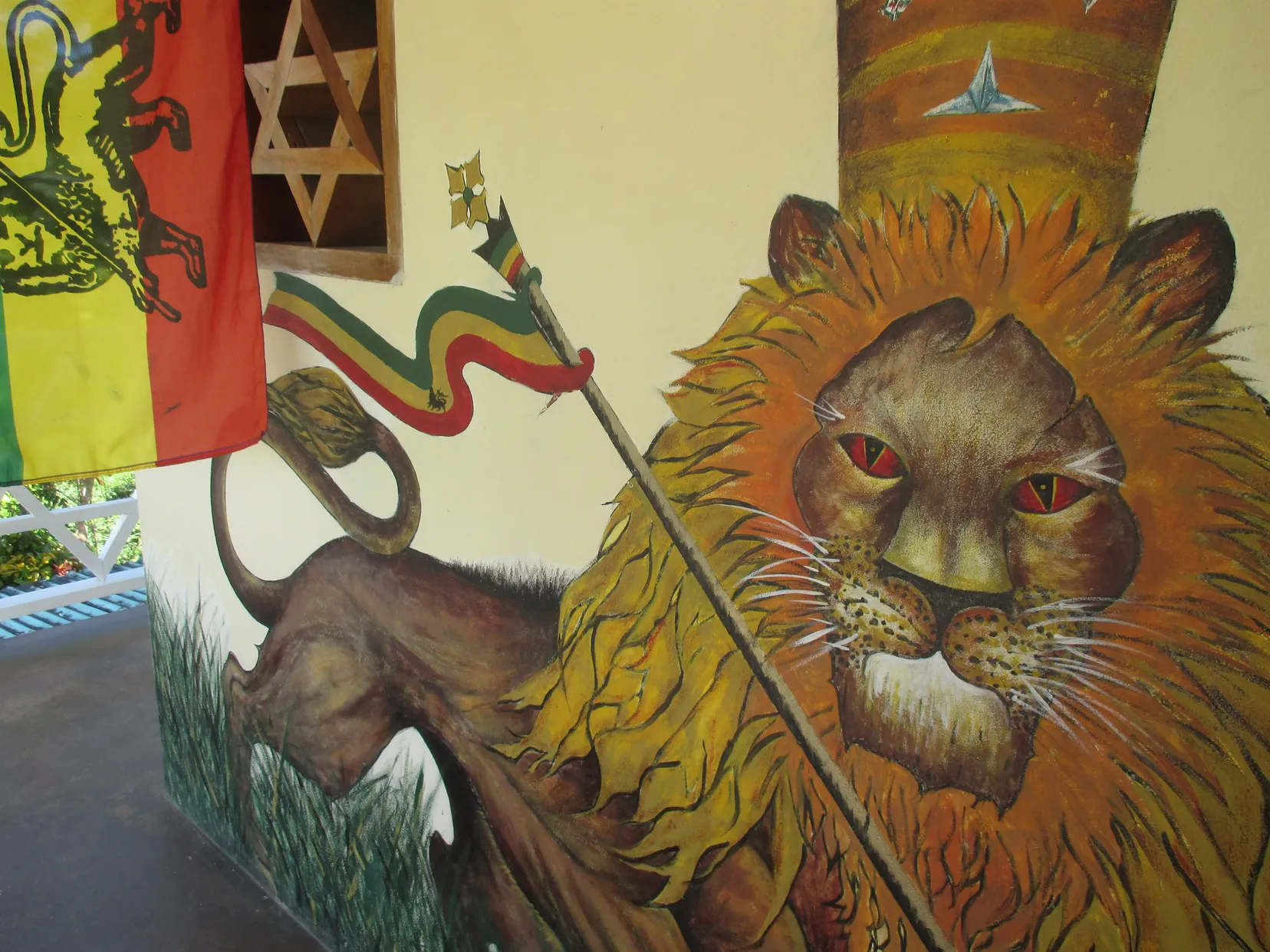
It's not that we begrudge these people their earnings, but they could have shown a little more respect for the scarce visitors they get. And also honour their historical heritage. There were several murals, including one depicting the five National Heroes of Jamaica, but the once bright colours had lost all their splendour and power, and the paint was flaking. The large Parade Ground, which used to be the Maroons' military training ground and the place where justice was done, was now nothing more than the school's soulless playground. Here and there a sign was posted with some historical explanations.
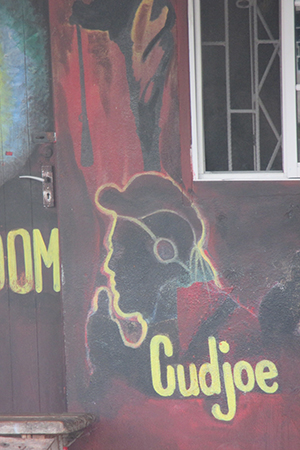
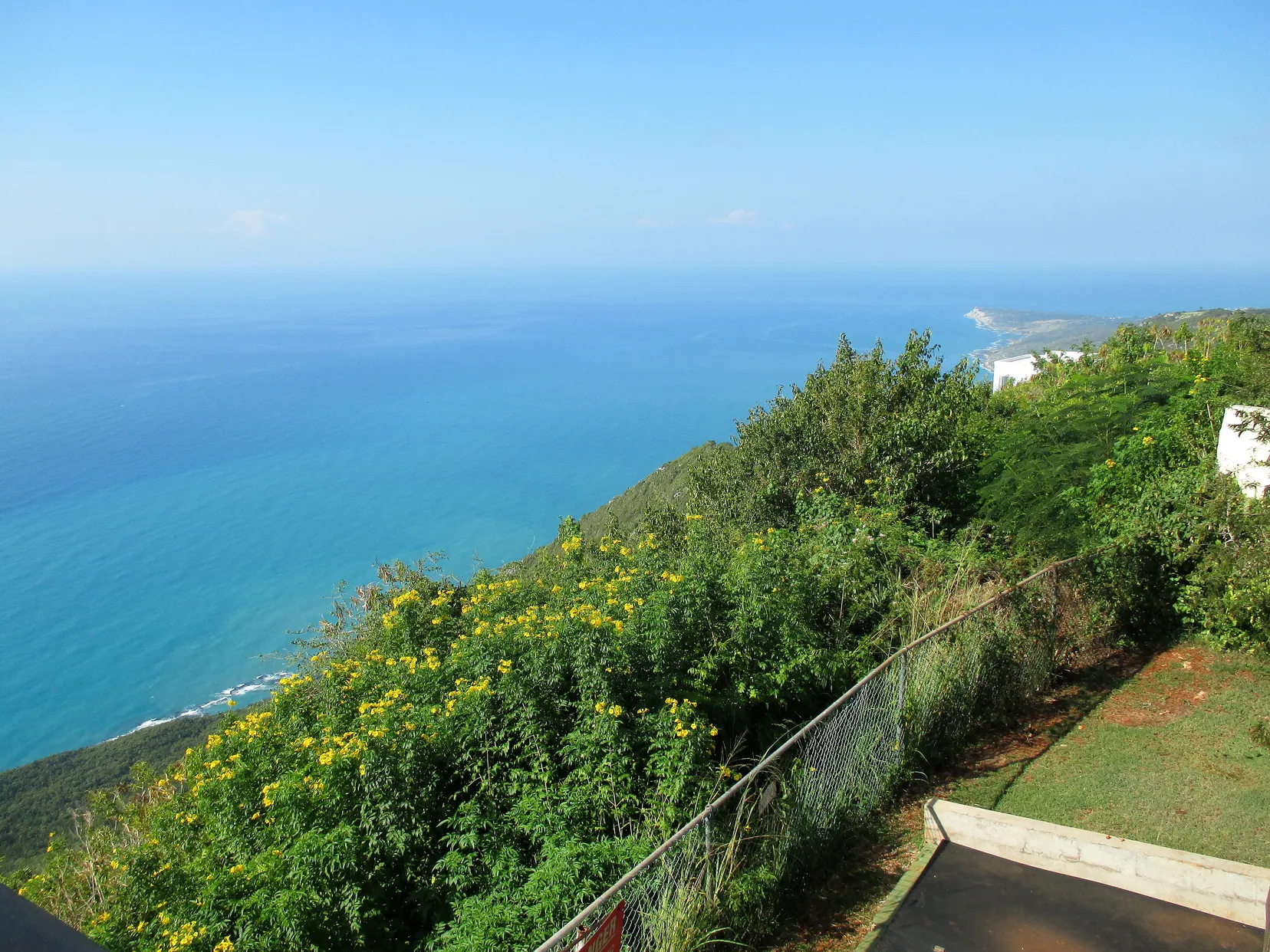
A beautiful avenue, bordered on one side by an impenetrable tangle of roots, first lead us to the rudimentary wooden statue of a Maroon warrior, and then to a clearing with a stunning view over the Cockpit Country. In the middle stood an impressive old mango tree with roots stretching high above the ground; the Kindah Tree is said to be over 300 years old, and this is where Cudjo, the leader of the Trelawny Maroons once met Nanny, his Blue Mountains counterpart. "This was their office.", says the guide. Cudjo was also the man who, after the first Maroon War in 1739, signed a treaty with the British, which not only provided his people with 1,500 acres of land, but also a great deal of autonomy and their own jurisdiction. The Maroon villages still enjoy this status. They have their own representatives in parliament and every year on January 6th the Accompong Maroon Festival takes place here, with the Prime Minister and numerous foreign VIPs as guests of honour. Accompong is not named after the city of the same name in Ghana, but after Cudjo's brother.
Not all Maroons were lucky enough to stay here. After the second Maroon War in 1795, 500 Trelawny Maroons were first deported to the barren Nova Scotia, and then to Sierra Leone, on the west coast of Africa. A number of these Maroons "returned" to Jamaica in 1841, thus completing yet another historical circle.
I built a spliff on the roots of the Kindah tree. Commander had regained his usual posture and allowed us to photograph him together with the tree and his African stick. Here's to another spiritual heir of Nanny and Cudjo, a proud warrior loyal to his African roots. The guide, black like tar, with a fierce, natural Afro hairstyle, continued on about the war against the English and the ganja fields the Maroons apparently maintain a stone's throw from there.
On the way back we met a young man who introduced himself as Lance. We started talking and he had a very different view on the history of his people. At first it was African kings who sold the slaves to the whites, he said. And that the British gave the Maroons the opportunity to trade sugar cane after the abolition of slavery, but that they ignored that offer. "It is our own fault that we've hardly seen any economic progress since then."; a Jamaican who dared to look at history from another side: you don't meet them every day.
It was already around four in the afternoon and we still had a long way to go. The local hospitality industry would have to survive without us, and we'd already spent enough money here for the little we'd gotten in return.
We drove back, this time taking the "normal" road. It proved in excellent condition. Hardly any potholes or debris, which, apart from the few main roads, is still exceptional in Jamaica. Commander knew why. First of all the Maroons get extra money to support their community and apparently that money is actually used here for the benefit of the general public. In other villages, politicians often put the subsidies in their own pockets and the roads remain unattended for years. In other words, most of the roads on the island. It remains unbelievable how difficult it is to reach large parts of Jamaica and even certain gated communities. Ten kilometres of traveling will sometimes cost you an hour's drive.
It had already gotten dark when we entered Montego Bay again and by that time we were starving. Since the delicious porridge Commander had prepared for us that morning, we'd only had a few crackers to munch on. In the old city there was an Italian restaurant, but that seemed to be closed already. We decided to go for the other extreme instead: Tracks & Records on Hipster Avenue, in fact Jimmy Cliff Boulevard, the tourist strip along the waterfront. Owned by Usain Bolt, there's also a branch in Kingston. Suddenly it was as if we were somewhere in the US, even though in American sports bars you probably won't find vinyl records decorating the walls (singles, LP's and maxi's of all kinds of Jamaican labels) and won't hear dancehall blasting from the speakers. But the vibes were definitely American, with nothing but sports on big screens everywhere, smooth waiters and junk food menus. No veggie, no fresh juices or fruits, but burgers and Buffalo wings aplenty though, and soda from a plastic tube. Commander didn't eat anything, we had something with chicken, but at least we were able to satisfy our hunger.
The patio of Tracks & Records is home to two statues. The effigy of Bob Marley looks a bit cramped, his fists taut, one leg forever frozen in the air. His jacket is blue but they are not jeans. His dreadlocks start somewhere halfway up the oversized forehead. The statue of Usain Bolt in his iconic archery position, is a much better likening, made entirely out of bolts with some artistically applied yellow, green and black pieces of mirror glass. The sculpture reminds me of the Maroon warrior in Accompong. Same pride, same strength, same history. Happy to have been there, after all. No visitor should neglect this fascinating episode in Jamaica's turbulent history.
Foto's: © Route 876 Tours & Jah Shakespear

.Dl7BAwhJ_ZJXLLF.webp)