
.Dl7BAwhJ_ZJXLLF.webp)
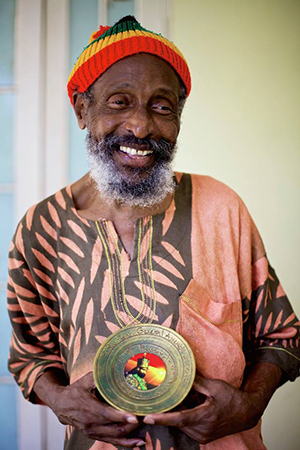
After the death of the legendary drummer Count Ossie in 1975, Sam Clayton stepped forward as the spiritual leader of Mystic Revelation of Rastafari. In the 90s and 2000s he led the company to the biggest venues and festivals in Europe, Japan and America. Brother Sam was one of the few rasta's who personally visited Haile Selassie in Ethiopia.
I'm not fond of gurus and spiritual teachers (each one teach one) but when it comes to rastafari, nobody has taught me more than Brother Sam, as I have called him from the start. No one brought me closer to the heart of the livity, and he also introduced me to some of the greatest Jamaican artists and most important personalities. With Brother Sam and his entourage, rastafari nestled deeper into my consciousness and sowed the seeds of The Rasta Revelation, the book in which he featured as one of the main characters (Brother Marcus).
Since the death of Count Ossie in 1975, Brother Sam has been the frontman of Mystic Revelation of Rastafari. He welcomed the audience and told stories about his people's history, international politics and the Universal Declaration of Human Rights. He sang the hymns and folk songs of yesteryear with Brother Bunny.
"Mystic Revelation of Rastafari is primarily a community project," said Brother Sam the first time I met him, in 1997. "We want to improve the situation of the poor people in our country by involving them in social and cultural projects. We do not see ourselves as entertainers but as communicators. We bring a message of peace, love, understanding and justice."
Sam also wanted to understand the doctrine of sound, and the influence of certain tones on the brain. The musicians of Mystic Revelation are 'conscious creators of the antennae' that have to capture visions of a more tribal community life, and that transform such visions into a concrete reality. One day he even explained Ohm's law to me, to prove that only love can help man in evolution and that resistance only evokes aggression. I didn't quite understand what he meant but Sam said that I only had to remember one thing, the conclusion of the formula: God is love in man'. That same theory is also on the cover of 'Tales of Mozambique', Mystic Revelation's classic second album.
A year after that first heartwarming meeting with the men of Mystic Revelation, I visited Brother Sam in Jamaica. The Reggae Boyz, the national football team of Jamaica, had qualified for the World Cup in France, the first time in history. That was so special that a sports magazine sent me to write some stories about football in Jamaica. Which of course was even more special for me. Suddenly my professional activities (at the time I was mainly a sports journalist) coincided wonderfully with my love for reggae and rastafari. Although since Bob Marley football is an indispensable part of the livity of the rasta's. His best friend was Allan 'Skill' Cole, the best footballer Jamaica has ever known and who Bob had secretly wanted to be himself (even though a football injury eventually cost him his life).
Cole was one of the many prominent Jamaicans I visited with Brother Sam. I could not have dreamed of a better and more respected guide. Everyone knew and respected him, from singers and musicians to journalists and politicians, from sportsmen to professors, from the rich people uptown to the sufferers in Rockfort, home of Mystic Revelation of Rastafari for almost 70 years now. Sam Clayton also brought me to Jamaican television and introduced me to Sizzla, Luciano and many other artists.
From creation
Brother Sam didn't have dreadlocks but he did carry in him everything that I find so beautiful and mystical about rastafari. No dogmas or rituals. Always ital food on the table, fresh and healthy. In harmony and togetherness with his environment, the heart filled with hope and love. Angel and rebel alike. Brother Sam, more than anyone else, embodied the lyrics of my favourite reggae songs. 'Natural Mystic' by Bob Marley & The Wailers, about the miracle of connection that is so strongly felt in Jamaica. To understand the soul of the country, you only have to surrender to reality as it presents itself. 'Positive vibration', also a song by Bob Marley: isn't it the antennaes of Brother Sam and his conscious creators that can capture these vibes? 'Prodigal son' by Steel Pulse, the story of the chosen son who has to get his people back on the right track. 'Creation rebel' by Burning Spear, as all rasta's have always been rebels. 'Why worry' by Israel Vibration: why worry if you can pray?
It was as if I had always known Brother Sam, from creation. In his company I didn't want or desire anything anymore. I listened and learned, and was grateful for the knowledge and love he wanted to share with me. If someone else put it this way, I would immediately think of a guru. How had Leonard Howell called himself again, the first rasta? Gangunguru.
Every morning, hours earlier than I ever get out of bed at home, we went to the Mineral Baths of Rockfort. Sam practiced with his trained body in the healing water, I just floated around a bit and occasionally stood under the wide, flowing stream of water, as in a massage. Then we drove to Rockfort, where (still before breakfast) a well-filled chalice awaited us, a kind of bong, with herbs from Westmoreland that a friend of Sam personally approved, bought and cleaned.
As a foreign visitor you are advised not to visit that 'dangerous' neighbourhood, but I'v been received as well in very few places as in the yard of the late Fuzzy, where Putus, Time, Rohan and their friends were reasoning and playing music every day. One of my best friends has become the godfather of Putus' newborn baby. Both John and the child have died in the meantime, but the ties that were forged then, in that crumbly yard, can never be broken. Reggae is the music of the people, I realized then more than ever. This is the breeding ground of a culture that has conquered the world, or at least the underworld in which I move.
Across from Fuzzy's yard is the Count Ossie Cultural Center. The building was erected in the mid-1970s with the help of some German development workers. It was not only intended as a rehearsal space for Mystic Revelation but also as a local library and community centre for the children and young people from the neighborhood. Due to a lack of money and the gradual impoverishment of Rockfort, these social activities have long since stopped, but every Sunday the rhythm of the nyabinghi still resounds.
"Drums are an African culture," says Brother Sam. "When I was in bed as a child, I heard drums all night, as you hear the sound systems now. People were drumming everywhere. Also during the day. When I went to church with my sisters, we always passed by a group of revivalists. They were dressed in white and played the drums. Drums are inextricably bound up with our people, including the Rastafarians. We brought them from Africa and they never left. That is why I also wear African clothes. Africans know which clothes fit the equatorial climate, loose and airy."
"Our roots lie in Africa. I always say: We were brought here by force to these Carribean, carry us beyond our borders. Not by free will but by force. John Hawkins was given a charter by Queen Elisabeth to bring slaves from Africa to the West Indies. They called us human cargo."
Sam, accompanied by nyabinghidrums, literally expresses these last sentences in 'Narration', the first song on the triple 'Grounation'-LP, the pièce de résistance of Count Ossie and his musicians from 1972. So near are his poems and stories (and those of so many other griots, singers and poets) to the reality and reasonings of the rasta's.
"And here we are today,'singing and chanting as free people. From slavery to freedom from slavery to independence. We also had drums in our house. At the Christmas market my sisters wanted dolls and I wanted drums. But the best drummer in the family was my brother. He even inspired Count Ossie to go drumming. Every Sunday evening they played together. I was still young then, compared to all those elsewhere, but I came to learn and listen."
Peace and love in Rockfort
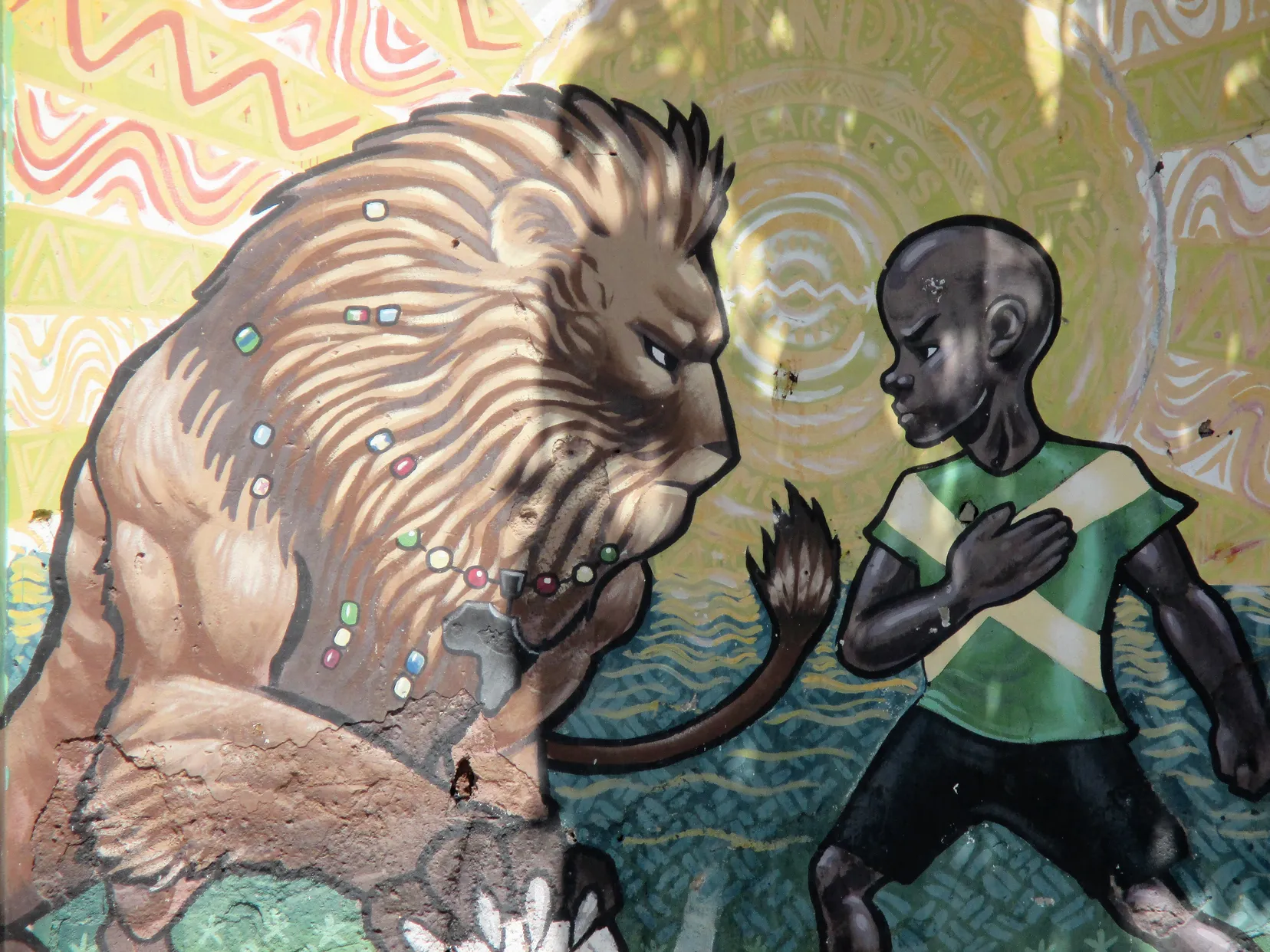
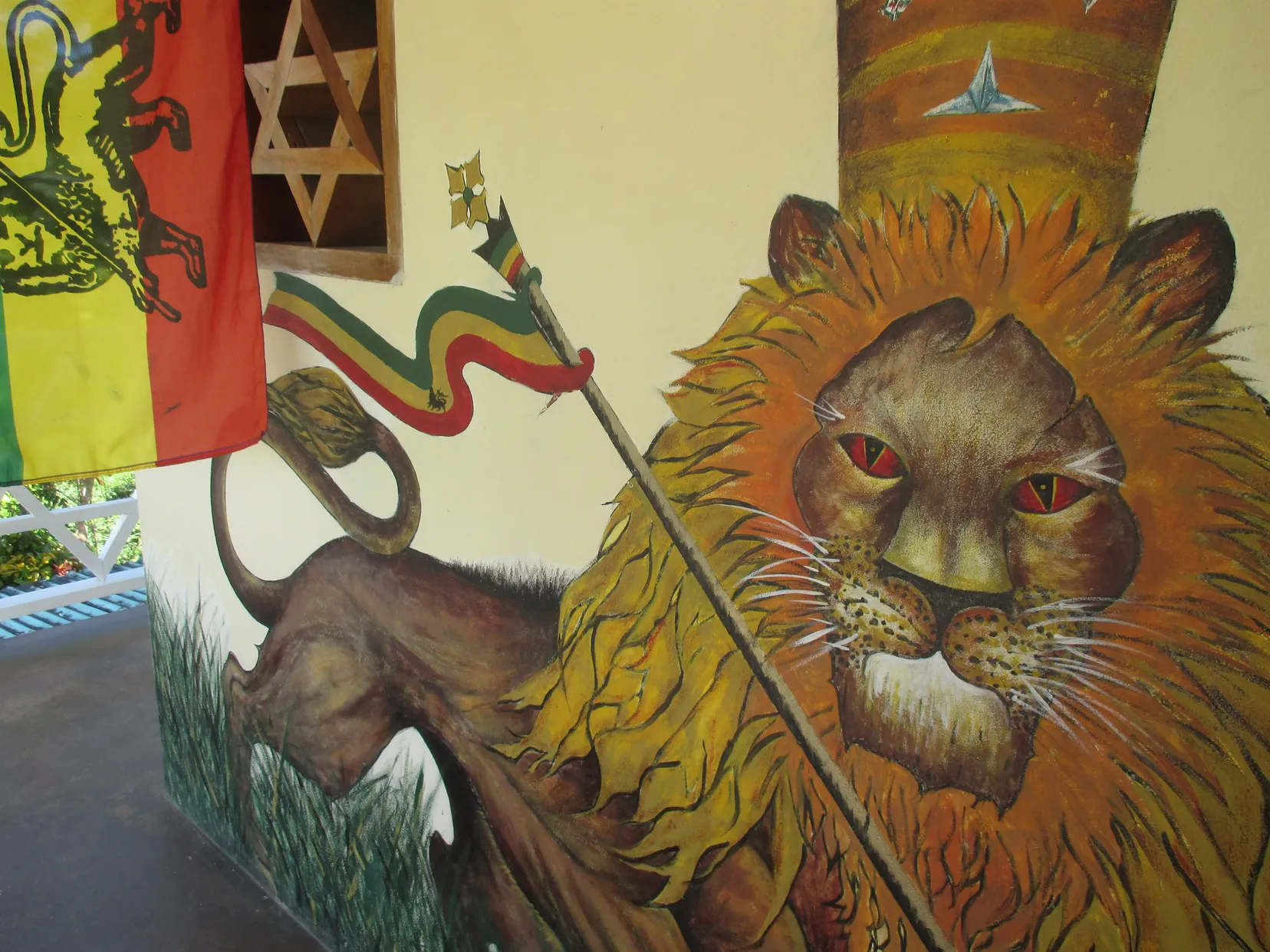
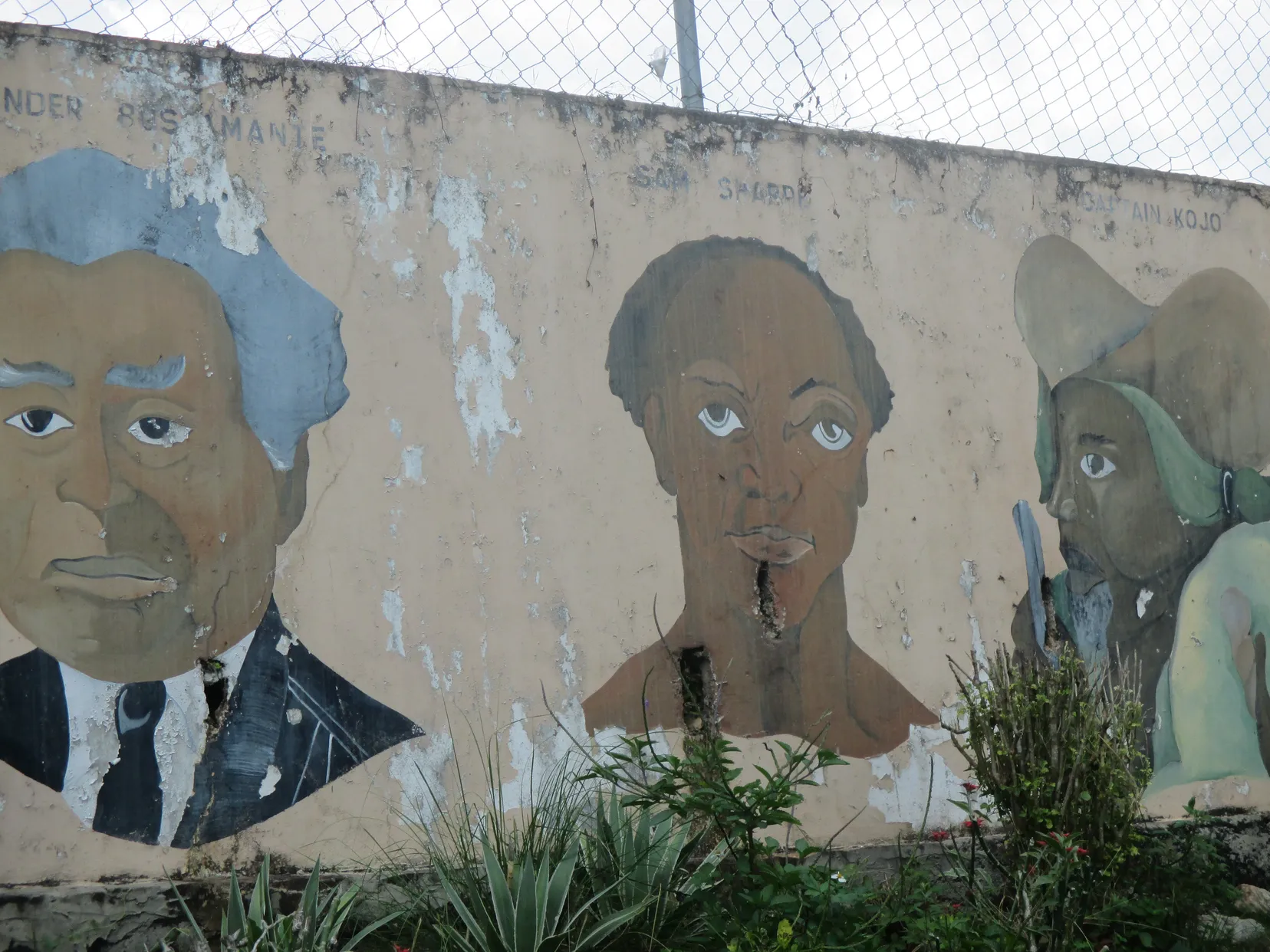
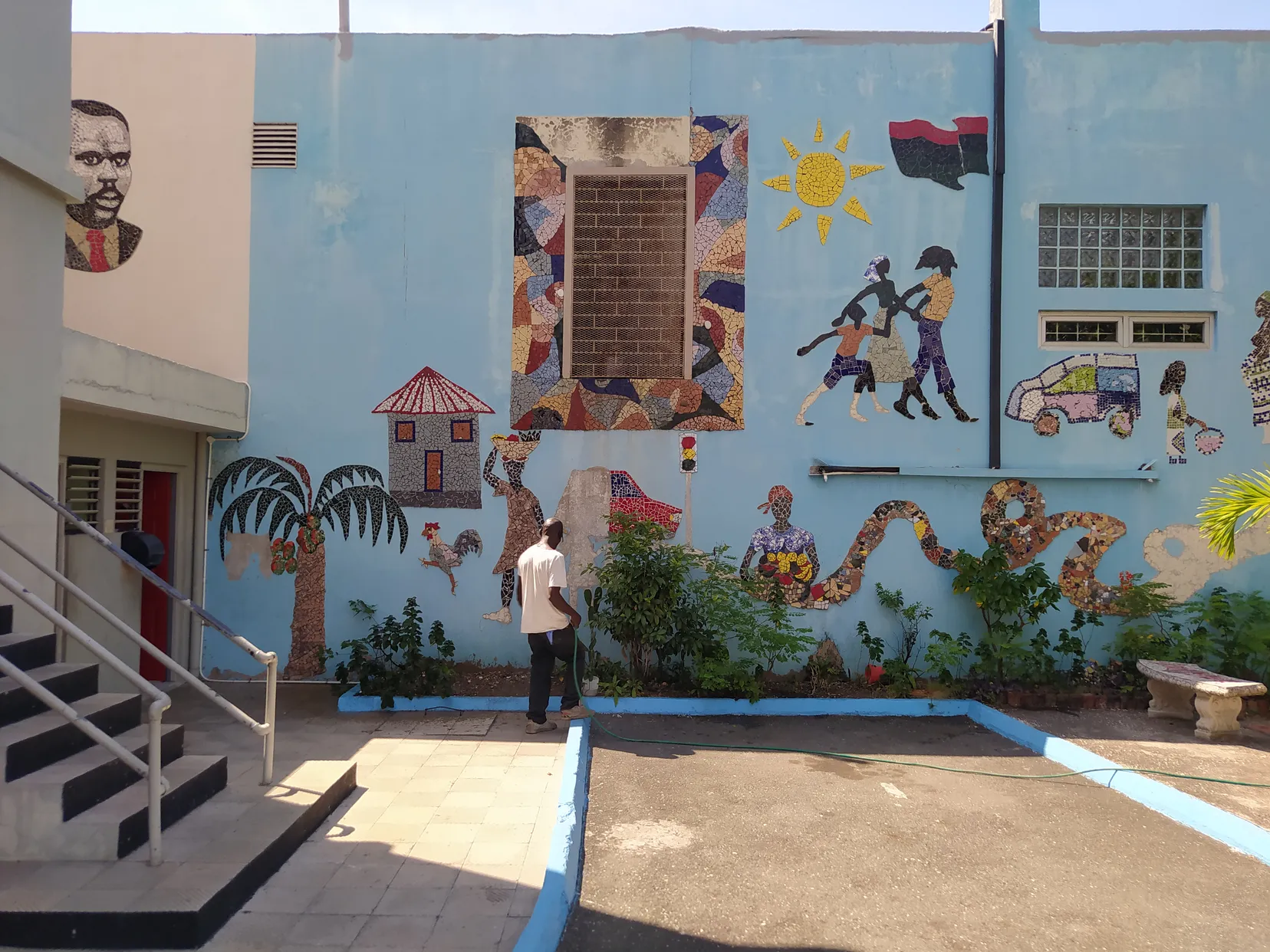
My first visit with Brother Sam to the Count Ossie Cultural Center was a magical experience. The African inspired mural of the building adorns the cover of 'Tales of Mozambique', after 'Grounation' the second classic album of Mystic Revelation of Rastafari. Suddenly the cover became alive before my eyes. The drawing shows how the Portuguese took the first slaves from Mozambique.
It took a few hours before everyone had arrived, the old drummers and three horns, and the weed made ready for smoking, stripped of all seeds and twigs, cut into tiny pieces like spinach. Brother Bunny, the singer, had a large kitchen shelf and a razor-sharp machete at his disposal. Only after the chalice had gone around for the first time and darkness had come did the drummers gradually look for a place on one of the wooden stools. The horns men tasted their instruments. Brother Bunny stood behind the microphone, looking at the photo of Count Ossie hanging on the door. "Peace and love," said Brother Sam hardly audible, after which Brother Bop (with a p, because as a youngster he was so good at pounding on jazz music) started the rhythm with his funde drum. The other two funde's followed him, the repeater started to frolic, the bass drum deepened the sound. That's how the music must have sounded in the rasta camps at the time, I realised at that moment. I didn't feel like dreaming away or becoming euphoric. It was just another moment my whole life had led to, not more beautiful or special than any other moment. Just like reggae was born over and over again here.
The three horns men started a song, the song of the rasta's, 'Satta a massagana'. Brother Sam had introduced them to me almost carelessly: Johnny 'Dizzy' Moore (trumpet), Cedric 'Im' Brooks (saxophone) and Lester Sterling (saxophone). When I heard those names, I started to get dizzy. These men had invented ska in the early 60's, I had seen them perform several times with The Skatalites, the godfathers of Jamaican pop music. But first, long ago, they had passed here, at Count Ossie's and his drummers. Here they had connected their jazz education with the inspiration of rastafari and the rhythms of the drums. On Sundays they still came here to jam as they've done since the fifties.
Bunny sang 'Rivers of Babylon', the song that the rest of the world had come to know in the disco performance of Boney M but was in fact an anthem of the rasta's, one of the first biblical lyrics in the history of reggae. 'By the rivers of babylon, there we sat down; Yeah, we wept when we remembered Zion.' Psalm 137.
Almost all members of Mystic Revelation of Rastafari who were then in the Count Ossie Center and who had toured Europe a year before, have died in the meantime. Just calculate, if you know that in the 30's they were fascinated by Haile Selassie and were already rasta before there were dreadlocks.
Visit to His Majesty
In 2014 I visited Brother Sam for the last time, to record an interview for the documentary 'My Ras Tafari Roots' which I made together with director David Verhaeghe. To our surprise, he came up with a few suitcases full of cuttings, photos and memorabilia that he had never mentioned before. Tom, the cameraman, filmed as many relevant documents as possible: an image of Brother Sam at the emperor's, headlines about Selassie's death, passports and youth photos... That material should be properly archived, and preserved for posterity, as cultural heritage. Not the strongest side of Jamaica, I know, but as a rational white European I can only regret this neglect. The same feeling struck me earlier at the birthplace of Marcus Garvey in Sint-Anne's Bay. Where is the respect for the great Jamaican heroes? Although we would probably be better off asking ourselves where the government would get the money to honour all those monuments and documents. There are more important problems in the country.
Brother Sam joined the group of Count Ossie only after he had visited Haile Selassie in 1965. The Rastafarians, or three important representatives of the unstructured movement, then had personal discussions with the emperor about the 'repatriation' of a large group of Jamaicans to 'their homeland'. Two years earlier, the Jamaican parliament, then subordinate to Great Britain, had already sent out a mission with the same objective. It consisted of seven people: Philmore Alvaranga of Mystic Revelation, Douglas Mack (another confidant of Count Ossie, who himself preferred not to come to the fore), Mortimer Planno, the spiritual father of the modern rasta movement and teacher of Bob Marley, Cecil Gordon of the Ethiopian World Federation (EWF), Westmore Blackwood of Garvey's still active UNIA, members of the militant Afro-Caribbean League and of the Afro-West Indian Welfare League, a journalist and a doctor.
For the second mission Brother Sam was chosen, together with Douglas Mack and Philmore Alvaranga. They collected the money for the trip, which would last no less than fifteen months, in the dancehall, with the sound systems of Duke Reid, Coxsone Dodd and The Matador.
On the way to Africa, the trio met Mohammed Ali in New York and submitted a petition to the United Nations, asking for reparations for the descendants of the slaves from Great Britain, France, Spain, Portugal, Italy, the Netherlands and Belgium. (In 2015 Jamaica and other Caribbean countries submitted a similar request to the British government, yet another theme that the Rastafarians put on the agenda in the twentieth century.)
Brother Sam and his companions first visited a few West African countries and finally travelled to Ethiopia via Kenya.
"When we arrived in Addis Ababa, there was a large press conference going on in the palace, with representatives from all African countries. We had to wait for a while but still got a short audience. There was a lion next door, he did not move and looked at us tightly. We walked past it in the hope that he would not attack us and he did not. Next to the lion stood a soldier. There was a soldier next to each lion in the palace."
The most remarkable photos that Sam has kept show the emperor in the company of a lion and a tiger. It seems as if the animals give him cups, like house cats do. "That was the moment when I thought: 'This is really an exceptional person,'"says Brother Sam, "a secular leader with divine qualities."
"We went inside. His Majesty addressed us, a high priest translated his words. So you are here to see me? Yes, Your Majesty. We gave him a gift, a wood carving with an image of Africa and the letters OAU scoring a victory over the world. His Majesty really loved it. He thanked us and said he would welcome us again after the press conference. We bowed, stepped back and walked out of the room. That was our first meeting."
"When we met His Majesty, we were.... I don't know how to express that feeling. We were not afraid but when you are in the palace, with the King of Kings, and all those lions... We just knew, in a very soulful way.'
And then the long wait began. I know the stories from 'The Emperor', the book by Ryszard Kapucynski that Haile Selassie framed in the west, and the play 'Hof van Haile' by the Dutch company Orkater. You never really knew when the emperor would welcome you. He didn't seem to keep up with an agenda, an appointment had no value at all. Only through the goodwill of the courtiers who at that time were in the favor of Selassie, a visitor might get an official audience.
"We have visited several places in Ethiopia. We stayed with a Jamaican, Moses Johnson, who was married to an Ethiopian woman. They lived in an old, remote palace in a region where gorillas were still wandering around. He said so anyway, and that's why he always had a gun with him."
"On September 11, New Year in Ethiopia, His Majesty received us again. First we got an extensive breakfast. Royal food, tea, coffee. Some sandwiches and ting. His Majesty stood before his throne, completely dressed in white, also his shoes. Next to him stood six of his grandsons. We were told that on this day everyone would wear white clothes so we did. We sang a psalm."
I will praise thee o Lord with my whole heart, I will shew forth all thy marvelous works. I will be glad and rejoice in tea. I will sing praise to thy name, O thou most high. When mine enemies are turned back, they shall fall and perish at thy presence. For thou hast maintained my right and my cause; thou satest in the throne judging right. Thou hast rebuked the heathen, thou hast destroyed the wicked, thou hast put out their name for ever and ever. O thou enemy, destructions are come to a perpetual end: and thou hast destroyed cities; their memorial is perished with them. But the Lord shall endure for ever: he hath prepared his throne for judgment. And he shall judge the world in righteousness, he shall minister judgment to the people in uprightness.
Brother Sam has now completely forgotten that the camera is on. His gaze is not empty or unfathomable, but it is directed towards an indefinable point behind me, somewhere where the past resides. The psalm becomes a vision.
The Lord is known by the judgment which he executeth: the wicked is snared in the work of his own hands. The wicked shall be turned into hell, and all the nations that forget Jah Ras Tafari. For the needy shall not always be forgotten: the expectation of the poor shall not perish for ever. Arise, O Lord Jah Ras Tafari, let not man prevail: let the heathen be judged in thy sight. Put them in fear, O Jah: that the nations may know themselves to be but men.
"When we had sung that psalm, His Majesty brought out a white handkerchief and wiped away a tear. He said he definitely wanted to see us again. At his farewell he muttered something against the priest, who repeated and translated it for us: Abba Gebriel Meshesha. Messenger or God."
Messengers of God: that is how Haile Selassie would have called Brother Sam and the other Rastafarians. At the third meeting, again a few weeks later, the emperor gave Mack, Sam and Philmore a gold medal. The fourth and last time they talked about the living conditions in Jamaica and the perspectives for Shashamane. "He said we had to prepare the crossing well and send the right people. There were already a couple of settlers in Shashamane but they weren't well organized. At the farewell His Majesty said that he would definitely come to Jamaica, and that we would see each other again."
I ask Brother Sam if Haile Selassie also said something about rastafari.
"Action speaks louder than words. He met us and spoke to us. And he is ultimately the king of kings. He doesn't behave like a politician. He shows you his love and gratitude on a much higher level. I have experienced that power myself. I literally couldn't move anymore."
A year after the second mission to Africa, Haile Selassie actually visited Jamaica. Jamaican television made a wonderful report of the festivities at the time. The most striking images are engraved in the memory of everyone who carries Rastafari in their heart. Rastas hold up signs. 'The rastafarian movement Nyahbinghi welcomes the King of Kings.' Bible verses. And then a beautiful, full-screen image of Brother Sam in his white robe. He was there, at this turning point in Jamaican and rasta history, in the front ranks of Jah Army.
Fly away home to Zion, Brother Sam.
Jah Shakespear has been listening to reggae music since 1977, started writing about the subject in the early nineteen eighties (for De Morgen, De Standaard, P-Magazine, Highlife and a number of other magazines) and founded this website in 2002. He's also the author of 'De Rasta Revelatie' (2008) and 'In Het Spoor Van De Keizer' (2016).
Nov 01, 2018