Can we gradually call Onesty the most successful Belgian reggae artist ever? Not in record sales perhaps (Pura Vida?) but as a regular on the international live circuit. She has toured with Black Uhuru and Lady G and opened for Sanchez and Romain Virgo at Valentine's Affair in the UK. She's been living in Jamaica with her daughter Jahmie for five years now and has found shelter there with Marcia Simpson (Duckie's wife, Black Uhuru) and Ajang Music. Those who follow our Tina (Sureda) on Facebook know that she's regularly being invited for radio and TV interviews. In the homeland of reggae, Onesty is at least the best established Belgian reggae artist ever.
On this debut album the singer brings together her best tunes of the past years with a handful of new tracks. Still, this is a very homogeneous production, with a sound that is very nicely (some would say smooth) finished to reggae standards. Largely recorded in the Ebony studio in Zwijndrecht, this is just as much a perfect showcase of Onesty's talent as of Sen-C P's craftsmanship. Together they give the music a colour that should also appeal to pop and r'n'b lovers, especially in the United States, where Tina has built up a solid fan base.
That doesn't detract from the quality of the songs, the vocals and the arrangements. Although 'Don't wait' is flat r'n'b, the only song in which Onesty also lapses into textual clichés, all other tracks are pure, high quality popreggae with an occasional fine roots touch. Opener 'Way to life', the single that preceded the album, drags by on an old Black Uhuru riddim (Sly & Robbie), with Bugle starring in the role of raw counterweight for the light-footed vocals of Onesty. Another singer from the Ajang-stable, Spade Again, lends his Chronixx-like, slightly autotuned voice for 'Get up & give in', a cheerful duet that you probably won't hear with Jah Shaka or Black Pearl but maybe on the Jamaican and American commercial radio stations.
That also goes for 'Roll the dice', with that dominant rock guitar, a fusion of r'n'b and experimental dancehall, pure pop, so to speak, with Onesty in top form, this time also in her lyrics. 'Love of a woman' is not a banal love song but a beautiful ode to woman, rhythmically classic one drop, soundwise unmistakably contemporary. We already knew 'Life starts', still a wonderful birth song, written when Tina became a mother, and therefore straight from the heart.
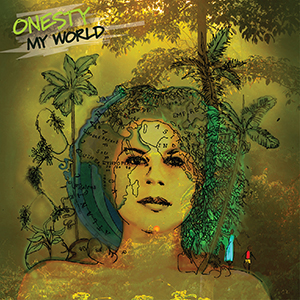
'I rise' is not new either, but it's my favorite tune on this album, thanks to the mature roots riddim and likewise lyrics, a reflection of the inner power that helped Onesty to make her dream come true. 'My world', the title track, floats on a stylised nyabinghi riddim, while the singer dares to dream even bigger, following in the footsteps of John Lennon's 'Imagine'. I keep dreaming about a place where we share and where children don't have to work'.
The supersweetr synths of 'Not good enough' couldn't convince us in the past, but the tune is frisky enough not to irritate. And, like in every other song, we can enjoy the high quality backing vocals, mostly Tina herself, which are rightly given a prominent role on this album.
'Hold on' remains a very strong version of the (Belgian!) Puff Puff riddim and provides some variation in the harmonious soundscape of Sen-C P. In 'Wake up' Onesty once again brings her message of 'encouragement, love, unity and consciousness' (own words). She doesn't only want to awaken the town ('Wake the town and...') but the whole world. 'We can keep singing songs of freedom, but it's time to live up to words and prophecies'. Let the true heroes rise up now, she asks, and 'help your brothers and sisters to wake up.' We always welcome uplifting lyrics.
The finale of the album, 'One moment', is a melodic sing-along on a very tight riddim. Onesty may not make the reggae of your choice but it's not bad to leave your comfort zone every now and then. Hear that voice, listen to the lyrics, enjoy the immaculate sound, and you will realize that 'My world' is indeed a milestone in the history of Belgian (and maybe even a bit Jamaican) reggae. How many women in this genre have ever made such a full-fledged album?



.Dl7BAwhJ_ZJXLLF.webp)