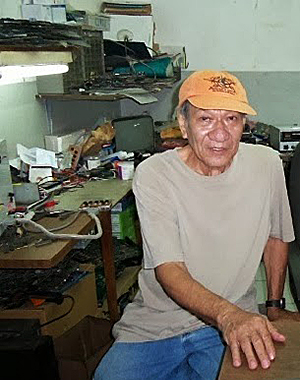
In the mid 70s Joseph Hookim brought together Sly Dunbar and Robbie Shakespeare in his brand new 16-track studio. Reggae became rockers, the distant forerunner of the steppers that dominate the dub scene today.
My daughter came back from London last month with a fantastic collector of Pressure Sounds: 'Drum Sound - More Gems from the Channel One Dub Room 1974 to 1980'. Apart from my first reflex as a father ("Well raised!"), the music took me back to the early days of my reggae addiction. I was particularly fond of dub and then you couldn't avoid Channel One at the time.
The studio was owned by brothers Ernest and Joseph Hookim (Hoo Kim), formerly active in the slot machine industry. In 1975 Channel One was upgraded from four to sixteen tracks, an intervention that would revolutionize reggae. A nice bridge to the name of the studio band Jo Jo Hookim had brought together to create the new sound, The Revolutionaries, entirely in line with the militant attitude that the self-confident rasta's had adopted. On the cover of 'Revolutionaries Sounds Vol.2', one of my very first and still favorite dub-LP's, is the iconic image of Che Guevara, with one small change: on his cap, instead of the traditional communist star, the logo of Well Charge, one of the labels of Channel One can be seen.
Militant, according to a young David Rodigan (who was allowed to write the liner notes), also were the rim shots of Sly, "...sounding like gun shots.". He called The Revolutionaries The Skatalites of their generation, a band that announced a new era in Jamaican music history. Sly Dunbar and Ranchie McLean (bass) were previously in Skin, Flesh & Bones. Robbie Shakespeare was the bass player of The Aggrovators, the house band of Bunny 'Striker' Lee, although he also played there with Sly and other musicians who made their appearance at The Revolutionaries. They were both changing companies. Sometimes Santa Davies was behind the drums. Ranchie and George Fullwood were stand-in for Shakespeare. Ansel Collins often played the piano, on percussion we usually heard Sticky, Skully and Sky Juice. Prominently present were the horns: Tommy McCook and Herman Marquis on saxophone, Vin Gordon on trombone, Bobby Ellis on trumpet.
The Revolutionaries mainly recorded Studio One riddims, at the request of Jo Jo Hookim. At first he was critized but soon everyone did it. When those old riddims are ruminated, remixed and pimped to this day, we owe it to Hookim. But those new dubs did have a glorious dimension, much more spacious and colourful than reggae had ever sounded. That was largely thanks to Sly and engineers Ernest Hookim and Stanley 'Barnabas' Bryan, who finished every tune perfectly.
The beat was also new. Influenced by the disco that reigned at the time, Sly Dunbar introduced the four-to-the-floor pattern in reggae, as it still is used in dance and EDM, under the typical chops (guitar, keyboards) and the timeless bass lines of Robbie Shakespeare. The flying cymbals of Bunny Lee, who had made dub big (in combination with the magic powers of King Tubby) had to make way for a new style called "rockers". Also the name of the best reggae film ever, made in 1977 and indeed named after the sound that had conquered the dancehall.
I got to know Channel One through dub (also in my top 3: 'Negrea Love Dub', a production by Linval Thompson, mixed by King Tubby) but most of those tunes once appeared in the "original" version, sung or instrumental. In 1976 Mighty Diamonds collected their best songs on the record 'Right Time', which was released by Virgin Records. It also meant the international breakthrough of the rockers sound, which reignes supreme until deep in 1979.
After the murder of their brother Paul, the Hookim brothers largely withdrew from the music world. The younger Kenneth Hookim picked up where they left off in the 80s, but has never known that much success. Channel One still remained the most popular studio in Kingston, where Sly & Robbie and producer Henry 'Junjo' Lawes recorded hundreds of tunes. In my record case no studio is as strongly represented, with records of almost all my favorite singers and groups. And a lot of dub, superior dub that I still hear forty years later in... well, dub. And now also at my daughter's.




.Dl7BAwhJ_ZJXLLF.webp)