'What a gwaan, people?' We've flown nine hours from Brussels, had our fingerprints scanned, been filmed, photographed and checked, had a body scan, put our hand luggage on the belt twice, all in the transfer zone of terminal 9 at Atlanta's airport. In the 21st century flying has become a real security operation. But then suddenly there's this voice at the gate of our flight to Jamaica, and music of Sizzla, Gregory Isaacs and Mr Vegas. It's the first time I'm not hearing any muzak at an airport, no soft pop or jazz, but solid reggae. And the first time I hear a stewardess address the passengers in her own patois instead of the good old 'Good evening, ladies and gentlemen. We are now ready to board flight..' No, here it's more along the lines of: 'Yu' all ready to fly to Jamaica now?', causing all fatigue and irritation to melt away instantly. We're almost there. 14 hours of air-conditioning later, the heat in Kingston hits us like a hot, wet blanket suddenly wrapping itself around our bodies. In the next few days we'll discover that the nighttime brings little to no cooling off in Jamaica, at least not now, after a four-month drought. This heat is making even the Jamaicans themselves puff, and, on top of that there's a water shortage.
Spliff break
It's still close to a three-hour drive to Discovery Bay, where we'll be staying the next few days. At a service station we buy our first spliff, a kidney-shaped dose of weed, tightly packaged in some plastic. Jamaicans roll pure, the entire amount ends up in one joint. We roll with tobacco and have enough for 3 spliffs. Price: 100 JA dollar, a little less than one euro. Available everywhere, but definitely not necessary. The Jamaicans, and certainly the rastas, rather share their weed than sell it. And the quality is always better than in the streets. Bobby, too, welcomes us in his house with a taste of his own excellent culture. It really is a lovely house, with a porch all around, swimming-pool, WiFi and a fridge stocked with his own freshly made fruit juices. We make a deal with Bobby that he'll provide us with a solid Jamaican breakfast and dinner for the rest of the week, plentiful and nutritious enough to get through the day. No problem for the rasta man, who exclusively eats 'ital' and knows exactly how to create a balanced meal. No salt, no meat, no processed foods. Instead he uses callaloo, ackee, tofu, yam, platan, bananas, peppers,… Jamaican food all the way, veggie style. We've come to Jamaica to shoot a documentary, working title 'My Ras Tafari Roots' or 'Lost Roots'. The main character is David, also director, who traces his family's Ethiopian roots in this film. His grandmother was born to the court of a man who was then (1921) known as Ras Tafari, and who, according to David's mum is alleged to be her extramarital father. Another story claims that his grandmother's mum was a niece of Ras Tafari, and that her father was the Greek Cypriot who would adopt her later in life. Whichever story is true, David became fascinated by Haile Selassie, about whom he hasn't heard many good things in western media. But in the reggae world it was decided this Ethiopian emperor was worth it, and even more than that. Some seemed to worship him even. And then I came into the picture. David read my book 'The Rasta Revelation' and contacted me, asking if I was interested in working with him on his documentary, which would relate the family story and link it to Rastafari history and ideology.
Chronixx in the air
What do you think my answer was? Meanwhile we've done our research in Jamaica and Ethiopia, we've filmed in Belgium, Italy and Cyprus and now we're here, accompanied by a professional cameraman (Tom) and sound engineer (Yves), both of whom are first timers to visiting Jamaica. We are meeting with Prof-I, the nyabinghi rasta man, close to Ocho Rios, with Max Romeo in Linstead, and with Brother Sam Clayton (Mystic Revelation of Rastafari) in Kingston. In the capital we'd also like to get a young artist in front of the camera. Protoje maybe, or Chronixx. Bobby says he knows Dre Island, and on the internet we even find a Jah9 phone number. Everything's still possible, we're not on any deadline. Time flows gently in Jamaica. Things happen exactly when they need to happen, and if not, they just don't happen. What has to happen later, will happen later. You never have to check the clock. 'Reggae in the morning, reggae in the evening, reggae at nighttime, on Irie radio': Irie FM's day tune has never changed in the last 20 years, and neither have any of the other station calls and jingles. But the songs are brand new, something you can rely upon at this station. In the car on the road from Discovery Bay to Ochi we hear the new roots hits of the moment: Tydal's 'Silent Warrior', 'Backbites' by Jesse Royal, 'Call The Police' (Pzed & Little Hero), 'Allelu Jah' (Binghi Fire) and of course 'Who Knows' by Chronixx & Protoje, even though pretty much every DJ then also mentions it's an international hit. In Jamaica, Chronixx is currently having a hit with 'Spirulina', a song about healthy nutrition, tonics, roots drinks and natural supplements. 'Let your food be your medicine and your medicine be your food': it's a wise phrase we'll hear more during the next few days, one of the fundamentals of ital & conscious living. However, Chronixx is using a nice drumming dancehall riddim to spread his message, and here, in Jamaica, I like it at least as much as the classical reggae rhythm of 'Who knows'. It always happens to me. In Jamaica I can listen to and tolerate dancehall much better, it's as if the music suddenly finds its rightful place in my reggae universe. Sometimes I wonder why I don't react to it so well at home, while here I'm rocking to it, tapping my fingers on the dashboard. I'm curious about every new tune, roots or not, conscious or reality, with or without auto tune. It's the music of today, the people's music, constantly moving, and nowhere is it moving more than in Jamdown, where musical innovations are sometimes only fully appreciated dozens of years later. In the afternoon and evening Irie FM and a handful of other reggae stations play nonstop dancehall, and I never seem to get enough. Anyhow, for the time being, little can be heard of a large-scale roots revival on Jamaican radio. However, we immediately dive into the roots of Rastafari, to the Redemption Ground of Prof-I (Andrew Reynolds), the nyabinghi rasta man who released the 'Iyabinghi Redemption' album last year (RUNN). He lives together with his bredren in the oldest house of Great Pond, a community in a green setting, north of Ocho Rios, where a backa used to live, a slave owner. That's exactly why Prof-I bought this house, hoping to transform the negative energy of the former plantation. As a rasta man Prof-I doesn't call upon the bible, but on the age-old African heritage, which was crystallised in the person of Haile Selassie in the middle of the previous century. Based on that inspiration, he tries to live in harmony with nature and his surroundings. He only eats raw food from his own (large) backyard, brews his own healing roots drinks and does not use tap water. Together with his bredren he plays nyabinghi, the original beat of reggae (and dancehall!), the rhythm of the heart and of the motherland, Africa. We want to capture all of this in image and sound, including a nice interview. Prof-I has invoked rasta elders and youths from all corners of the land to greet the great grandson of His Majesty and to hold a modest nyabinghi session. Modest in length (a 'binghi' can last up to 9 days) but not in force and conviction. Prof-I everything from the heart and with all the energy and vitality on offer. A rasta man through and through.
His Majesty's Great-Grandson has arrived
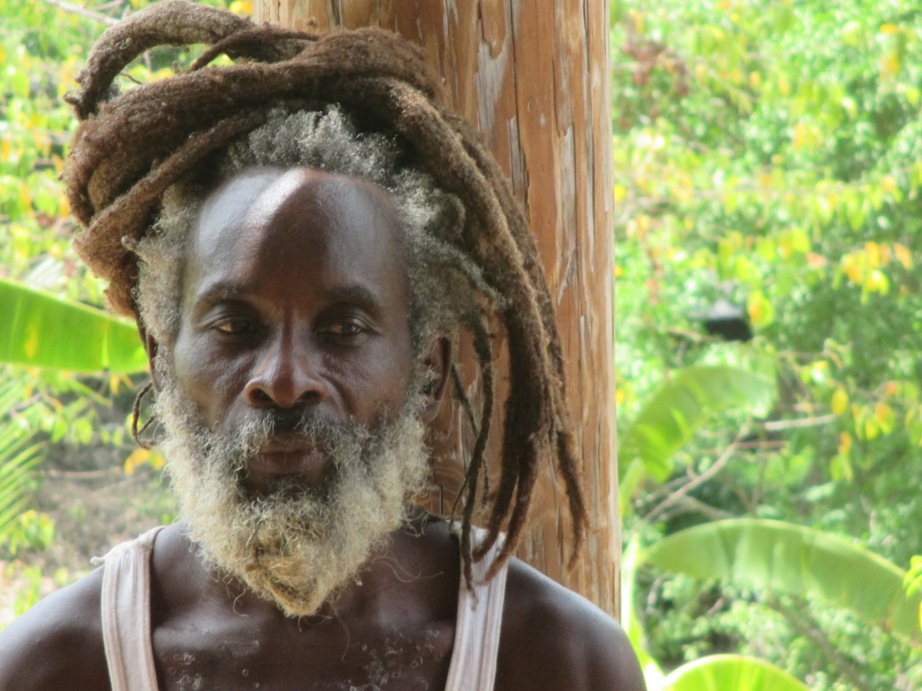
It moves me when I see what a warm welcome David is getting from the rastas. We thought that maybe they would react in a slightly hostile way when we suggested the emperor's said to have had an illegitimate child, but the opposite is true. 'His Majesty was a man, like all of us'. And many men in Jamaica have children from different women, so what? Prof-I has fathered 15 children himself and is friends with all the mothers. Congo Bashi, Ily, Jah T, Perthy, Papa Curvin (once the drummer of Boney M, the band who took 'Rivers of Babylon', one of the greatest rasta anthems ever, to the top of the charts worldwide). They all want to greet David and tell them their story. How Selassie appeared to them in a dream, how he inexplicably disappeared from a locked room in King's House during his visit to Jamaica in 1966, how he inspires them on a daily basis to lead a good life. Some refer to the bible, others to Ethiopia. Fascinated, they listen to David's family history. Perthy respectfully and consistently calls Selassie 'Your great-grandfather'. Heartical; there's no other way to describe our meeting. Whoever David's great-grandfather was, I feel like a privileged witness of a meeting between people looking for their roots, and finding one other in their fascination and admiration for the emperor. On the first day we film Prof-I and Iyashop at the crack of dawn. Nowhere else do I need less effort to get up early than in Jamaica. While the sun rises towards the sky surprisingly fast, two rasta men are farming their land, cutting and slashing with their machetes. There are ackee, jack fruit and breadfruit trees, tomato, paprika and pepper plants, avocados and yams, bananas, sweetsops and soursops. It hasn't rained for the past four months along the northern coast, but Prof-I gets water from a source in the mountains. His garden of Eden grows and flourishes. But the rocky soil makes it hard work. Thankfully Iyashop is a rock of a rasta man himself. Humble and yet proud. Helpful but not submissive. Completely in the moment with a foundation reaching back thousands of years. A man who puts Prof-I first, but is equally prominently present. And an excellent chef, as we're fortunate to experience twice. His cold dishes are as tasty and spicy as the hot dishes he prepares with his bredren. We're not among fundamentalists here. Prof-I and Iyashop are veggie master chefs who prefer raw food (and couscous soaked in cold water), but they also please their guests with cooked or steamed food. The next day we return to film the binghi. In the tabernacle, the round hut where traditionally the grounations are held, Iyashop makes a blessed fire. He takes it to the middle of the big field of grass on Redemption Ground, where the binghi will take place today. There is no talking, no signalling, there are no questions asked. Tom starts filming, Yves turns on the microphone and tunes the sound. The session has begun, exactly at the moment it was supposed to begin.
Nyabinghi chanting
Some 15 bredren take a seat around the fire, with their fundeh, repeater and akete drums. Prof-I dictates the rhythm (nyabinghi!) and the melodies, a mix of his own songs and binghi classics. It doesn't take long before everyone in the place is swept away by the music. The repetitive chants and rhythms take us into a dreamy trance. Nobody can keep their bodies still. I can see Yves moving constantly as well. Fascinated by drums since he was a child, he's having the time of his life. His meeting with the rasta man is a sort of revelation. I strongly doubt whether better images and sound recordings have ever been made of a binghi in Jamaica. Even the interview turns out better than expected. The drumming has barely stopped before ital food is being served again. A full plate for everyone, prepared by the few rastas who weren't by the fire. It's a day we'll never forget, if only for the millions of times that Yves and I have been bitten by all sorts of mosquitoes, flies and little spiders. He'll be feeling it for days, while I am nursing my legs with a rum ganja tincture, a herbal cure that can be found in just about every Jamaican kitchen. The bites don't disappear, but the intolerable itchy feeling does. Herbalism is the key.
When we say our goodbyes, Prof-I tells me again the bredren are very excited about David's visit, 'His Majesty's great-grandson'. 'Im come to them like a child', he whispers, 'like an innocent lamb.' Had to pick up the bible for this one. Episode 2: Max Romeo, Mystic Revelation of Rastafari & the new generation. Translation: Rudi


.Dl7BAwhJ_bSbwe.webp)