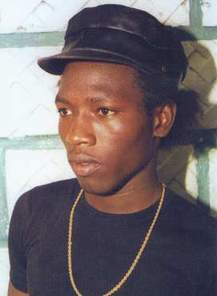
When you run through Wayne Smith's discography, it's astonishing to see how many singles he has released. And yet his name will forever be associated with that one revolutionary tune, the track that marked the transition from music played live to digital beats.
At the start of 1985 the Japanese synthesizer company Casio threw a number of cheap, portable electronic keyboard instruments on the market, containing pre-programmed rhythms and built-in melodies. Noel Davey, a friend of Wayne Smith's, who had tried to cut it as a singer, owned a Casiotone MT40. One day they built a riddim together with the preset 'rock'n'roll', a sample of Eddie Cochran's 'Something Else' to be exact. The lyrics and the melody of the song sounded suspiciously like Barrington Levy's 'Under Mi Sensi', the greatest reggae hit of 1984 and a blatant tribute to the herb, but the sound was new and exciting.
When the two companions took this early version to (then) Prince Jammy, he judged it to be too fast. "It sounded crazy to me: too fast, no rhythm section, just drum and bass going at 100 miles per hour. Not the right tempo for reggae music, so I slowed it down to dancing mode. Then we overdubbed some piano, some percussion, and that was the beginning of 'Sleng Teng". Jammy's called upon keyboardist Tony Asher and recorded it.
A couple of days later Jammy launched the tune at a sound clash competing against Black Scorpio in Drewsland, near Sandy Gully, Kingston. Since 1980 Jammy's Super Power Sound had somewhat fallen out of fashion because of his outdated equipment, but for this clash he'd had brand new material specially flown over from the UK. When he put on 'Under Mi Sleng Teng', the massive went berserk. "We had to play it all night long", said Jammy.
Wayne Smith wasn't present at that dance but the next morning he was woken up by a friend of his. "Wayne, a the wickedest thing inna dance! It play the whole night. Nobody nah want hear nothing else!"
'Sleng Teng', according to some the first ever ragga tune, was an instant success. Straightaway Prince Jammy had a few dozen versions recorded, and before long other producers followed suit. In '85 and '86 innumerable versions and spin-offs were made, including remakes by Tenor Saw, Culture and (for Studio One) The Gladiators. 'Sleng Teng' also effectively ended the supremacy of the Riddim Twins, Sly & Robbie, who consequently felt compelled to make the transition to digital tunes. Moreover, it paved the way for Steelie (keyboards) & Cleevie (drum machine). The mixing engineer of Jammy's Waterhouse Studio was Robert Dixon, who would later be all the rage as producer Bobby Digital, with his own label Digital B. Digital sounds would rule the new Jamaican pop music until well into the first decade of the 21st century.
'Sleng Teng' also hit Europe as if it were a sledgehammer. I clearly remember how plenty of people dropped out and were barely interested anymore in new reggae, let alone dancehall. That first generation had grown up in the conviction that you couldn't make reggae without live drums and bass. So was 'Sleng Teng' actually reggae? No matter what you think of it, it's certainly a tune that still sounds fresh and new today, and that has had a lasting influence in dancehall for nearly 30 years, whether adapted or remixed. It was also one of the very first Jamaican hits that were adopted by the American hiphop scene and that had a heavy impact on the development of that much younger genre. Up until now there are supposed to be almost 400 versions of 'Sleng Teng'.
We can ask ourselves if 'Under Mi Sleng Teng' was the only claim to fame of Wayne Smith. Indeed, my record collection only comprises that most memorable 12", plus also half an album with Patrick Andy, 'Show-Down Vol.7', a Channel One production. At the time I wasn't particularly charmed by his many other singles or by that one early record, 'Youthman Skanking'. Otherwise I would have bought them. For the last 25 years of his life Wayne Smith lived mainly in New York, where he ran his own Sleng Teng Recording Studio. I've never heard anything from it but probably the royalties of his biggest hit were more than sufficient to keep the business afloat.
And while Wayne Smith only turned up in Europe a couple of times, at some very low-key gigs, in 2011 with the virtually unknown Swiss band Little Lion Sound (correct me if I'm wrong), King Jammy has been constantly touring the big festivals with dub sets in which 'Under Mi Sleng Teng' still manages to get the massive going raving mad. And the best ganja still comes from Westmoreland!
Quotes from 'Solid Foundation' (David Katz)







.Dl7BAwhJ_ZJXLLF.webp)