
.Dl7BAwhJ_ZJXLLF.webp)
Shashamene is the Promised Land of the rastaman, generously made available to the Africans of the diaspora by His Imperial Highness Haile Selassie of Ethiopia himself. However, Shashamene is also an impoverished city, in which the Rasta community and the local population is fighting hard to survive. Here are pictures and stories from a land far far away.
It's like coming home when you suddenly catch sight of the painted notices, not in Amharic characters, but in familiar Western writing: Twelve Tribes of Israel, Ethiopian World Federation, Nyahbinghi Order. In Shashamane the most important houses of Rastafari dominate the townscape, at least on the large areas of land appropriated by the rastas over the years. As the Emperor himself would have wanted, they say, but that's not an argument likely to impress the Ethiopian government. After all this time, the Rasta community has still not acquired a permanent right to exist in Shashamene, even if this was due to the different mansions and communities failing to speak as one. And if we are to believe the crushing comments in the tourist guidebooks and on the Internet, few visitors find their Promised Land here: Don't go there! A town full of thieves and conmen! The one English word they understand is money. You'd have to be crazy to go to Shashamene, let alone stay there. - This is the predominant message of all of the travel reports.
And yet we are pleased to be here. In Ethiopia's capital city, Addis Ababa, last week we went in search of the roots of the Emperor, Ras Tafari. In Shashamene we hope to catch a glimpse of the dream of all Rastafaris, the movement. What happened to the rastas who obeyed the words (and the song), and actually did "go back" to the motherland of all Africans throughout the world? We also hope to tell this story in the documentary we are preparing, under the working-title My Ras Tafari Roots. After all, it was the rastas who inspired our Producer, David, to piece together his family history, and visit the country where his mother and grandmother were born. Jah! Ras Tafari! Did they really hail his great grandfather with these words, as the big family secret suggests? Whether or not this is true, for David this is a homecoming, to a community to which he has links, not just through music and spirituality, but also through family.
We drove for nearly four hours, away from the bustle and choking smog of Addis Ababa, across the magnificent African landscape. The broad, straight, asphalt road has drawn the villages and small towns, which we passed on our way, (such as Mojo, Alemtena, Meka, Abossa, Bulbula and Kuyira), a great deal closer to modernity, but as we experience it in the West. Buses and lorries drive on and off it, forcing the jostling people and animals to the sides of the road. Not all of the goats, sheep, donkeys and cows crossing the road are startled by the traffic rushing past, but both herders and drivers are aware of the risks, and keep a respectful distance. In populated areas you have to keep an eye out for the ramshackle blue and white taxi vans and the three-wheeled bajajs, as the Indian tuk-tuks or motorised rickshaws are called here. They stop and start wherever they please, or wherever people are standing waiting. Even though they are about as fast as an aged tortoise, you really don't want them driving in front of you.
New roads are not the only sign of progress in Ethiopia, as the government somewhat monotonously announces via radio, television and large hoardings. More and more shiny office blocks, housing estates and even shopping malls are rising up in and around Addis. Chinese and European investors attempt to out-do each other with gigantic industrial sites, and the accompanying employee infrastructure. Close to Lakes Langano and Shala signposts direct you to bona fide holiday resorts. Not that I would avert my gaze from the horrific poverty still experienced by Ethiopians each day, especially in the capital's slums, but there are apparently many people who still believe in this land.
Rastas have done so since the 40s and 50s. Or we should say: the members and supporters of the Ethiopian World Federation (EWF), the organisation of American origin founded in 1937, under the aegis of the exiled Emperor? After the Second World War Haile Selassie donated the EWF a large piece of land, in gratitude for services to the Ethiopian people, and as an act of inspiration for all Africans scattered all over the world. Had the Emperor known at the time that the rastas would go on to infiltrate and take over most of the departments of the EWF, (strangely enough not in Jamaica itself), he would probably not have been so generous. But the first settlers were not rastas, nor even Jamaicans. We'll be happy, if we get to meet a Rastaman from the first generation of men and women who moved from Kingston to Shashamene during the late fifties, during our first visit.
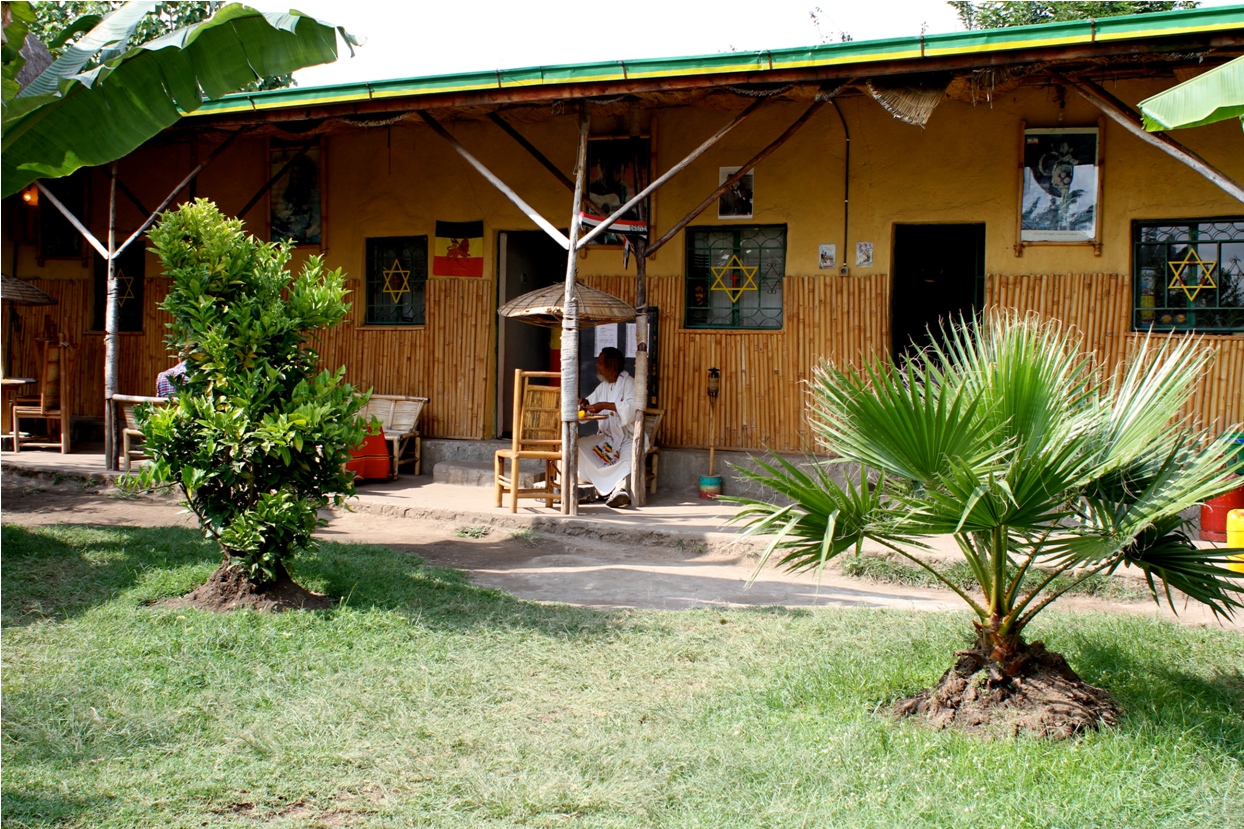
At the recommendation of a friend we booked rooms at the Zion Train Lodge, the only comfortable lodgings in the town, and, with four rasta flags waving proudly. Once we had left the main road even our 4x4 had difficulty finding its way across the many potholes and bumps in the sand. The further from the "centre" we drive, the more children, animals and carts we find travelling along the road. In this new, mainly Ethiopian district only the signs pointing the way to the lodge indicate the presence of a rasta community in Shashamane.
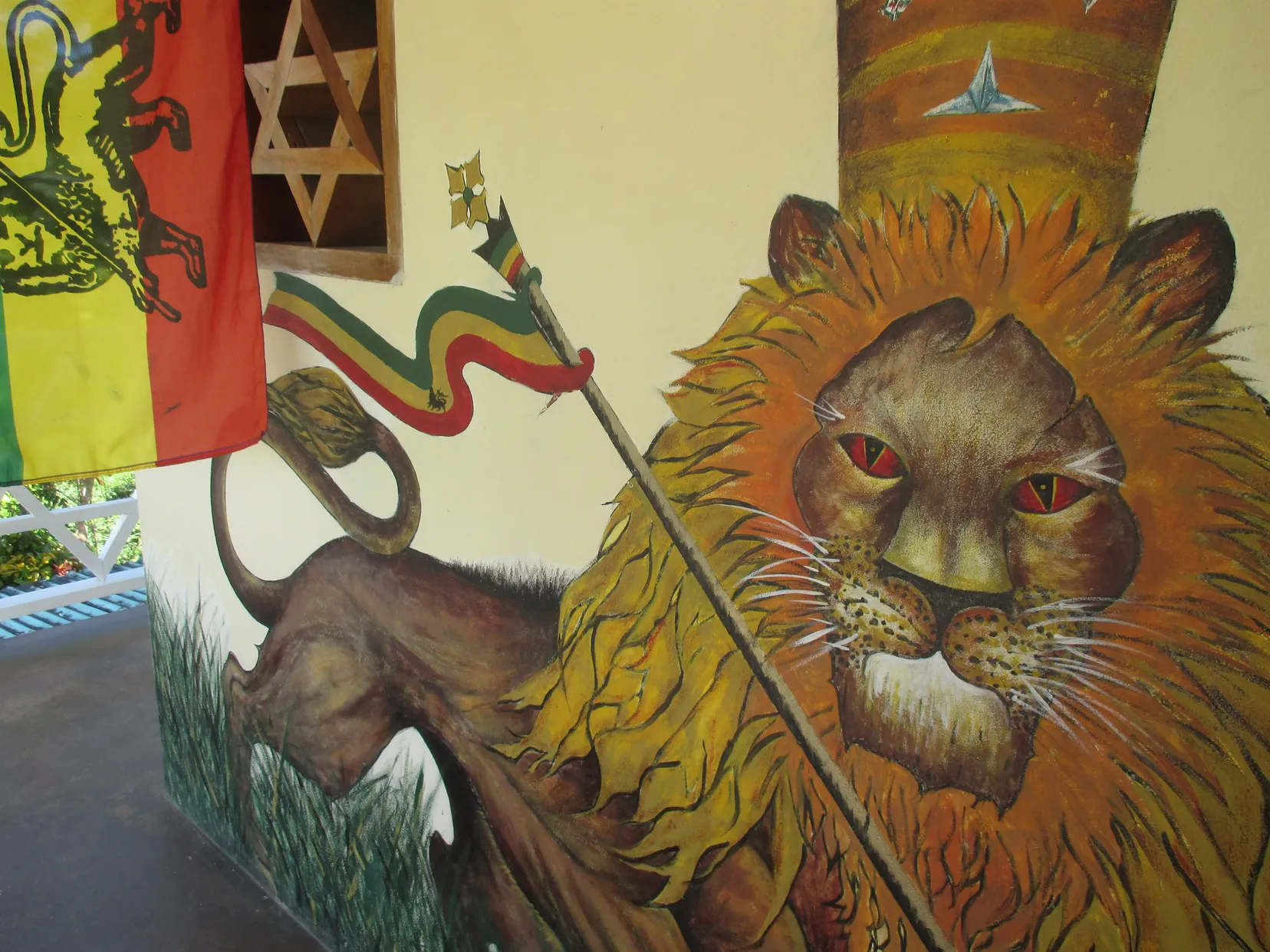
That is, until we stand at the gate of the lodge, painted with brightly-coloured portraits of the Emperor and his wife, both in full religious robes. The guard allows us to drive in, and almost immediately this place captures our hearts. The Zion Train Lodge is an oasis of peace, exotic greenery and unabashed rasta vibes, such as we have never fully dared express them. So this is how the ideal rasta man lives: surrounded by photos and posters of Haile Selassie, Marcus Garvey and Bob Marley, with Ethiopian flags bearing the lion of Judea, red-gold-and-green touches and paraphernalia. In the small kitchen Ital food is being prepared: rice and vegetables, banana fritters, fresh fruit and soya milk drinks. An old rasta cleans out his ganja and fills a chalice. The rooms of the lodge also fit in perfectly with the dream image that I have of the rastaman existence. Traditional handcrafted bamboo furniture, trimmed with cane and other natural materials, African motifs on bedspreads, tablecloths and decorative articles. We'll be sleeping in one of the three large tulkus (Ethiopian style, albeit with all of the comforts that the less adventurous Western traveller expects), but the three rooms in the small central building are also immaculately furnished.
Sandrine proves to be an excellent hostess and an authentic rasta queen. Together with a Jamaican cook she ensures that you can eat and drink pretty much all day at the Zion Train Lodge. She also feeds her guests knowledge and stories, in the spirit of the Rastafari as she, Alex and their children experience it, and try to apply it in their daily life. At the table she follows her husband in prayers, a combination of French and Amharic, dedicated to the Emperor. Rastafari.
'And watch out for the hyenas on the way back,' says Sandrine. At first I think she's just joking. We've just been telling her how Shashamene is described in the Bradt Travel Guide, and she appears to be playfully exaggerating. – "Thieves! Murderers! Hyenas!" - But no, she means it. At night hyenas really do prowl round this paradise, looking for dead dogs, cats or vermin - just as long as it's dead meat.
'Can't we take a taxi?'
'Taxis? They don't come around here. Only bajajs, and I doubt whether they'll still go to 12 Tribes tonight.'
For a moment David is caught in a quandary. He hates animals, (especially dogs), and he can't even contemplate hyenas. 'We'll sort something out,' I console him. 'How often do you get the chance to attend a dance of the Twelve Tribes of Israel in the Promised Land? You're not going to let a bunch of corpse grazers stop you, are you?'
I too find this quite mystical. We've scarcely arrived in Shashamene, and we're already invited to a party in the yard of Twelve Tribes, the rasta organisation closest to my heart, (and that of most reggae fans of my generation). It's nearly eight o'clock when Sandrine sets off with us in the lodge minibus, yet another of the facilities which make a stay there so enjoyable. We even have a 4x4 with driver at our disposal, but we already know that we won't be needing it for the next couple of days.
It's dark on the Twelve Tribes compound, but no darker than elsewhere in the city. Tonight Ethiopia is celebrating the beginning of the new year (2003), but there are few signs of this in the town. The darkness does remind me of Jamaica, and the Ol' Hits dance in Port Antonio where I once was, and other yards where primitive sound systems had been rigged up. Or was it due to the music? - You can always pick out an old tune. Damn it, the whole scene is pure Jamaica. A half-open building, ideal for a film set (!), is divided into three rooms. On the left, the DJs' hut. They use turntables and a laptop. An MC links up the vintage tunes, his accent only just falling short of Jamaican. The patois we know and love is the second language in Shashamene, after Ethiopian, but above the plain pidgin English you normally here. In fact, most of the inhabitants of Shashamene do indeed known only one English word: money; and at best give me money. The travel guide did get that right.
But we are not in the company of native Ethiopians here. These men (and one solitary woman) hail from Great Britain, Jamaica and other Caribbean islands. They learned the patois at home and also speak it here, in Africa. They don't dance, they skink, with the controlled, restrained movements they first saw in films and documentaries at the end of the 70s. Yes, the rastas here are of that generation, my generation and older, men with grey beards and old woolly hats. Rasta people.
The dancing takes place in the central area between the loud speakers. The sound is not perfect, nor overwhelmingly loud, but this does not spoil the fun. The choice of music is strong enough to keep you entertained. Sugar Minot, Treasure Isle, Harry Muddies, you name it... Not that there are many people on the concrete dance floor, but there is constant movement, due to different oldies reacting to their favourite tunes.
In the right-hand part of the building a grumpy Jamaican is selling drinks, rice and peas, fish, stew, cow tail and cake. Five men sit around a table playing ludi, the Caribbean version of dominos. Here and there spliffs are lit up. You can't get much closer to the real Jamaica.
My fellow travellers, David and Jah Rebel, can't stop dancing. I usually like to conserve my energy, but this gradually becomes impossible with this music, my music, classical reggae (and rock steady) I grew up with. So here we stand, (I think to myself), in the middle of Ethiopia, on the Horn of Africa, thousands of kilometres from Europe and further still from Jamaica, and yet completely at one with our surroundings and the people who live here. Just for one moment I want to enjoy the illusion, after all those years of surprise and amazement about the rich musical culture of reggae, and study of Rastafari.
A drunken youth rudely awakens us from our dream. He attacks another man, has to be restrained by the others, goes off to look for a knife, and starts venting his frustration on us. Reality check. In Jamaica, shots would already have rung out, here the small community manages to calm tempers. (Alcohol, it should be banned.)
A bajaj has been standing ready on the compound all night. In two trips, (only three people can travel at once), it transports our group back to the Zion Train Lodge. We encounter no hyenas on the way. It is close to midnight when we smoke a final spliff in the tulku, pure and adulterated, because we've run out of cigarettes. Happy New Year!
Next morning Sandrine serves up a delicious breakfast: omelette with onions and peppers, homemade jam and chocolate spread, even pancakes. After the Twelve Tribes today we want to visit the Nyahbinghi Order, that other old rasta mansion, more strictly doctrinal, more disapproving of the white oppressor, and therefore more religiously and intellectually challenging, (although, according to some people, these two characteristics can never co-exist).
The Nyahbinghi compound last week suffered somewhat of a crisis. The city authorities want to build a new street here, and the organisation cannot formally prove that it owns the land. This perhaps explains the oppressive atmosphere around the tabernacle and in the small museum. But Tomas, our young guide, insists on playing it cool. I recognise that streetwise attitude from the rude boys in Kingston, and from gangsta rap. It's a blend of nonchalant arrogance regarding anything rich and white, and insecurity as to his own status. Tomas has a Jamaican father and an Ethiopian mother. Offspring of the second (or third) generation, somewhere between West Indian and African culture, there's something touching about his Jamaican patois.
First he takes us to the small museum. There's a sign hanging at the entrance: Welcome to His Imperial Majesty Haile Selassie Moral Theocratical Churchical Order of Nyahbinghi Reign (Nyabinghi Tabernacle Shashamene). It was the Nyahbinghi who in 1992, erected a tabernacle to celebrate the hundredth anniversary of the Emperor. I even bought a certificate of it then, in aid of the project.
For those entering the grounds, please observe the following.
Man must remove all head covers.
Women must have their heads covered.
Absurd religious regulations: the old rastas in Jamaica never bothered me about them.
Women wearing trousers are not to enter. Exposing garments are forbidden. Women must not enter when observing their menstral (sic) period (a duration of 7 days)
Apart from the fact that I know women, who only discharge blood for two or three days each month, I would more likely have expected these regulations from the Bobo Shanti. My ideal rasta man respects his Queen, regardless of her clothing and hormonal situation. A strong, dignified woman knows how to dress and behave. She doesn't need us man to tell her.
No weapons, drugs, alcohol or cigarettes.
I assume that ganja is not a drug.
Use of flesh and all other harmful foods is forbidden.
As far as I'm concerned this law should be introduced at home immediately.
No outrageous behaviour.
We're not that type.
Inside, Tomas leads us past an untidy hotpotch of photos, newspaper clippings and imperial paraphernalia. He mumbles a few names and clichés, and asks a small contribution to the centre. It's an insignificant little museum, in which the scant visitors learn nothing about Rastafari. But I spot an old man sitting in a side-room, he's a rasta of advanced years, and unmistakeably Jamaican. 'That's Papa Rupie,' says Tomas. 'Ask him if I may talk to him.' Tomas approaches Papa Rupie humbly and with respect. I'm allowed to go in.
Papa Rupie is 78. As a child, he read in a newspaper about an Emperor in Ethiopia bravely battling Italian occupying forces. This is how Rastafari revealed itself to him; an insight to which he would remain true a lifetime long. For many years he saved his money in order to come and live here permanently in 2000. Papa Rupie is spending his old age in Shashamene. Could an old, intensely religious rasta man wish for more pleasant twilight years?
We proceed to the tabernacle, a kind of altar under a round roof supported by poles. No photos. Huh, that's no way to get the outside world interested. And yet really beautiful, powerful ceremonies and rituals take place here. Just for a second I wonder if they are putting on a show for the tourists, but it turns out that a Nyahbinghi really is in progress, with the necessary pauses and interruptions. Ras Mweya Masimba who is setting the place (and the chalice) on fire. He's quoting, chanting and improvising profound rasta lyrics and orthodox religious texts. He does this with the elegance, self-assurance and conviction of real rasta philosophers like Mutabaruka and Brother Sam Clayton of Mystic Revelation of Rastafari. In my lifetime, I have met only a handful of such rastas, and I can pick them out immediately.
I sit listening, fascinated, but Jah Rebel is completely at one with the Nyahbinghi. 'Selassie', he mumbles in chorus with them. 'Rastafari!' Could this be his natural habitat? Another white man is sitting amongst the rastas, he has a dense ginger beard and ditto dreadlocks, and he's wearing a headdress. And who might that woman be with her two children? A white rasta queen, who does not hesitate to use percussion to add colour to the monotonous rhythm of the drums. Even more people join in, spontaneously, it seems, as the mood strikes them. It's just as I always imagined a Nyahbinghi, with no real beginning or end, without set rules or regulations.
Even Papa Rupie takes the trouble to hoist his colossal body out of his chair, and proceed in full regalia, (long white robe, magnificent red, yellow and green turban, gold jewellery), to the tabernacle. He joins in with the singing and chanting at the top of his voice, he honours Jah and praises Ras Tafari. A true rasta man. Half and hour later, he departs as dignifiedly as he arrived, back to his room.
Another rasta, younger, fine-locked, clothed in white linen, whispers in my ear that he will be waiting for us afterwards at his Banana Art Gallery. This must be Ras Hailu, one of the few settlers to make it into the tourist guidebooks. Tomas has meanwhile promoted himself to our guide for the day. We agree a fee of 200 Birr, a little less than 10 Euros. I know that a guide is indispensable in countries like Ethiopia (and Jamaica), if you want to get to know a city or area quickly and with a minimum of hassle. Tomas is not the best guide, not the man to show you Shashamene in depth. In any case, he speaks far too little English to be able to do that. But I trust him, and a short while later, in the streets of the Jamaican Quarter, I manage to defrost him a little. He rewards me with a beaming smile.
On the way to Ras Hailu we bump into an older friend of Tomas, Ras Asher. He's no archetypical rasta, nor a Jamaican with dreadlocks, but a very dark-skinned British man, who at the end of the 90s leapt into his car, and drove straight to Ethiopia, to the Promised Land. 'As I drove into the country across the Sudanese border, pretty much immediately I felt liberated. I knew I'd come home.' The full conversation with Ras Asher (member of Twelve Tribes of Israel, but equally welcome in all of the mansions) can be found elsewhere on this site.
In the Banana Art Gallery of Ras Hailu, Jah Rebel relives golden times. The rasta man welcomes us routinely, as he probably receives most other visitors. But it takes Jah Rebel only a few sentences to break the ice: 'Are you that Belgian collector on eBay?' Ras Hailu is taken aback. Two men from different worlds with a shared passion: His Imperial Majesty Haile Selassie I, his medals, his coins, and depictions. The two of them are soon deep in discussion about Hailu's collection, the major part of which is displayed here for sale. The walls are hung with the art of Ras Hailu, his one-time patented banana art, pictorial collages made from coloured pieces of banana tree leaf. It sounds rudimentary, but the scenes and the style of these artworks emanate a great organic power and authenticity. I decided to buy a few.
Ras Hailu shows us a depiction of the icon of Saint Catherine, Christos Pantocreator (Christ, Creator of the Universe), discovered near Mount Sinai in the third century after Christ. The image bears an uncanny resemblance to early portraits of Haile Selassie, or is our vision clouded by the rasta smoke, which has meanwhile gathered around us?
Ras Asher takes us to see Brother Moses (Anthony Nevers), in 1976 one of the first settlers of the second generation. A long-time chairman of the local Twelve Tribes section, he is now engaged in education and community work. Himself a skilled welder and carpenter, he is setting up training and courses for young people through his Ethio-Carribean International Friendship Association. The name of the organisation says it all: Brother Moses reaches out his hands to both the Caribbean and Ethiopian communities. 'Rasta is unity', he says. 'We came here to work together with the Ethiopians for progress in this land, not to go and live on our own.'
Brother Moses takes time to talk to us. First, he wants to know in which month we were born, and thus to which of the twelve tribes we belong. To this he attributes a few characteristics, which are wonderfully spot on. You can read the full report of this fascinating conversation on another page, but I can tell you that in my ideal world, in my Promised Land, this brother would be the prototype rasta man, the rasta who in all respects corresponds to the dream image created by reggae over all these years. Friendly and self-confident, with a humble manner. Well informed, and with a good social, political and historical grounding. Fully active in the local community, helpful and very practice-oriented. Brother Moses doesn't take the promised land for granted, he keeps working on it every day.
During our meeting a tropical rainstorm pours down. This is the end of the rainy season, and we haven't yet had one dry day. The heavy raindrops drum hard on the corrugated iron roof. Brother Moses constructs a spliff and pours out a small glass of home-brewed, alcohol-fermented root drink. On TV, Obama is remembering 9/11. The Press is an English-language Iranian news channel, which broadcasts 24 hours a day, and Moses'main source of information, although he sometimes watches BBC World too. You mustn't view these people as cut off from the world and fleeing reality. The harsh living conditions in Shashamene perhaps bring them that little bit closer to reality, to the roots of existence.
That's subject matter enough for further conversation, or rather for reasoning with Alex, Sandrine and the other guests at Zion Train Lodge. This is another pleasant benefit of these lodgings: you meet like-minded souls there, or at least interesting people. Like the two young Austrians, who arrived from Addis, in seven days, by horse and cart (!). They known nothing about Selassie and Rastafari, but they have our greatest respect for their love of live and sense of adventure.
While we are sitting there chatting, our juice and spliff in hand, four beautiful ponies come strolling by, followed, a short while later, by two chilled-out donkeys. They seem to form part of the household, now and again working for their keep. This is indeed a magical atmosphere.
That evening we are invited to another party, this time in the yard of Sister Joanne, who descended (rose up?) to Shashamene over a quarter of a century ago, and is one of the most respected women (and cooks!) of the Jamaican community. Her son is celebrating his 21st birthday, and that is also the average age of the guests, fresh-faced girls and boys of (part) Jamaican origin. 'The sound' plays mainly dancehall and Caribbean R and B. Not my cup of tea, but we are pleased to see this side of the promised land too, the young side. And it goes without saying that we rich Europeans buy a couple of rounds. Tomas and his mates have a fantastic, beer-drenched evening, but that is no different from at home or in Jamaica. Not everyone lives in a cloud of ganja.
Sunday is the Lord's day in Ethiopia too, and so people go to church. My previous religious experience in Ethiopia (Axum) was so life-changing that I decide to accompany Alex to church. Up early, no breakfast, and a bumpy ride by minibus to the other side of town. Curious glances and begging hands: for the first time we venture out of the comfort zone, which Rastafari has created for us so far. This is no party or Nyahbinghi, but a celebration of the Ethiopian Orthodox Church, and moreover on the feast day of John the Baptist, which makes all the more colourful and important.
The small church building itself is the Holy of Holies, which only the highest priests are allowed to enter. The many thousands of believers are standing outside, around the church, their devoted eyes directed at the building, some even with their forehead against the wall, just to be as close as possible to the sanctuary, and thus find redemption. All of the women are wearing the typical white veils, light and coarsely woven, edged with thin stripes of colour. Most of the men have wrapped a white shawl around their shoulders. Some flaunt a skilfully decorated, velvet parasol.
For the first two (!) hours we listen to readings by a priest. His voice sounds shrill and distorted, half-heartedly amplified by a crude sound system. I don't understand a word, but gradually fall under the spell of the rapt devotion displayed by the people around me. Now and then a mobile phone rings, or a spluttering bajbaj passes, yes indeed, right through the people. Mendicant monks and vendors of wicks and small crucifixes discretely seek contact with the people. I buy a long, fat wick and light it with my lighter. A little girl, instructed by her mother I see, gestures that she wants to share my light. She holds her wick against mine, and I suddenly feel very closely connected to these people. Together with them, I listen to the texts, which they too scarcely understand, (well not if they are pronounced in Ge'ez, the Church Latin of the Ethiopians), but we do feel the same spiritual energy. Instead of closing myself off from this collective religious trance, as you might expect from a Western intellectual, I allow myself to be drawn into it. Instead of dismissing the ceremony as superstition or religious delusion, I recognise a primal force a tribal feeling, which we only encounter in massively diluted form at pop concerts or other mass gatherings.
Slowly, spontaneously and impulsively, reactions emanate from the audience. Someone answers in the affirmative. A few women make a high, cooing sound, such as you hear everywhere in Africa and the Arab world. The reading gains a rhythm, a second priest takes over, and people clap. There is no apparent system or melody to the ensemble, and yet music is created, perhaps the first music, as played by Saint Yarned at that time in Ethiopia. The most important words gaining emphasis, the most important sentences a rhythm. A man with a large drum confirms and emphasizes the cadence. A dozen or so male and female dancers begin a slow deliberate dance. A man takes over the microphone, and sings one exuberant call-and-response song after another, typically African, typical slave song, typical Nyahbinghi.
Then the tabor is brought outside, the copy of the Ark of the Covenant, the holiest object of the church. The crowd reacts with cries, singing and applause, and then starts to move. Alex says that we must now all walk twice around the church. I tag along willingly amidst the exuberant Ethiopians. And in this way, we all shuffle in the wake of the tabor, to the Promised Land, not that of the rastas it is true, but this procession is much older, much more original, much more real. In this procession I feel at home, closer to my Christian roots than at any other religious gathering I have experienced in my life. If I have to convert to one faith, it will probably be the Ethiopian-Orthodox Church. You do know that Bob Marley also converted to this religion during the last months of his life?
We return to the Zion Train Lodge for a hearty breakfast. Ras Asher wants to introduce one more man to us. Priest Paul is the leader of the Bobo Shanti, the youngest and most controversial of the mansions of Rastafari. 'If one man can represent us in the government, it's Priest Paul,' says Asher. 'Of all the Rasta leaders, he has most authority in his community.'
This soon becomes apparent, when unexpectedly we run straight into Priest Paul in the Ras Hailu district. There had been a break-in the night before at the house of David, the Flemish migrant who died there a few years previous, under suspicious circumstances. Paul is leading the investigation, trying with a few of the faithful to get to the bottom of the matter. The atmosphere is tense, Paul constantly peering around the area. Ras Asher introduces us, and I get straight to the point. Like most Bobo Shanti, Priest Paul speaks to me distrustfully and distantly, at times even arrogantly. He reminds me of Sizzla, the first Bobo I interviewed in those days, my first encounter with a new-style rasta man. What had become of the natural love and kindliness of the rastas? What had I done to deserve being treated like a doormat, when for years I have defended the rasta man through thick and thin? And don't even get me started on the trinity of the Bobo Shanti. When you've finally managed to explain to people a little of what Rastafari stands for, and the continuity between the original (biblical) Trinity and Haile Selassie, they suddenly come up with another figure. - As if that Prince Emmanuel could measure up to the ankles of Jesus Christ and Haile Selassie.
But I put all of this aside in order to get to know Priest Paul. Would he like to take part in our documentary? Not if the community receives nothing in return, he answers directly, and I can fully understand that. We are not the first film crew to pass this way, and I can imagine that the local population rarely benefits from it, especially considering the negative vibes that the resulting images often transmit.
'We don't need any positive promotion,' Priest Paul surprises me. 'We already have a good reputation, all over the world.' Okay… 'I'm talking about a concrete contribution to the development of our community.' I promise that we will draft a plan to generate support for the whole Rasta community in Shashamene.
'I will get back to you in a few months.'
'To the I. Not you.'
'To the I, excuse me.'
In that tone. David and Rebel are not impressed, but this Priest Paul intrigues me. I would like to have a good talk with him, in all openness, about Rastafari, but I'm afraid he would not take up by offer. After all, I'm just a white suppressor, and the Bobos uphold the principle of black supremacy. My view will always be subordinate and inferior. It's a pity, because Priest Paul is a powerful figure, as Ras Asher already mentioned, a man who assumes full responsibility for instilling discipline and industriousness in Shashamene and the Rasta community.
Fortunately, another interesting person is waiting to talk to us at Ras Hailu. We arrive to pick up our souvenirs: Jah Rebel his medals, and me, my banana art. And Hailu is sitting playing chess with Brother Mweyu. Healready noticed us yesterday, he says, during the Nyahbinghi. I say that he read a very powerful text there. I've scarcely introduced myself (journalist, wrote book, been to Jamaica: over the years I've learned to say it in one breath and immediately brush aside the suspicion of the rastas), when he starts to bombard me with complex questions. What is my concept of Rastafari? Do I think that the people here are poor, or that they consciously distance themselves from the consumer society? And why don't I convert to the Ethiopian Orthodox Church if I feel so closely connected to it?
'Because there's one big difference between you and me,' I reply. 'You were born into the faith. For you it's an inviolable certainty. I'm a rational westerner, who can never completely commit to a religion, of any kind. Somewhere along the way we lost our unconditional faith in Jah.'
Ras Mweyu is a man after my own heart. Sensible, alert, critical and inquisitive. I have had this type of conversation in Kingston too, with Brother Sam, the man who kept alive the holy fire of Mystic Revelation of Rastafari after the death of Count Ossie, and who himself visited Haile Selassie in 1963.
It is our final meeting at Shashamene. We have to get back to Addis Ababa. We say goodbye to Ras Asher, Alex and Sandrine, and mentally, to the whole community of brave rastas, who put their money where their mouth is, and came to live here. Rastaman fi true.
Jah Shakespear has been listening to reggae music since 1977, started writing about the subject in the early nineteen eighties (for De Morgen, De Standaard, P-Magazine, Highlife and a number of other magazines) and founded this website in 2002. He's also the author of 'De Rasta Revelatie' (2008) and 'In Het Spoor Van De Keizer' (2016).
Sep 21, 2010