
.Dl7BAwhJ_ZJXLLF.webp)

In the first part of this series, we explored the earliest contacts between Belgium and what was then known as Abyssinia. We now move forward to 1924, when Ras Tafari, the future Emperor Haile Selassie, paid his first visit to Belgium.
From Recognition to Encounter: Ras Tafari in Belgium (1924)
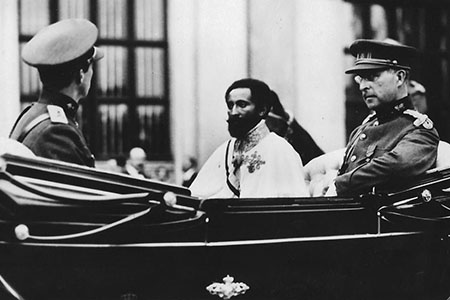
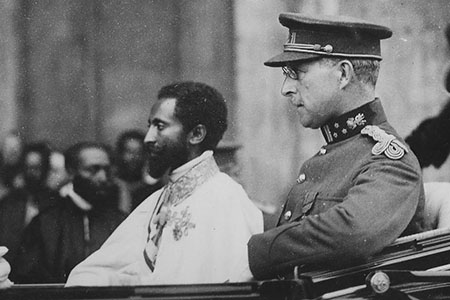
As a token of gratitude for the diplomatic support rendered during Abyssinia's admission to the League of Nations in 1923 [1], Enderase, or Prince-Regent, Tafari Makonnen paid Belgium a visit of roughly one week in May 1924.
On Thursday 22 May, Ras Tafari and his entourage arrived at 6 p.m. by train from France at Brussels-South, where he was received by King Albert I. The Prince-Regent's travelling party included Ras Hailu Tekle Haymanot, Governor (or Shum) of the province of Gojjam; Ras Seyum Mangasha of the western province of Tigray; Ras Mulugeta Yeggazu of the province of Illubabor; Ras Makonnen Endelkachew; and Tafari's diplomat and confidant, Blattengeta [2] Heruy Welde Sellase.
The Ethiopian delegation had been met in Paris by the Belgian senator Albert Lejeune, who possessed numerous personal interests in Ethiopia, and who, together with Lieutenant-General Count Charles Greindl and Baron Léon le Maire de Warzée d'Hermalle, would assist the Ethiopian party throughout the entirety of their Belgian stay.
In La Nation Belge of 23 May 1924, we find the following striking passage concerning the Prince-Regent's arrival:
Prince Taffari (sic) descends slowly from the train, slender, small, yet majestic, with a languid majesty. He is clad in white silk, tight hussar-style trousers, patent 'European' shoes, his shoulders covered with a short white cape embroidered with gold, and across his chest the broad blue and black sash of the Order of Leopold II. The Ras holds in his hand a large grey felt hat.
Haile Selassie himself would later record the following passage about his visit to Belgium in his autobiography [3]:
The Belgian Ambassador in Paris had informed Us that on 14th Genbot (22nd May) the King of the Belgians, H.M. Albert, would officially receive Us, and therefore We departed from Paris towards evening and went to Brussels. At the railway station H.M. King Albert, together with his ministers and his army officers, did Us the honour of an unforgettable welcome. It was in a wing of the main palace building in which H.M. lived that quarters had been prepared for Us; We went there and rested a little. Afterwards he introduced to Us H.M. Queen Elizabeth and Prince Leopold, his crown prince who later on became king, and his daughter, Princess Marie Jose. At the banquet His Majesty assured Us of his complete desire that the firm friendship between the Belgian and Ethiopian governments should in future continue to grow.
Brussels
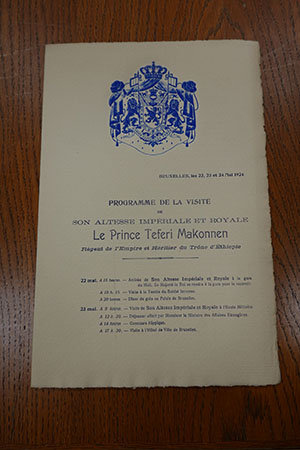
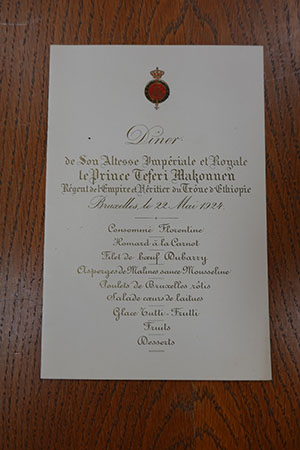
In Brussels, Ras Tafari first went to pay his respects at the Tomb of the Unknown Soldier at the Congress Column. The scene was vividly described in La Nation Belge of 23 May 1924:
Slowly he descends the steps leading to the Tomb of the Unknown Soldier, upon which he places a simple crown of ivory, composed of two elephant tusks, adorned at both ends with silver rings: a wreath of olives surmounted by the arms of Ethiopia completes this work of art. The Prince bows for a long moment, surrounded by his suite. A great silence hangs over the group, come from so far away to render homage to the Belgian soldier.
The day concluded with a grand gala dinner at the Royal Palace. In La Libre Belgique of 23 May 1924 we found both the full speech of King Albert I and that of Ras Tafari:
Monseigneur,
We are deeply sensible of the visit which Your Imperial Highness has been pleased to pay us, and Belgium is happy to salute in its capital the Prince-Regent, representative of an illustrious family that reigns over one of the most ancient empires in the world.
We see in the presence of Your Imperial Highness among us a precious testimony of His sentiments of friendship towards us.
Belgium, which has no other ambition than to contribute, through the fruitful paths of works of peace, to the moral and economic development of humanity, attaches great value to the friendly sentiments of Ethiopia, with which she desires to multiply relations equally fruitful for both countries.
In entering the League of Nations, the Ethiopian Empire has demonstrated its firm resolve to contribute its share to the accomplishment of a lofty work of civilisation.
The League of Nations is destined to become an essential organ of international life and to prepare a new order founded upon justice and the solidarity of nations.
Belgium has rejoiced in contributing effectively to the adhesion of Ethiopia to the League of Nations; in placing our influence at the service of a cause so dear to Your Imperial Highness, we were pleased to offer a sincere proof of our warm sympathy.
May Your Imperial Highness be pleased to convey, to Her Majesty Empress Zaoditou, a sovereign held in high esteem, belonging to a dynasty whose origins ascend to the great King Solomon, the expression of our respectful homage and of the wishes which my Government and I most fervently offer for the glory of her reign, and for the happiness and prosperity of Your Empire.
It is in these sentiments that I raise my glass in honour of Your Imperial Highness, and drink to Your health and to that of the members of the Imperial Family.
Sire,
The gracious invitation which Your Majesty has been pleased to address to me to come and visit your glorious and dear country will serve to strengthen the friendship already existing between Belgium and Ethiopia; this invitation will never be forgotten either by me or by the Ethiopian people.
The friendly welcome which Your Majesty has been pleased to accord me in your beautiful capital has deeply touched us and filled my heart and those of the dignitaries accompanying me with joy; we shall preserve an indelible memory of it.
I learned in Ethiopia that Your Majesty was animated by sentiments of great friendship towards my country, and since then I had a great desire to come and pay my respects to Your Majesty.
Although Ethiopia goes back to the highest antiquity, if her progress has been delayed, it has not been through negligence, but chiefly as a result of continual and bloody wars which she has had to wage for the defence of her independence and of her religion, against pagans and Muslims.
Today, I have the pleasure of declaring to Your Majesty that relations marked by the greatest friendship have been established between Ethiopia and the European powers. They amply prove that our country has the firm will to develop its intellectual culture. Belgium was pleased to assist us last year by supporting our request for admission to the League of Nations, where we shall follow the path of progress, while defending our rights and our interests and while giving satisfaction to the friends who have aided us.
I pray God that He may be pleased to grant Your Majesty good health and a long life, happiness and peace for your people and for your country. I raise my glass to the health of Your Majesty, to Her Majesty the Queen, to the Royal Family, as well as to the health of Her Majesty the Empress Zaouditou and to the prosperity of the Belgian and Ethiopian peoples.
On Friday 23 May, the Ethiopian party remained in Brussels. The programme included, among other things, a visit to the Royal Military Academy in the company of Prince Leopold, followed by a luncheon at the Ministry of Foreign Affairs and a visit to the Concours Hippique in the Cinquantenaire Park [4]. Thereafter they proceeded to Brussels City Hall, where the Prince-Regent was received by Mayor Adolphe Max.
The day concluded with a gala evening at the Théâtre de la Monnaie, where the Ethiopian delegation attended a performance of the opera 'La Traviata' and were treated to the ballet 'Coppélia'.
Antwerp
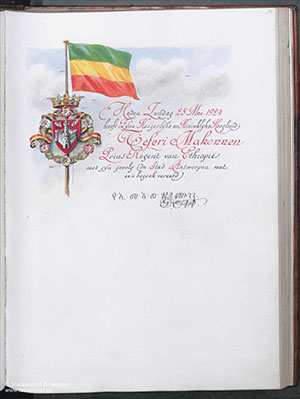
On Saturday 24 May, a brief visit to the Grand Duchy of Luxembourg was first scheduled. Only shortly before midnight did the Ethiopian delegation arrive at the station of Wilrijk [5], where they were received by the Mayor of Antwerp, Jan Frans Van Cauwelaert, and the governor, Baron Henri Holvoet. Senator Albert Lejeune again acted as host, and Ras Tafari, Ras Hailu, Ras Seyum and Blattengeta Heruy spent the night at his residence, the Château Lejeune on the Della Faillelaan, while the rest of the entourage took up quarters at the Grand Hotel Terminus [6] in the Pelikaanstraat.
On Sunday followed a visit to Antwerp City Hall, where Ras Tafari and his suite were received by Mayor Van Cauwelaert, followed by a tour of the port of Antwerp aboard the yacht Mercator, during which, among other things, the shipyard of Cockerill Yards in Hoboken was visited. The party was then welcomed at the Provincial Palace, where Governor Holvoet offered them a gala luncheon. After the festive meal, a visit to the Antwerp Zoo was also on the programme.
Concerning this visit, De Nieuwe Gazet of 26 May 1924 wrote:
In the lion hall, the visitors took great interest in the behaviour of the lions, tigers and leopards. The hippopotamuses, the elephants and the seals also aroused their curiosity. In the aquarium the Ethiopian guests lingered for a very long time, for it was the first time that they had the opportunity to observe the fishes in their natural element. After having also examined the kangaroos and the monkeys, Ras Taffari left the Zoological Garden.
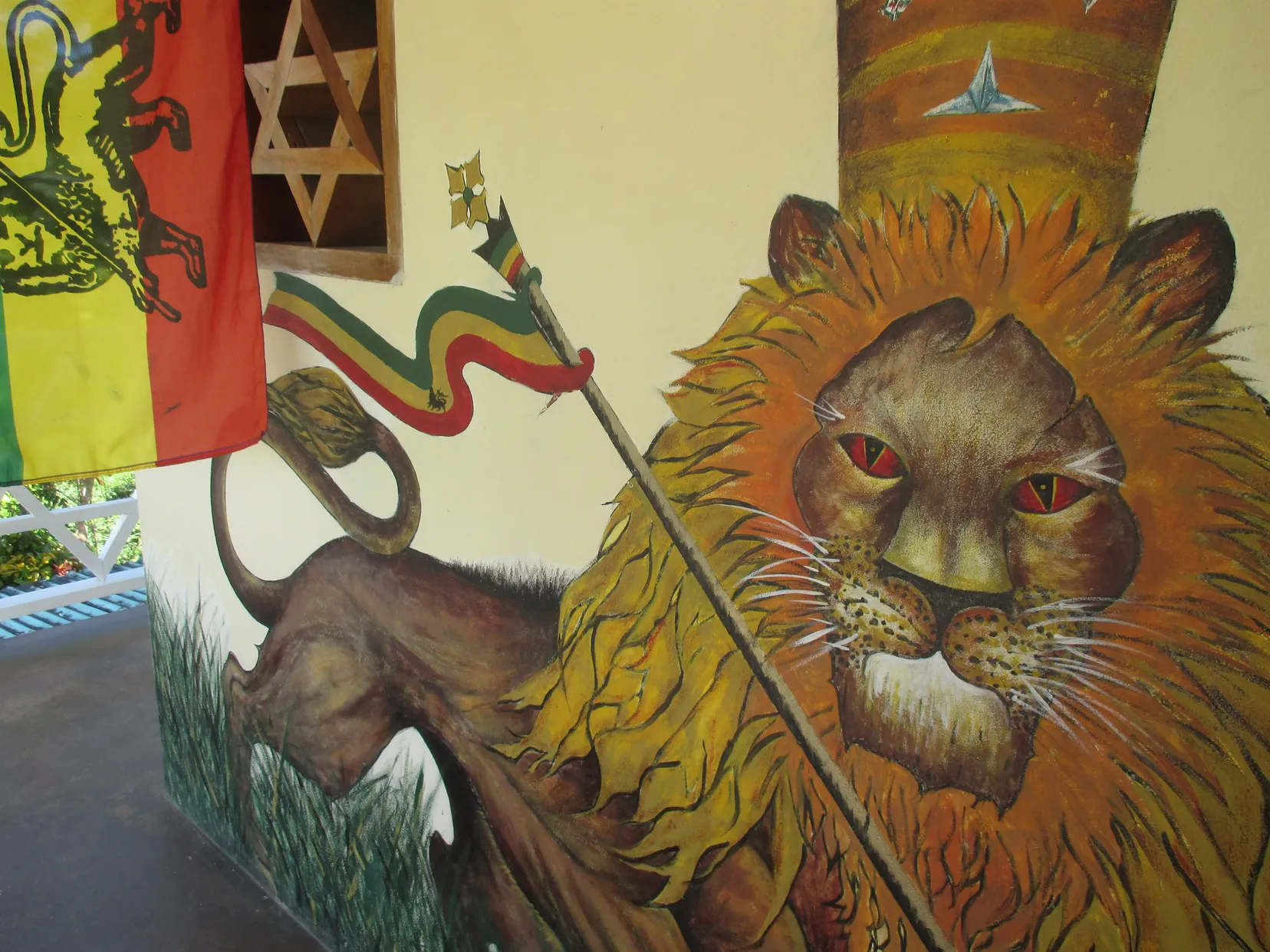
After his return to Addis Ababa in September 1924, Ras Tafari decided to present the Antwerp Zoo with an Abyssinian lion and eight ostriches. It would involve considerable difficulties, but the animals eventually departed on 18 November 1924 aboard the steamship Ville d'Arras from Djibouti to Marseille. Not all the ostriches survived the voyage, but for a time there did indeed reside a true Lion of Judah [7] in the Zoo of Antwerp.
Senator Albert Lejeune also sat on the board of directors of the Régie Impériale des Alcools en Éthiopie, and it was therefore in the offices of the R.I.A.L.E.T. that Ras Tafari concluded his visit to Antwerp.
The Régie Impériale des Alcools en Éthiopie, Chronicle of a Foretold Demise
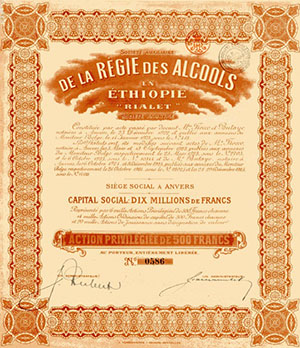
In its report on the Prince-Regent's visit to the city of Antwerp, Het Handelsblad van Antwerpen noted:
After the visit (to the zoological garden, ed.), the Prince was offered tea at the seat of the board of administration of the Imperial Alcohol Régie, Arenbergstraat.
The story of the Régie Impériale des Alcools en Éthiopie [8] is somewhat of a chronicle of a foreseen death. The R.I.A.L.E.T. was founded in Antwerp in 1922, after the monopoly rights for the production and distribution of alcoholic beverages in Ethiopia had been obtained from Regent Ras Tafari. In theory this enterprise, which disposed of considerable starting capital, was a veritable gold mine, but in practice matters turned out quite differently.
The Belgians envisaged the venture on a grand scale and immediately began purchasing a number of local distilleries, chiefly in Greek hands. Just outside Addis Ababa several plots of land were acquired and a large new distillery opened.
Although the Greeks appeared outwardly to acquiesce, they often simply reopened a distillery behind the Belgians' backs with the money they had earned. Moreover, the Greeks had already built up many contacts with the local population and were therefore able, with relative ease, to persuade them not to supply raw materials to the Belgian newcomers.
As a clause in the monopoly negotiated with the Ethiopian government stipulated that the properties of the R.I.A.L.E.T. would be nationalised if the agreed production quotas were not respected, the Belgians soon found themselves in a very precarious position.
When the inevitable finally occurred, the R.I.A.L.E.T. attempted to salvage the situation by bringing a case before the International Court at The Hague, but as they could not persuade any of the parties involved to testify in their favour, this too proved of no avail.
Ninove and Ghent
On Monday 26 May, a visit to the match factories of Union Allumettière in Ninove was on the programme. The Prince-Regent was presented with a golden match holder, after which the party set course for Ghent, where he was received at City Hall by Mayor Alfred Vander Stegen. After a short luncheon came visits to the cotton spinning mills of Union Cotonnière Galveston and Usines Cotonnières Gand-Zele-Tubize, the flax factory Société Linière La Lys, the port of Ghent, and finally the Gravensteen.Liège, Herstal and Seraing
A day later, on Tuesday 27 May, the Ethiopian party took the train to Liège, where they were awaited at the Liège-Guillemins station by Governor Gaston Grégoire and Mayor Émile Digneffe.In Liège, Tafari's interest was directed above all to the Fabrique Nationale de Herstal. This marked the beginning of a short but fruitful relationship. In the period 1925-1935, FN became the principal arms supplier to the Ethiopian state and, since the average Ethiopian knew only Belgian rifles, firearms soon came to be designated by the term "belgik".
Although few confirming sources remain, the Ethiopian court most likely became acquainted with Belgian arms through the Liège businessman Georges Laloux, whose Comptoir Européen [9] had been active in Djibouti and Addis Ababa since shortly after the First World War and who also served as an administrator for FN.
As a farewell gift, Ras Tafari received a Browning inlaid with gold and silver.
After a brief luncheon at the Provincial Palace of Liège, the party proceeded to Seraing for visits to the crystal and glass works of Val-Saint-Lambert and the steel works of Cockerill, where the Prince-Regent was even presented with a field gun [10], and finally to the Société Anonyme d'Ougrée-Marihaye. The day concluded with a dinner at La Violette, the City Hall of Liège, and a torch-lit military parade which made a deep impression on the Ethiopian visitors.
Maurage
From Liège, the Ethiopian entourage travelled by train on Wednesday 28 May to Charleroi, from where they continued by car to Maurage in Hainaut for a visit to the Marie-Josée coal mine. At the last moment, the Ethiopian delegation declined the invitation to descend into the mine, and the focus of the visit shifted to the coal-washing plant and the engine room. Upon departure, the Prince-Regent received a miner's lamp as a gift.That evening, the Ethiopian delegation was offered a gala dinner in Brussels by Émile de Béco, Governor of Brabant and brother-in-law of the already mentioned Marcel Dupret.
Tervuren, Genappe and Waterloo
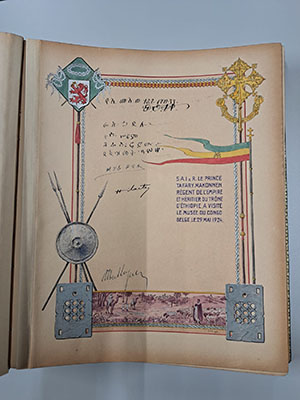
Thursday 29 May, the final day of the Ethiopian visit to Belgium, began with a brief visit to the Musée du Congo belge in Tervuren [11].
Thereafter, together with the Minister of Agriculture, Baron Albéric Ruzette, the Ethiopian party attended an agricultural demonstration at the Sucrerie de Genappe, of which La Libre Belgique of 31 May 1924 provided an extensive account (including the full printed speech of Mayor Joseph Berger, who officially welcomed the Prince):
AT GENAPPE - A SPLENDID AGRICULTURAL CELEBRATION
At Groenendael, Prince Teferi, still accompanied by his entourage and the Belgian dignitaries attached to his person, proceeded to Genappe, where an impressive celebration awaited him.
The charming Brabantine town had, from early morning, been lavishly decorated with flags, crests, and garlands. The reception took place in the sugar factory, whose ornamentation was particularly elegant.
…
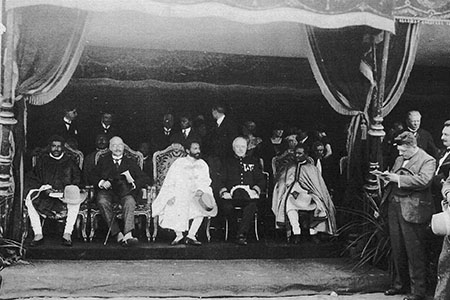
At 3:30 p.m., the cars bringing Prince Teferi entered the grounds of the property, preceded from the town's entrance by forty young horsemen. A sumptuous stand had been erected in the courtyard of the establishment. The public was separated only by the parade ground, where the finest specimens of our livestock were to be showcased.
A dense crowd pressed against the barriers, cheering the prince, to whom Mr. Berger extended a welcome in the following words:
Your Highness,
A great honour falls today upon our modest town.
Although you are aware that you will not see here sumptuous monuments nor powerful artistic or industrial attractions, you have deigned to traverse our countryside and visit humble establishments whose sole merit is to demonstrate to Your Highness our goodwill and our desire to receive you well, despite our limited means.
Nevertheless, we take true pride today in exhibiting the fruits of the patient and intelligent labour of our breeders, who have created equine and bovine products whose renown we are pleased to present to you.
Without today's countryside exhibition, the vision of our agricultural and rural life would have been absent from the memories Your Highness will take from the journey that has honoured us, and for which we thank you from the bottom of our hearts.
We hope, in turn, to draw from your beautiful country, so mysterious to us, lessons derived from its ancient and marvellous traditions, from a civilization connected to a past whose historical grandeur shines most brightly.
Genappe too has its history.
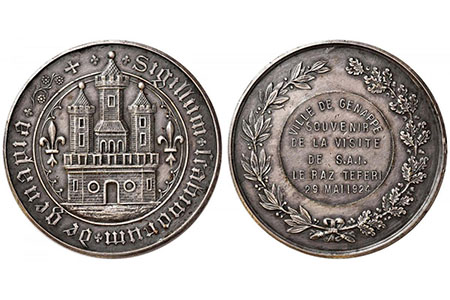
The medal we ask Your Highness kindly to accept bears witness to it, being an exact reproduction of the seal of the old and renowned Court of Lothier, which once sat in a now-vanished castle located on the very site where we stand.
Permit me to ask Your Highness to receive the sincere wishes of the Belgian countryside for the greatness of Ethiopia and the imperial family.
Prince Teferi took his seat, surrounded by the notables and the Ras of his suite. Facing the stand, he could see a banner welcoming him in his own language and in Ethiopian script.
The setting of this celebration was picturesque and bathed in sunlight. The temperature was almost… Ethiopian.
The parade began immediately, accompanied by the excellent music of Genappe, directed by Mr. Vossure. First came the powerful bulls, prize-winners in every competition. Prince Teferi signalled the applause as these massive beasts, embodying all the qualities of a robust breed, stopped before the stand. He examined the animals with great attention. The dairy cows met with no less success. Then came the horses, whose appearance drew cries of admiration from the crowd and elicited further cheers. Several of the stallions presented had won the highest distinctions both in Belgium and abroad. Prince Teferi did not hide his admiration. After attentively listening to the explanations provided by Mr. Van Autgaert, he requested the album containing photographs of these magnificent animals.
He then watched demonstrations by police dogs, which seemed to amuse him greatly. Another lively success greeted the charming group of reapers, who danced before the stand with grace and spirit—a truly delightful spectacle.
At the end of the procession came several floats, tastefully arranged.
After the parade, the prince visited an exhibition of agricultural instruments set up on a lawn, escorted by the crowd.
Back at the stand, he signed the guestbook, conversed briefly with Messrs. Withouck, and then presented a card bearing the imperial crown and a gold medallion with his effigy to the young boy and girl who had offered him, upon his arrival, the program of the celebration and the medal presented by the town.
New ovations arose from the crowd as, to the strains of the Brabançonne, the prince departed the sugar factory and re-entered his car, once again preceded by horsemen to the town's outskirts. Throughout the route, the crowds were numerous. Genappe was jubilant, and the festivities continued even after Prince Teferi's departure.
…
In Le Lothier Roman 2 (2024), the quarterly magazine of the Cercle d'histoire et d'archéologie du pays de Genappe, an extensive article appeared about Ras Tafari's visit to Genappe. To our surprise, it even included a folk song written by a certain Auguste Lefèvre, celebrating the visit of Ras Tafari to Genappe:
El' Visit' à Gniapp du Ras Tafari
(The Visit to Genappe of Ras Tafari)
A Gniapp la despu saquant s'maines
(In Genappe, for several weeks)
O n' pal' pu que d'in affaira
(People have been talking of nothing else)
Qui va nos amainé pu d'gins
(That will bring us even more folks)
Gué si vasie pou n'fwère
(As if it were a fair)
Ça dwé awé lieu à l'Ascinsion
(It must take place at Ascension)
La faridondaine, la faridondon
El' visite du Ras Tafari biribi
(The visit of Ras Tafari, biribi)
A la façon du barbari, mes amis
(In the manner of the barbari, my friends)
O f'ra in ortèche Agricole
(We will have an agricultural procession)
Qu'on parlera dins l'histwère
(That will be remembered in history)
Les vâriets mett'ront leu fau-col
(The farmhands will don their collars)
Et f'ront tertous d'leur pwère
(And all do as they please)
Ils arriv'ront dès tout l'canton
(They will arrive from across the whole canton)
La faridondaine, la faridondon
Pour v'nu vir' el' Ras Tafari biribi
(To come and see Ras Tafari, biribi)
A la façon du barbari, mes amis
(In the manner of the barbari, my friends)
Les gros sinçi vèront tertous
(The prominent farmers will all come)
Dins leur' automobile
(In their automobiles)
I seront là comme des hommes
(They will be there like proper gentlemen)
Qui n' se sont jamais pon fait d' bille
(Who never worry about anything)
Ave in cigare dins leur mouson
(With a cigar in their mouths)
La faridondaine, la faridondon
Fe honneur au Ras Tafari biribi
(To honour Ras Tafari, biribi)
A la façon du barbari, mes amis
(In the manner of the barbari, my friends)
Dins l'cortèche, o vira passer
(In the procession one will see pass by)
Des toutes les soutes des blesses
(All sorts of animals)
Des boucs, des gates, des vatches, des tchès
(Bucks, goats, cows, and dogs)
Des rubans à leu tiesse
(With ribbons on their heads)
Les tours, les ronçus qui churons
(The bulls, the stallions that follow)
Mins les tchats n'seront ni admis biribi
(But the cats will not be admitted, biribi)
Peu qué yun n'mainiche el Ras Tafari
(So that none may bother Ras Tafari, biribi)
A la façon du barbari, mes amis
(In the manner of the barbari, my friends)
El' Furet f'ra in groupe des méch'neux
(El Furet [12] will lead a group of reapers)
Qu'a co l'air de bé plaire
(Which will surely please everyone)
I pourront danser pu d'à deux
(They will be able to dance in more than pairs)
Au mitant d'el pavée
(In the middle of the road)
Et co tchanter su tous les tons
(And also make music in every key)
La faridondaine, la faridondon
Quand s'ra raller l'Ras Tafari biribi
(When Ras Tafari has departed, biribi)
A la façon du barbari, mes amis
(In the manner of the barbari, my friends)
Before returning to Brussels, the Prince-Regent made a brief halt at Waterloo, where he visited the former headquarters of Emperor Napoleon Bonaparte.
Few sources exist, yet it may reasonably be assumed that Haile Selassie had a certain admiration for Le Petit Corse [13]. In My Life and Ethiopia's Progress, Volume Two, he wrote:
Many people used to visit Us at Our home called Fairfield. The house had many rooms and was chilly. The view through its front windows reminded Us of the hills of Harer. We never went to the theatre or any other places of entertainment. Our only recreation was the time We spent chatting with Our children. We stayed awake late in the night reading books and writing the history of Our life. The books we read mostly included diplomatic histories and the biographies of patriotic leaders such as Napoleon, Abraham Lincoln and… (works) about the Christian church.
In Le Soir of 31 May 1924 we also find the following remarkable description of the Prince-Regent's brief visit to Waterloo:
The Prince of Ethiopia remained there for a long time, motionless, arms crossed, before the bust of Napoleon. His melancholy and impressive gaze became fixed, impenetrable.
On Thursday evening the Ethiopian delegation then departed once more from Brussels-South towards France. In a telegram Ras Tafari thanked his host in the following words:
At the moment of leaving Belgium, I send to Your Majesty and to Her Majesty the Queen the expression of my profound gratitude for the welcome I have received everywhere and of which I shall retain an unforgettable memory.
Just before his departure, however, La Dernière Heure succeeded in obtaining a brief interview with the Prince-Regent, in which he was asked about his impressions of our country:
Ras Teferi smiles, and it is without the slightest accent, in a French in which he seems to possess the full richness of the language, that he replies to us:
I am truly delighted with the fine stay I have just made in your country, and the receptions accorded to me will leave me with an unforgettable memory.
In Brussels first, then in Antwerp, then in Liège, where in the streets the flower girls covered us with flowers and where the children waved, shouting, little flags in the colours of my country, everywhere it was charming. Of all the nations I have visited, it is Belgium that gave me the most cordial reception.
I have admired your beautiful country and have been amazed by its industrial activity. You are a hardworking people and, while carrying away from my visit the most beautiful memory, I express the wish that the friendships between our two countries, despite their distance, may only grow and become ever stronger.
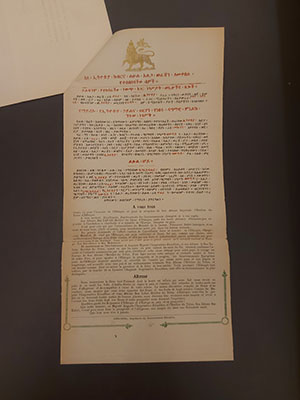
Upon his return to Addis Ababa on 4 September 1924, Ras Tafari was welcomed as a hero. In the archives of the Belgian Ministry of Foreign Affairs, we found the original document circulated by the Ethiopian court containing the words of thanks of the Minister of War and President of the Imperial Council of Ministers, Fitawrari [14] Habte Giyorgis Dinagde:
To all of you,
gathered here for the honour of Ethiopia and for the reception of His Imperial Highness, the Heir to the Throne of Ethiopia.
To you especially, Excellencies, Representatives of Foreign Governments, and to you, subjects.
His Highness, Ras TAFARI, Heir to the Throne of Ethiopia, having departed from the Ethiopian highlands to respond to the most charitable and gracious invitation of Europe, now returns in peace.
It is for this reason that, through the Minister of War, Fitourari Habté Giorgis, and on behalf of all of us, Chiefs and Army, we express our joy in the following terms:
The guiding thought and continuous effort of the unforgettable glory and light of Ethiopia, Emperor Menelik II, was that Ethiopia, his verdant and blossoming country, should be united, like a chain, with the Sovereigns of Europe and neighbouring States, and allied by a strong and indestructible friendship, more precious than gemstones and diamonds. You know that it was for this great work that he often sent His Excellency Ras Makonnen to Europe.
And now, Your Most Gracious and August Majesty, Empress Zauditu, and His Highness Ras Tafari, Heir to the Throne, having seen that the friends of the son, desiring to confirm the friendship and intimacy begun by their father, have decided upon this singular but genuine friendship and bond of His Highness the Heir to the Throne in Europe. To revive this ancient and true friendship and alliance of our Father, and to add prosperity and progress to Ethiopia, the Governments and peoples friendly to Ethiopia wish to demonstrate the sincerity of the friendship that has long existed between us and them, to receive His Highness the Heir to the Throne with radiant joy and enthusiasm, and have shown, as in a mirror, the grandeur and strength of their friendship. That is why all of Ethiopia, through the voice of her Light, the August Empress Zauditu, offers them her most distinguished recognition.
Your Highness,
We thank Almighty God, whose goodness is infinite, who allows us to see each other again in peace and health. The City of Addis Ababa, where peace and friendship prevail, sends forth on all sides its cries of joy and sympathy at your return. Even the season itself, filled with flowers and greenery, shows us that you bring us the flowers and fruits of Ethiopia.
As Her Majesty the Empress Zauditu and you, His Highness Ras Tafari, Heir to the Throne of Ethiopia, are the guarantors or the harbingers of good words, we earnestly desire that all our efforts may produce the good fruits in which you flourish and prosper, in deeds and in bounty.
May God keep the Kingdoms of Ethiopia and of Europe in peace and prosperity!
May our light, Her Majesty the August Empress Zauditu and the Heir to the Throne, His Highness Ras Tafari, live for us in prosperity and joy, a long life in flourishing health.
May their name live forever.
To be continued...
[1] Excerpt from "Le Ras Taffari régent d'Éthiopie", published in L'Avenir du Luxembourg on 22 May 1924:
It was in August 1923 that a delegation came to Geneva to request the admission of the empire into the major international organization. The Belgian delegates declared themselves in favour of this request. Mr. Hymans, who chaired the commission responsible for its review, gave it his full support. The intervention of our country had a considerable influence on the final vote, which admitted Ethiopia into the League of Nations.
[2] Amharic for "lord or master of the pages", a high court official responsible for managing the palace. The title was later also used as an honorary designation.
[3] My Life and Ethiopia's Progress
[4] At the beginning of the twentieth century, the Concours Hippique in the Parc du Cinquantenaire in Brussels was a prestigious event held in the Halle du Cinquantenaire, today's Autoworld. These competitions were organized by the Société Royale Hippique de Belgique and were of great significance for Belgian equestrian sport.
[5] Wilrijk Station was a railway station on line 27A in the Wilrijk district, on the Bist south of Antwerp. Of the station, which closed on 29 September 1970, only the forecourt remains, at Jules Moretuslei 245–265.
[6] The Grand Hotel Terminus on Pelikaanstraat in Antwerp was a historic hotel dating from 1902, designed by J. Hertogs on the site of the former inn De Pelikaan. The striking Belle Époque building near Central Station, renowned for its luxurious interiors, was demolished in the second half of the twentieth century to make way for office buildings.
[7] See note 55
[8] Formerly: Société Auxiliaire de la régie des Alcools en Éthiopie
[9] The Comptoir Européen was active in trade between Djibouti and Abyssinia. According to the Annuaire des Entreprises Coloniales (1937), the company maintained comptoirs in Dire-Daoua and Addis Ababa and was engaged in the commercial exploitation of Abyssinia. It exported coffee, wax, hides, and goat and sheep skins, and imported cotton fabrics, building materials, hardware, glassware, and other colonial trade goods. From Djibouti, via the railway to Addis Ababa, it acted as an intermediary in regional commerce.
[10] A 47 mm Cockerill Nordenfelt M85
[11] The later Royal Museum for Central Africa
[12] Nickname of a local figure.
[13] The Little Corsican, one of the nicknames of Napoleon Bonaparte.
[14] A military title referring to the commander of the vanguard of a traditional Ethiopian army. The rank is roughly equivalent to that of a baron.

About the author
Jah RebelMore Less
Together with Jah Shakespear, one of the founders of Reggae.be, he first started as a critic and a reporter before in the end of 2014 becoming editor in chief. Divides his time between his two passions: music and Haile Selassie.
Published
July 21, 2026