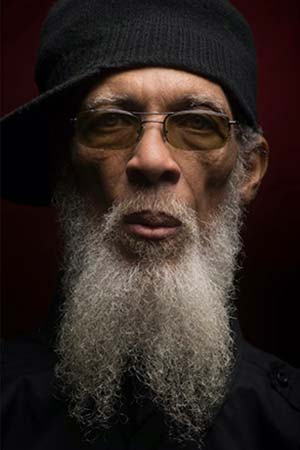
Oku, first and foremost, allow me to express how truly overjoyed we are, finally being able to see you perform at the Reggae Geel festival.Oku Onuora: "The feeling is mutual. I always find it good to go to new places and interact with different people. It's all about spreading the word, making people aware as much as I can. I'm not a prophet, nor a preacher, but I express myself best through my poetry!"
You got a lot of your early education from a guy called Negus. What can you tell us about him? What kind of person was he?Oku Onuora: "Negus was an awesome person! He was a pan-Africanist and when I initially met him, he was still illiterate, couldn't read nor write, but he taught himself and subsequently set up a school called Tafari, as he saw the value of education. He was one of my earliest mentors who guided me and helped me become aware of what it means to actually understand what is going on instead of just being frustrated or angry with a situation. He taught me to analyze things and find out what is at the root of certain issues. You can't come up with a solution if you don't know the cause. He also showed me the importance of interacting with youths, and I've been defending youths ever since! The children of today will eventually become the men and women of tomorrow, so I can't stress enough how important it is that we educate the youths of today so that we can have a better tomorrow."
Even though you didn't exactly come from marginalized surroundings, something must have sparked inside of you, triggering a fire or a fury that's never quenched since.Oku Onuora: "I actually came from a working-class family. My mother was a factory worker, but I had everything my heart desired because I was an only child until the age of fifteen. I definitely had stuff that I saw my peers didn't have, like television for example. I remember putting our television on the veranda, so my friends could come and watch as well and we could have our own little movie theatre so to speak! (laughs) I also always wore clean clothes, never patched up, like I saw many of my friends wear. So, yes, I was definitely well taken care of. But my mother was also the kind of person who couldn't stand to see other people suffer, and was constantly helping out wherever she could. I'm an extremely sensitive person, so I very quickly picked up on that, and growing up, seeing what was going on all around me - people sleeping on the sidewalk, eating out of garbage bins and so on - this all-enveloping injustice instilled a fury inside of me. At that time the pan-Africanist movement was on the rise and the Black Power movement in the US was at its peak, so I started drawing inspiration from what those people were saying and doing. To be honest at that time I was convinced the only real change could come about through armed struggle and revolution. Che Guevarra was my absolute idol. With age I've come to realize that's is about more than physical revolution and that ultimately, we'll also need a spiritual revolution to bring about change. Changing the minds of others is what is hardest, so it definitely needs to be our focus. You can liberate the body and bring about physical freedom, but if the mind, the spirit and the soul aren't liberated as well, you'll still be living in captivity."
Having taken up the true revolutionary lifestyle, you were eventually convicted to fifteen years imprisonment and twelve lashes for the armed robbery of a post office. Even though you got the sentence reduced to ten years imprisonment and two lashes, I was still quite shocked to read about the lashing system. When was this form of corporal punishment finally abolished in Jamaica?Oku Onuora: "It's actually still in the penal code! It's never been taken out, but they have reformed the penal system in Jamaica. I believe the initial severity of the punishment was because I was described by the police as a revolutionary, and the system didn't take too well with that! (laughs) From my perspective, I was given that sentence to discourage others from following the same path, thinking they could overthrow the system. As you stated, I eventually got the sentence reduced to ten years and two lashes, but I got those lashes none the same."
It was while in prison that you first took up writing. Am I right in assuming that the fact of being able to express yourself in words and putting them to paper, act as a sort of catalyst for the anger you still fostered?Oku Onuora: "Oh definitely! It was a release, a catalyst for my anger. You have to know I managed to escape prison twice, the second time I'd even got shot by the police, and after that I started using writing as a sort of therapy. If you read my first collection of poems called 'Echo' (Sangsters, 1978, red.), there's no poem in there that speaks about prison, except in an indirect way, like 'Last Night'. At one point my poems were confiscated by the prison authorities and when I was summoned to appear in front of the superintendent, he didn't quite grasp what I was writing about and he asked me why I was going on about blood and violence so much. The poems I wrote in that period were mostly about the life path and the causes that led youths to serve time in prison, things like poverty, unemployment, lack of education and so on. So even though I was in prison myself, I was writing about the conditions on the outside of those prison walls!"
To get those first poems published, you first had to work out a way of getting them out of prison, which you did by setting up a whole system of people you trusted, starting with your mom, then there was Barbara Gloudon, who was a journalist with The Gleaner, a Rasta brethren you met in jail called Alric Denham, to Jamaican actress and radio personality Leonie Forbes, who finally brought them to the attention of Mervyn Morris, who became known as the first Poet Laureate since Jamaica gained independence. I couldn't help but being reminded of the underground railroad system that was used to smuggle slaves to freedom.Oku Onuora: "I'd say the system was definitely akin to that, yes. At first, I would write my poems and keep them, but the prison authorities would often raid my cell, seize them and subsequently refuse to return them to me. To avoid that from happening, I tried to rewrite as many as I could from memory and started smuggling them out of prison through my mother, who then stored them at home. Now I'd written a letter to Barbara Gloudon once, because as you mentioned she was a journalist and had a weekly column in the Saturday edition of The Star called 'Stella', which she mainly used to make socio-political comments about the situation in Jamaica, and I liked her work. That letter was also smuggled out of prison, so even though she wanted to, she couldn't reply to me just by sending me a letter back. Now I'd gotten close to Alric Denham when we'd spent some time together in jail, so after he go out, he went to see Barbara and that's how the whole ball got rolling. My mum would get my poems to Barbara, who'd pass them to Leonie Forbes, who in turn brought them to the attention of Mervyn Morris. Mervyn has been very instrumental in getting 'Echo', that first collection of my poems, published while I was still imprisoned."
Then at one point you were presented with a typewriter by none other than Judy Mowatt.Oku Onuora: "Like many other people, Judy became aware of my poems at one point, somehow found out where my mother lived and decided to provide me with a typewriter. It was of course also through my link with Judy that my relationship with Bob Marley came about."
During your incarceration you also got to perform alongside Light Of Saba.Oku Onuora: "Yeah, that was during the Christmas season. The prison authorities would usually treat us to some kind of surprise and that year it was a concert by Light Of Saba. But my fellow inmates insisted I'd do some of my poems on stage and the prison authorities eventually gave in, so that's how I ended up sharing the stage with Light Of Saba. Whenever I'd write a new poem in prison, I would get up the next morning and recite it to some of my fellow inmates. Eventually they got so used to it, that whenever I would come out of my cell, they would ask me for a new poem. These people were really my first source of inspiration and encouragement."
It was also while still imprisoned that you got permission to do a very first live reading of your poems at a place called Tom Redcam Library back in 1977.Oku Onuara: "Yeah, that's where the headquarters of the Jamaica Library Service were located. For me this was a very symbolic place to do my first public reading and it was organized by an organization called P.E.N. (Poets, Essayists and Novelists, red.). At the time I was still incarcerated, and since there was no possibility for parole at the time, me being able to do this as a prisoner felt like a landmark moment!"
That same event also led you to cross paths with another foundation dub poet, Mikey Smith.Oku Onuora: "Mikey was indeed present at that reading, and when I finished reciting my poems, he approached me and told me he was also a writer and a poet. I then invited him to visit me at the Fort Augustus prison, which at the time was used to incarcerate prisons serving short term sentences. I'd been moved there because in Spanish Town there had been two consecutive riots, I'd both been involved in. Nothing malicious, as prisoners we were just trying to improve our living conditions. Mikey and I got to know each other better and after I was eventually released, I started attending the Jamaica School of Drama (now part of the Edna Manley College of the Visual and Performing Arts, red.), where he was also enrolled."
How do you remember him? What kind of a person was he, as he supposedly suffered some mental issues?Oku Onuora: "First and foremost, I'd like to say Mikey was an awesome poet and a real word-Smith! And regarding his mental issues, I don't think I'm well placed to address that, but what I can say is that Mikey was an individual who was really infuriated by the injustices of the system. He would always speak up against those injustices and what eventually led to his death was the fact he'd heckled a JLP party member who was having a political rally in Stony Hill (Saint Andrew, red.). Ironically enough Mikey ended up being stoned to death in Stony Hill on the birthday of Marcus Garvey!"
The funny thing is that at one point Linton Kwesi Johnson offered to produce your first album, but you turning him down, he then turned to Mikey, which eventually led to his 'Mi Cyaan Believe It' debut album being released by Island Records.Oku Onuora: "(laughs) Yes, I was approached by Linton with an offer to produce my first album, but I turned him down because I felt I didn't forever want to be under his shadow. It wasn't a matter of ego, it's just that I felt and still feel that our styles are totally different. As I would put it: Linton Kwesi Johnson is a reggae poet, whereas I am dub poet!"
From your enrollment in the Jamaica School of Drama came the fact that you remained involved with theater and playwriting for the rest of your life. What did you find there, that you wouldn't necessarily find in poetry?Oku Onuora: "Well at one point during my prison sentence, I was reprieved by the Governor General of Jamaica, but on the condition I would find a job or get enrolled to further my education. I decided I didn't really want a job at that point, as I felt a simple nine to five would feel too constrained. I'm too rebellious to follow instructions on a daily basis. (laughs) I decided on drama because while in prison I'd already written a play called 'Confrontation', which went on to win first prize in a playwriting competition and was eventually produced as a radio play by the now defunct Jamaica Broadcasting Corporation or JBC. For the very first time the production wasn't staged at their radio studios, but in prison with a cast consisting of both prisoners and outside actors. This actually forced the prison authorities to really take my work serious and it got people on the outside involved and make them get more involved with the plight of the incarcerated. Ever since I've felt that putting on plays was a great tool in opening the eyes of people and helping others."
At that stage you were still publishing under your birth name Orlando Wong. When did that change to Oku Onuora?Oku Onuora: "It changed when I met the woman would later become my wife. She was part of a theatre group called Jamaica Theatre Play House and they staged a play using some of my poems. She was a member of the cast and when we finally properly met after I had been released from prison, I quickly noticed she was a fiery woman. We fell in love and got married and I have to admit she was really the one who instigated me to change my name. I gave the idea some thought and said: "Why not?", because a name is a symbol and symbols are powerful. In searching for a suitable name, I did a concert at what was then still the Cultural Training Center, which housed the drama, music, arts and dance departments, where at the end of the school year they would host a closing event. When I came off stage that night, I crossed paths with Umona, an African professor who taught at the school and he told me: "You're Oku Nagba Ozala Onuora, the fire that burns in the desert, the voice of the people!". Oku Nagba Ozala means "the fire that burns in the wilderness or desert" and Onuora means "the voice of the people". So that's how I got my new name."
When you started working on your debut album 'Pressure Drop', now a dub poetry classic, was it a conscious choice to work with a team of young upcoming musicians instead of seasoned veterans?Oku Onuora: "That was a deliberate choice, yes. I'd worked with people like Steve Golding, Aston 'Familyman' Barrett, Carlton Barrett and Ibo Cooper, all seasoned musicians, but the idea I had for the album was something new and from experience I know these veterans can sometimes be somewhat set in their ways. So I decided to surround myself with young openminded and enthusiastic musicians. I'm glad to be able to say that a number of them have gone on to become quite renowned people in their fields of expertise. Like Courtney Panton, for example, a great bass player who used to work with Shaggy and is now touring with his sons as New Kingston."
The short version of the band's name was AK7, an abbreviation of Armageddon Knights Column 7. What did that stand for?Oku Onuora: "Well the association with the AK47 rifle is quickly made, so it was really poetic wordplay to make my band my musical assault rifle! (laughs)"
You quit the music business for quite some years. What motivated you to give things another go?Oku Onuora: "I quit because I didn't like what was happening in the music business, but politically you also had this surge to the right and in some cases even the extreme right. You had people like Ronald Reagan in the US, Margaret Tatcher in the UK and Jean-Marie Le Pen in France. In Jamaican music I saw this same negativity reflected in dancehall culture, which was becoming increasingly popular at the time. I just decided to take a step back. However, in recent years I've seen the situation in Jamaica going from bad to worse, and I couldn't just stand by and watch from the sidelines anymore. I've always been very vocal about the conditions in my country in particular, but also the world in general, and I do that best through my poetry. So after nearly two decades of not performing, not recording and not doing any interviews, I decided it was time for my voice to be heard again. In reality I actually never left, because my music was still being listened to and my poems were being read."
For your new album 'I've Seen', you joined forces with Fruits Records from Switzerland.Oku Onuora: "Well it was actually Thomas 'Doctor T' Lautenbacher who first approached me and told me he was introduced to reggae music and dub through my poetry and Lee 'Scratch' Perry's productions. He was in a band called The White Belly Rats and they already toured and recorded with Scratch. My last album, 'A Movement', with Monty Alexander playing piano on the title track a cover I did of Bob Marley's 'Running Away', dates back to 2013. It was only released digitally by Zojak World Wide and didn't really feel like an album to me. As I was spending a lot of time in New York, I was just doing some recording with Courtney (Panton, red.) and together we revisited a number of my older poems I'd done for 'Pressure Drop' and 'Bus Out', poems that had no music to them on the original albums. It was just a bit of experimenting, flexing my musical and poetical muscles. (laughs) In 2017 I decided the time for a new album was ripe and when Thomas approached me, we talked for several weeks and in the end, I decided to give him a chance. He then invited some musicians from Najavibes, who did a truly excellent job, but as far as I'm concerned Doctor T is really the mastermind behind 'I've Seen'."
You're often credited as being the one who first coined the term "dub poetry", but I gather you don't fully agree?Oku Onuora: "(laughs) Honestly, how can you coin a term like that. First there was dub, like in dub music, dubbing, dub plates and so on… Now Linton said he had used the term in describing deejays in an article he'd done for a magazine called Race Today, but I live in Jamaica, I wasn't aware of what was going on in the UK. When I was asked how I would describe my poetry I replied: "It's a process of dubbing, it's dub poetry!", because I didn't want my poetry to be associated with traditional poetry from the likes of Chaucer, Longfellow, Shakespeare and what have you. If you look at what I was doing, I was literally dubbing traditional poetry and making it truly Jamaican, by putting a rhythm to it. When I recite my poetry, even without music, you'll still here that rhythm. If you then still add music, the mix is complete. It was a process of dubbing out unconsciousness and dubbing in consciousness, hence dub poetry! But I never ever claimed I coined the term first! When 'Pressure Drop' was released (Heartbeat Records, 1984, red.), Jean 'Binta' Breeze, Mike Smith, Linton Kwesi Johnson and Mutabaruka all already had albums out there, but I was the first amongst all of them to use harmony singers on a dub poetry album! It featured poems without music… None of them had dared or thought to do that! I used nyahbinghi rhythms, which was also something new. And with a piece like 'Thinkin'' I even threw some jazz in there! I dub it every which way!"
Earlier you mentioned 'Last Night', a poem from your first collection of poems, 'Echo', which, together with 'I've Seen', the opening and title track of your latest album, is in reference to the moon, begging the question if you feel you have come full circle? In itself also another nice reference to the lunar cycle…Oku Onuora: "Over the years I've done several poems in reference to the moon. I've always been fascinated by the moon, and as I state in 'I've Seen', no matter how many moons I've seen, I'm still in awe of her beauty!"
Foto: ©
Fernando Hevia 
.Dl7BAwhJ_ZJXLLF.webp)