.Dl7BAwhJ_bSbwe.webp)
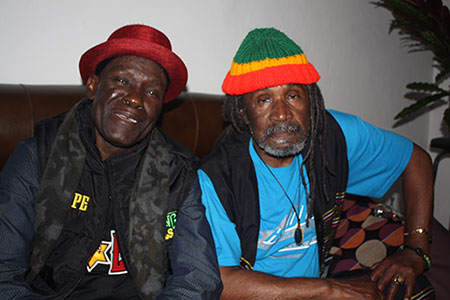
Pipe, Bread, I wanted to start off with some pre-Wailing Souls questions, starting with you Pipe... You started off in music as a member of an outfit called The School Boys.
Winston 'Pipe' Matthews: "Yeah, The School Boys was basically a duo featuring myself and a gentleman called Colin Johnson. Back then we were both still in school, hence the name The School Boys. We recorded for Prince Buster, and 'Little Dilly', a tune we did for him went straight to number one! Unfortunately, our parents made us split up and soon after Colin moved away to the US. That's how the whole Renegades story got started..."
Lloyd 'Bread' McDonald: "Even though we were known as Wailing Souls from day one, the reason why we also performed as The Renegades in those early days is because we were told the name was causing confusion with that of The Wailers or The Wailing Wailers as they were still called at that time. It was really Coxsone Dodd from Studio One who came up with the idea, and he even changed it to The Classics at one point, but in the end the Wailing Souls name was the one that stuck!"
Even though Coxsone claimed there was confusion with The Wailers name, The Wailers themselves never seemed to take issue with you guys being called Wailing Souls.
Bread: "No man, cause we were all brethren you know, living in the same yard, sharing the same house, both tutored by Joe Higgs. We were just good friends, and I always saw Bob as a bigger brother to me and Pipe."
Pipe: "We would cook, eat and sing together all the time, pondering about the future and how we could make this music of ours go internationally."
Bread: "Then Bob established his Tuff Gong label and we even ended up doing backing vocals on songs like 'Trenchtown Rock', 'Lick Samba' and 'Guava Jelly', and they returned the favour when we recorded 'Harbour Shark', 'Walk Walk Walk', and 'You Should've Known Better', which all appeared on the Tuff Gong label. As a matter of fact, 'Trenchtown Rock' was actually written at Pipe's place on 1st Street, which was sort of our base of operations as all our instruments were stored there."
Pipe: "I still remember I would be cooking food every day, cause they would always bring some to share. And we used to hang out together, reasoning, eating, playing music until the wee hours of the morning when they would head home! As Bread already mentioned, our joined mentor was Joe Higgs and he basically taught us two important things: firstly, the business side of music, making sure we always registered our songs as they would basically provide us with a pension later on, and secondly how to harmonize or sing lead properly. At that time, we were still youngsters, just doing what we loved most, but looking back on things now, Joe's lessons have proven to be very valuable indeed!"
Was it also Joe Higgs who introduced you to the livity of Rastafari?
Bread: "Not really, you know, living in Trenchtown you were literally surrounded by Rastafarians, going from well-known people like Mortimer Planner to lesser-known elders who could quote the Bible from beginning to end! Trenchtown was not only a musical place but also a spiritual environment in those days. We always said Trenchtown was a university and a college rolled into one! But it was a hard place as well… You literally had to fight to earn your spot, whether it be a place in a game or to able to walk around without being mugged. It's still one of the roughest ghettos around!"
Pipe: "At the same time the place seemed to be brimming with musical talent…"
Bread: "In those days even if you weren't born in Trenchtown, if you wanted to make it as a musician you would at least have to pass through the place."
Wailing first scored a string of hits for Studio One but eventually moved on to Channel One. Is it fair to say that it was those Channel One tunes that catapulted you guys into international fame?
Bread: "Well, yes and no... The songs we did for Mr. Dodd, tunes like 'Mr. Fire Coal Man', 'Row Fisherman Row' or 'Back Out With It', already did very well in the UK and established our name over there. JoJo Hookim from Channel One was clever in the fact that he had us redo a lot of the riddims we already recorded for Coxsone. Like 'Back Out With It' for example, which was turned into 'Things And Time', which grew into one of our most well-known hits. After that, big tunes like 'War', 'Jah Jah Give Us Life To Live' really pushed us into the forefront. Another factor is that when we started at Channel One, was around the same period we were picked up by Greensleeves Records and Island Records, so instead of releasing single after single, we started focussing on putting out albums, and that's always been a more international market! "
At one point, you guys moved to the US. What prompted that move?
Pipe: "Well it never was a pre-planned thing or nothing. The competition in the music business in Jamaica just kept getting bigger and musically the vibes a yard were changing. We still did the 'Stormy Night' album for King Jammy, and then Bread left in January and I followed in February of 1988. I still remember quite well, cause later that same year Jamaica was hit by hurricane Gilbert! Natural mystic as they say."
Bread: "Being that we had become a band that was more popular abroad than in Jamaica itself, practically it also made sense as every time we wanted to tour, we had to go to the lengthy process of applying for international work permits - which were and still are often denied - and moving to the US made that part much easier."
Pipe: "It was never a money thing though, cause we were always in it for the love of music. Wailing Souls are musical messengers, and in order to be able to spread that message we had to make sure there were as little obstacles in our way as possible. So, in that perspective, moving to the US was a good practical solution."
As the saying goes: "The proof is always in the pudding!", and you guys did just that with the release of the 1992 album 'All Over The World'.
Pipe: "Yeah, our first Grammy nominated album! Blessed album that one... It had a somewhat more mainstream sound, but still provided us with a couple of strong hits like 'Shark Attack' or title track 'All Over The World'. But it did get us some criticism as well, because some people refused to believe that Jamaicans could sound like that, so we had to do some live showcases to prove it was definitely us! (laughs) But a few years later we did 'Psychedelic Souls' (Pow Wow Records, 1998, red.), which was an album full of reggae cover versions of well-known classics from pop and rock history. We've never been afraid to experiment a little."
Bread: "Of course that was also the time we were signed to Columbia Records, which is one of the major record labels out there, so we didn't always feel we had full creative control over the music we were putting out. Even with 'Shark Attack'... I was trying to convince them that track should be the first single coming from the album, but the producer kept on insisting on 'All Over The World'.
Pipe: "Three of the songs from the album, 'Wild Wild Life', 'Picky Picky Head' and 'The Love You Want' were picked up for the soundtrack of the 'Cool Runnings' movie the next year, so that gave the album an even bigger boost."
Apart from music, another passion you guys have in common is sports.
Pipe: "Yeah, that's just yet another thing we inherited from our Trench Town days... Every day we would play sports, be it cricket, soccer or even an odd match of volleyball and it stuck until this day!"
I can't forget to ask you about your nicknames, Pipe and Bread. How and where did you get them?
Bread: "Well, mine came from the fact people used to dare me to do things, like jump a fence or something, and I would always reply: "That's a piece of bread man!", twisting up the old saying "a piece of cake". I would say it so often that one day one of the elders just told me: "You know what, from now on we'll just call you Bread!" (laughs)"
Pipe: "As for me, I was born in what is now known as the Culture Yard in Trench Town. I later wrote 'Down On The Rocks', from the 'On The Rocks' album (Greensleeves Records, 1983, red.) about that time, telling the tale of sixteen families sharing one yard (lyrics). Now the elders living there would hold a talent contest almost every night and whoever won got a Jamaican dollar as prize money. I would often participate and almost win the dollar each time, drawing a lot of attention from the girls in the yard. (laughs) Now one night this fellow called Mr. Gordon came up to me - I'll never forget him - and told me: "Boy, you're like the pied piper! Every time you sing, the yard is full of people and you always go home with the dollar.". Some people think I got the name because I used to smoke herb from a chalice or ganja pipe, but that's not the true story! In Trenchtown everybody has a nickname… Most of the time you won't even know someone's real name! (laughs)"
Have you guys always intentionally focussed on turning out conscious music?
Pipe: "Well, when we write songs, we try to keep the people in mind that have to listen to them. We've always stayed away from using obscene language and stick to positive messages. Our lyrics have to mean something! We proud ourselves of the fact our shows are for all ages. That's the way we were taught; we just don't sing about certain topics or use a certain type of lyrics, because those kinds of things won't feed the people's minds. We want to elevate the minds of the people and bring them joy and happiness. It's all about spiritual vibrations, not about scoring hits. We never worshipped money; it's all about our love for the music and the people! So, when you listen to our music, remember to listen to the words as well… Wailing Souls is word, sound and power, you know!"
Foto: © Fabrice De Smedt