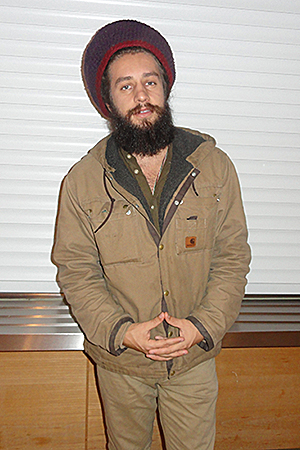
Met 'Rhythm Of Serenity' heeft Marcus Gad net een absoluut pareltje van een reggaealbum afgeleverd, dat dankzij de samenwerking met Zion I Kings waarschijnlijk vooral liefhebbers van de sound uit de Virgin Islands zal bekoren. Wij haddden een boeiend gesprek met de man dat ons van Nieuw Caledonia via Frankrijk naar Mali bracht om te eindigen in India en op de Maagdeneilanden!
Marcus, you've been living in France for some time now, but originally you hail from the archipelago of New Caledonia, a place not everyone might be familiar with, so could you start by telling us a bit about your home country?
Marcus Gad: "It's a place I can't really describe in a few words… Even though many people might never have heard about it, it's still a French overseas territory (in French: territoire d'outre-mer or TOM, red.), but as almost half of the population of the islands is still native and tribal, culturally it couldn't be more different. The islands making up New Caledonia, one big island called Grande Terre and five smaller ones, count around 380 different tribes and 27 languages, combined with people who have moved there from other places in the world, and that makes up a unique blend you can only really discover by travelling all the way over there!"
In November of 2018 an independence referendum was held, in which voters were given the choice of remaining part of France or becoming an independent country. The majority of the votes eventually were for maintaining the status quo. Why do you think that was and where do you stand in the debate?
Marcus Gad: "We'd been waiting for this referendum for a long time and for most of the native New Caledonians, or Kanak people as we are known, the result came as a big surprise and disappointment. The results were almost fifty-fifty (56.4% for maintaining the status quo and 43.6% in favor of independence, red.), so really close for either side. The majority of the population of New Caledonia is concentrated in and around Nouméa, the capital, and there people massively voted against independence. I think it will happen eventually though; it's like water from a river running to the ocean, you can try but in the end there's nothing you can do to stop it."
Geographically speaking New Caledonia is just about as far removed from Europe as it is from the Caribbean, but still reggae is almost like the national music on the islands. How do you explain that?
Marcus Gad: "I guess there are diverse reasons, but personally I think first and foremost it's the island vibe we share with Jamaica. Apart from that a lot of reggae music is quite revolutionary in nature and given the political tension in New Caledonia, the freedom fighters and a lot of the Kanak people in general found it to be a source of inspiration, upliftment and rebellion. Quite a number of well-known reggae artists like Burning Spear, The Gladiators, Bunny Wailer, Abyssinians, Mighty Diamonds or Toots & The Maytals, to name but a few, came to play in New Caledonia, and these shows were all organized by the Front de Libération Nationale Kanak et Socialiste or FLNKS, the political party striving for the independence of the archipelago. Reggae has become hugely popular in New Caledonia since. I still remember attending a Burning Spear concert when I was only 8 years old where more than 25000 people showed up! Back then the entire population of New Caledonia counted about 250000 souls, so that number gathered at one concert was incredible!"
On a personal level then, how did you get involved in reggae music yourself?
Marcus Gad: "Growing up in New Caledonia, reggae music was literally everywhere around us, so in some way there was no escaping it… Reggae is played on the radio, on television, on public transport, even inside the supermarkets. A lot of reggae artists visiting New Caledonia are often very surprised when they find out about that, as there is virtually no other place in the world, apart from Jamaica itself, where the genre has become so mainstream. In my teens I started having a bit of a rebellious streak… I wanted the world to change and reggae music quickly became the perfect medium for me to express my frustrations and anger."
Your travels have played a very important role in the development of your music. At which point did you decide to leave New Caledonia to go and explore the rest of the world?
Marcus Gad: "The first time I left New Caledonia was when I came to France to study after I'd graduated high school, but that didn't last for long as I didn't really like studying all that much. I started busking in the streets to make some money and that's how I really learned how to sing properly and perform in front of a crowd. To my surprise I quickly made enough money doing that to allow me to travel, so I packed my bags and the next few years became a constant mix of travelling from one place to another and busking and taking on various other little jobs here and there to make ends meet and travel to my next destination. For me those travels were the life experience I felt I needed to write my songs. I had a lot of things I wanted to write about, things like self-sustainability, communal living and so on, but felt I had to experience them for myself first or at least meat up with some people who had, so I could broaden my message and still sound legitimate."
Your debut album, 'Chanting', was still released as Marcus Gad & Tribe, but for the follow up EP, 'Enter A Space', you joined forces with a young Parisian beat maker called Tamal.
Marcus Gad: "Yeah, I welcome collaborations in all forms and shapes, as long as the vibe feels right. Tamal is my regular sound engineer, so we already knew each other and in fact he was already involved in the 'Chanting' album as well. As the title already suggests, you should view the 'Enter A Space' as a joint auditory trip Tamal and I experienced, trying to achieve something different from what we'd already been doing."
On 'Chanting' you still incorporated some influences from Australian Aborigine music, but the mix on 'Enter A Space' is much more varied, starting with the West-African influences in the form of the sound of the ngoni of Youssouf Diabate in 'Live Up To The Day', and the kora and voice of Losso 'Yelé' Keita in 'Inna Nature'.
Marcus Gad: "Yeah, I really listen to a wide variety of styles of music and I simply adore West-African music like the Malian music that's often referred to as "desert blues". I feel reggae is a genre that lends itself perfectly for mixing it with other influences and in this case it added to the meditative vibe I wanted to create on 'Enter A Space'. Take adding the ngoni in 'Live Up To The Day' for example, just doing that suddenly transports the listener to a whole different place and that's exactly my intention!"
You travelled all the way to the holy city of Varanasi in India to shoot the video for 'River'. That's a huge undertaking, so I imagine you already had that in mind when you composed the song?
Marcus Gad: "Yeah, absolutely! The lyrics of 'River' were inspired by the Hindu Advaita Vedanta philosophy, which also stems from India. Basically it's a non-dualistic philosophy which does not believe in the finality of death, so in that sense it's really close to Rastafari. Not surprising really as Rastafari was greatly influenced by Indian philosophy, especially in its early days. Indian workers had been brought over to Jamaica and Leonard Howell crossed paths with an Indian guru and eventually ended up with the Indian nickname Gong Guru Maragh. But it continues all the way up to Peter Tosh, who had a song called 'I Am That I Am', which is a typical Advaita Vedanta saying. What Advaita Vedanta also states is: "You are not this body!", meaning your body is just a vehicle, it does not define who or what you are. You're not even your mind, because that's the product of your brain, just a transient spirit or soul which isn't born so can't die either. This life is just an experience, there was something before and there will be something after it as well. I've personally found a lot of truth in Advaita Vedanta, which led me to writing the song 'River', already having images of Varanasi in mind. I had visited the city before and it's a place where death has a really special aura, as for Hindus it's a very important site to cremate their dead (ceremonies performed on ghats, riverfront steps leading to the banks of the River Ganges, red.). Hindus believe that if they are cremated there they will ascend straight into heaven and escape the cycle of reincarnation. You're right in stating it was a huge undertaking, as this whole 'Enter A Space' project took about two years to complete. Both Tamal and I felt the tunes we'd created all shared something very visual, almost cinematic, so we definitely wanted to give the public something to watch as well as listen to."
From the very beginning your music also echoed influences from the reggae sound of the Virgin Islands and for your latest album, 'Rhythm Of Serenity', you actually joined forces with Zion I Kings.
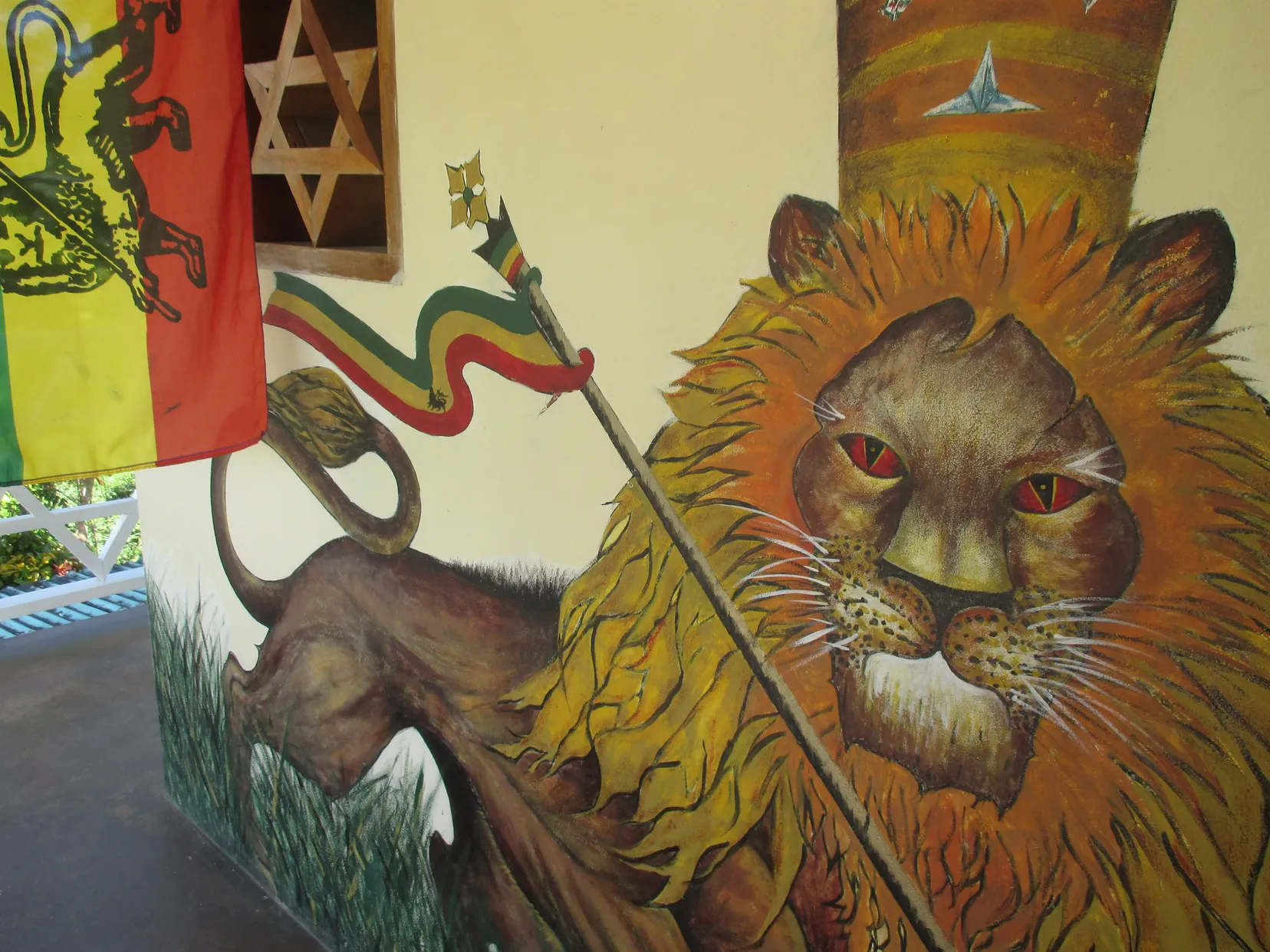
Marcus Gad: "People who know me, will know I see myself as the offspring of Midnite, a band and sound that have had a profound influence on me. In music I'm always looking for spirituality and divinity in music, and reggae has that deep spiritual, sometimes almost religious quality. Over the years reggae music has often been commercialized, and the symbols surrounding it like the use of ganja or the Lion of Judah flags have lost a lot of their symbolic value. But when I heard Midnite, I was immediately blown away again. There was a band that made me feel like someone was still keeping the flame burning! There was a depth to their music I hadn't heard for a very long time. So when I was contacted by Zion I Kings asking if I wanted to collaborate with them it felt like a great blessing and an absolute dream come true!"
Your stage name is Marcus Gad, which is a reference to the Tribe of Gad and I assume the Twelve Tribes movement in Rastafari.
Marcus Gad: "Marcus is my actual birth name, but, as I already told you, I travelled a lot, and one of the countries I'd always wanted to visit was Ethiopia. The first time I visited the country there wasn't even a link to Rastafari yet. I just wanted to explore what was described as being the poorest country in the world, but at the end of my trip I ended up in Shashamane where, for the first time in my life, I crossed paths with actual Rasta's. They taught me about Haile Selassie and the revelation of Rastafari and hearing and learning all that, to me felt like being hit by a lightning beam! The Gad name came through a brethren from Martinique called Ras Mau Mau, who was living in Shashamane. His young son came up to me one day and asked me: "What's your tribe?", to which I replied: "I don't have any idea!", as at that point I didn't really know what he was on about. He asked me what month I was born in and when I told him: "November!", he told me: "Well you're Gad!". From that point onwards it stuck."
In conclusion then: what does Rastafari represent to you?
Marcus Gad: "Basically it's the foundation of my life… Right now we're living in a world of confusion and Rastafari taught me discipline. Sometimes you might have a good heart and be well-intentioned, but because of all of this confusion going on around you, you still might make the wrong decisions. Rastafari is a livity that will guide you in making the right ones. I don't view it as a set of fixed rules, but rather as a collection of heartfelt principles. For me Rastafari has always been like a light guiding me along, showing me what path to follow; call it my lighthouse if you want! (laughs) When you're caught in yet another storm, all you have to do is aim for that light. Apart from that, it's also about bringing about change through positivity, humility and doing the right thing for mankind as well as the planet we live on!"

.Dl7BAwhJ_ZJXLLF.webp)