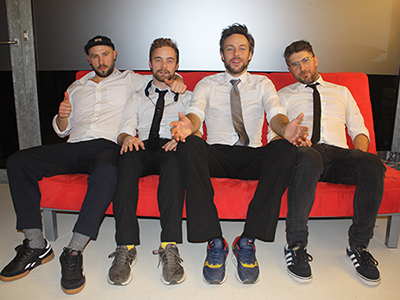
Zowat een jaar geleden was het Britse Gentleman's Dub Club al te gast op Unity in Turnhout en dat optreden moet blijkbaar in de smaak gevallen zijn want op 13 maart aanstaande staat de achtkoppige band alweer in Het Depot in Leuven. Als smaakmakertje alvast onderstaand gesprek met vocalist Jonathan Scratchley en bassist Toby Davies!
Jonathan, Gentleman's Dub Club basically started out as a bunch of college mates starting to play dub and reggae music together.
Jonathan Scratchley (vocals): "Yeah, we all met up in Leeds… There's a couple of guys in the band who already went to school together before that, but basically it was when we got to Leeds and fell in love with dub music. We were all musicians in our own capacities playing various styles, but we were all kind of mesmerized by that dub sound we discovered and it seemed like a nice idea to get together to try and create our own version of it."
Toby Davies (bass): "As Jonathan just said, when we were younger, we all played various genres ranging from classical music over punk and rock, but it all kind of started to crystalize when Johnny, Niall (Lavelle, percussion & samples, red.) and myself got a synth, a drum kit and a microphone, running everything through a mixing desk and starting to experiment with delays. One of our friends called Harry Evergreen owned a big sound system, and we would love to experiment on that as well."
And then there were the regular Sub Dub events in Leeds, organized by Iration Steppas, which had a profound influence on the development of your sound.
Jonathan Scratchley: "Yeah, those were like a full on experience each and every time. Dub dances like that are were the sound system becomes the main focal point of the night. Obviously the deejays and the MC's are important as well, but mainly people come to hear the music blast from a real sound system. There were more places in Leeds were sound system dances were held, but Sub Dub was particularly good for drawing large crowds enjoying a sound system being played in a large space. Iration Steppas would often have guests over, so we'd also get to enjoy sounds like Jah Tubbys, Abashanti-I, King Earthquake, O.B.F. from France and even Twinkle Brothers came down one night and played a sound system set."
Toby Davies: "For me one of the most infectious elements of those nights was the fact it really felt like a community coming together, like a family gathering almost. Often when you go to r&b, hip-hop or even dance club nights it's all about the way you look, dance and wither you're going to hook up with a girl, but in Sub Dub there was none of that."
Logic would perhaps have dictated that if you became that infatuated with the sound system scene, your next move would have been to build your own, but instead you guys opted to form a band.
Toby Davies: "Yeah, surprisingly enough, that was kind of our angle from the start… We all wanted to play live music, but at the same time try and create the same vibe the DJ's in the dub scene created spinning their vinyl on sound systems. We first started out playing sets in-between different deejays at various dub dances, and we could tell straight away the response was completely different, because of course visually as a band there was a lot more going on than when a DJ spins his records. We sort of gave the music an extra dimension I believe and that has worked out really well for us."
Jonathan Scratchley: "To be clear, we had no idea or premeditated plan of what we wanted to achieve. We were basically just messing around and the sound that evolved came naturally."
You named your first album 'FOURtyFOUR', after the place where it all started 44 Headingly Lane. Could you quickly describe what kind of a place that was?
Toby Davies: "Well at the time I was living at that address together with Nile and Johnny lived there for a bit as well, crashing on my floor mostly! (laughs) It was just this huge house in Leeds really. Leeds is a city where it's still quite affordable to find decent student accommodation, especially if you compare it to London for example. The house had about seven bedrooms, but more importantly for us, it also had a basement split into two small rooms with rather low ceilings. We had about 5000 watts of sound in there, spread across the two rooms and we used to host these mad house parties, usually announced on local pirate radio, where we'd get all the DJ's in the Leeds scene playing there. For example we had DJ Rusko come through, who's become quite big now, the guys from Central Beatz as well, who are now all touring internationally. It were house parties, but at a pretty high standard really. That basement sound system is also what we first started playing on and it also doubled as an ideal rehearsal space. With all the parties the place looked like shit and smelled even worse, but it was a great place to experiment."
If I'm not mistaken, you guys have all relocated to London. Does that mean you've become professional musicians now, renting a studio to record? Or did you build your own?
Jonathan Scratchley: "Professional is a bit of a scary word… (laughs) But, yes, I guess you could call it that. Toby's got his own studio, and some of the other guys as well, and we rent out a spaces when we need to rehearse or even record as well. London is just very different to Leeds, but we're also all at different stages in our personal lives."
Has that changed the band's dynamic?
Jonathan Scratchley: "Well, I suppose when we first started out, we would just meet up on a more regular basis just because we enjoyed doing it so much. It's still enjoyable today, but it's all more planned out and strategized now. When we meet up to rehearse now, it's either because we're soon be recording a new album or need to prepare for an upcoming tour, rather than meet up to have a chilled out jam session together. So, yes, the dynamic has changed, but thing is, we play live so much, something we've been doing for over a decade now, so we've definitely put in the graft to become a harmonized group of well-oiled musicians. The experience we now have on stage is pretty similar to the one we had during those early jam sessions in that Leeds basement."
With 'Lost In Space', you've just released your third album distributed by US label Easy Star Records. How did that relationship come about?
Toby Davies: "I can't really remember, to be honest… (laughs) I believe we just contacted them at one stage and when they replied the vibe we got from them immediately clicked. It's really been great working with them and they represent some great artists, so we're delighted to be on that same roster. And obviously with all the Easy Star All-Stars stuff, we were listening to that when we first started playing, asking ourselves: "Who put this together, this is genius!", so to be able to work with them now is still somewhat surreal. We're lucky to have them on board!"
As I just mentioned the new album is called 'Lost In Space'. I was convinced it was a wink at the new Netflix revamp of the nineteen sixties science fiction series, but apparently the real inspiration came from a cartoon series called 'Rick & Morty'?
Jonathan Scratchley: "(laughter) Yeah, exactly, it's an Adult Swim series (the American adult-oriented nighttime programming block of the children's basic cable network Cartoon Network, red.); a quite surreal cartoon comedy show, quite dark as well, but also really clever and at other times totally stupid. It's kind of like a cartoon version of 'Back To The Future' put through a blender or something! (laughs) Anyway, I highly recommend watching it. It delves into the idea of parallel dimensions and different lives that you could have potentially led if things had been different. It's very accessible but quite based in science at the same time. It was actually the psychedelic nature of the show that was our main source of inspiration for the album."
Toby Davies: "The 'Lost In Space' theme also felt like a very natural progression to us, because we started in a basement in Leeds, then moved to London, illustrated by the 'Big Smoke' album (Easy Star Records, 2015, red.), followed by 'Dubtopia' (Easy Star Records, 2017, red.), an imaginary island floating above London, so the only direction remaining was heading into space! (laughs)"
Sound-wise you guys described this album as: "…a space journey in search of a perfect bass line". Did you end up finding it?
Toby Davies: "I think we did, yes, with 'Stardust' we really hit the perfect bass line we were searching for. We went through a lot of different states of mind, but in the end we definitely got there. (laughs)"
Apart from those Sub Dub nights in Leeds, what would you say were your main influences in dub and reggae? What did you guys listen to?
Jonathan Scratchley: "Well, obviously people like Scientist and Lee 'Scratch' Perry and a lot of Adrian Sherwood's stuff as well. I'm really into that psychedelic explorative dub approach, with random sounds coming in from all angles; something that's got a song to it, melody, has a charge and energy, but has also got a freedom. Outside of dub we already mentioned Twinkle Brothers, and I'd also like to mention Israel Vibration and bands like Culture, Black Uhuru, all known for sets which musically could perhaps be describes as being straightforward, but spiritually communicate at a very different level and at the same time are unbelievably energetic."
I just posed that question, because I was wondering about the vocal guests you invited for the 'Lost In Space'; on the one hand there's Studio One veteran Winston Francis and on the other young Swedish dancehall artist Million Stylez. How do you guys chose who to invite?
Toby Davies: "I guess it's just anyone we like and think would sound good on a particular song. On 'Dubtopia' we had Lady Chann, who's generally more associated with grime and dancehall, Million Stylez just has an incredible powerful voice, and of course Winston was just one of our idols we absolutely wanted to work with. So coming to think of it, I guess it can also be a simple excuse to meet one of our idols! (laughs)"
Basically you guys are just a bunch of Caucasian lads from the UK, always performing sharply dressed in tailored suits and turning out albums that don't immediately echo any of the traditional clichés associated with the reggae genre. Is that something you consciously decided to steer away from?
Toby Davies: "Well, for starters, our influences aren't necessarily all based in reggae, so the way we've presented and written everything we've put out so far, is kind of like a culmination of all our various influences and ideas. Music for us is bigger than just one genre. If you think back of rock bands from the nineteen seventies like Pink Floyd or Led Zeppelin, the way they presented themselves was so amazing, so well thought out, using crazy artwork and turning out themed albums. That really appealed to us as well. I guess another major influence has been Mike Pelanconi aka Prince Fatty, who's just an unbelievably good producer and musician. He always comes up with really cool ideas to base his albums around and then proceeds to create the whole esthetic around it. It's that more artistic angle - and I'm saying that without wanting to sound pretentious - that really drives us in our music."
For you guys has it always just been about the sound, the musical sound of things, or have you also picked up on the social, conscious, revolutionary and spiritual message of reggae and dub?
Toby Davies: "That's a good question really… Our music comes from a place of seeking release and escape and you can definitely hear that in the lyrics and the music, but we don't really go into politics or anything like that, because for starters I guess you'd have to be better informed then we are (laughs), and apart from that you don't always need music to go into that direction; it's alright for it to be just about release and fun."
Jonathan Scratchley: "I think it's also about how you want to perceive our music. For me the most important thing is being genuine in what you are doing and singing about, with its worst counterpart being trying to impersonate others. If you can't speak from a place in your heart, there's really little point in what you are doing. If you look at reggae music as a means of communication the life experiences of a certain group of people at a certain time, then I believe that's exactly what we do as well! But we never grew up in the ghettos of Kingston, so it makes no sense for us to sing about the struggle we faced growing up. We'd rather sing about the issues that were and are important to us, things like positivity and staying true to yourself."
In conclusion, who came up with the Gentleman's Dub Club band name?
Toby Davies: "I think it was me, but it was after coming up with like two hundred different other names! (laughs) Gentleman's Dub Club just sound good and cool. Because we went out to different dub nights in Leeds, we actually were like a mini dub club and adding the Gentleman part just made it sound even cooler. The fact we now also dress up in suits wasn't as much a conscious decision as it rather evolved from us looking back at some early live footage on one of our phones, seeing a ragtag bunch of musicians on stage and thinking: "How can we pull this together?". The suits tied in nicely with the band name, but we never intended it to be like a 2 Tone statement, we just wanted to pull everything together artistically."
Foto: © Fabrice De Smedt







.Dl7BAwhJ_ZJXLLF.webp)