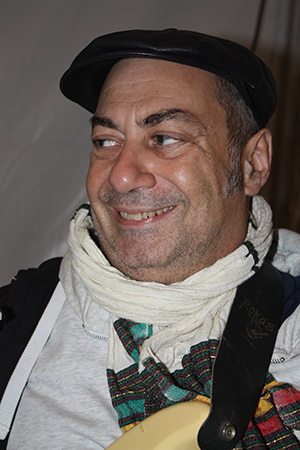
Nick 'Dubulah' Page, de drijvende kracht achter Dub Colossus had de afgelopen jaren af te rekenen met serieuze gezondheidsproblemen en dus werd het noodgedwongen wat stil rond zijn muzikale hobbyproject. Met 'Dr Strangedub, Or How I Learned To Stop Worrying And Dub The Bomb' staat Dub Colossus er nu echter weer helemaal. Hoog tijd dus voor een diepgaand gesprek over deze fascinerende Jamaicaans-Engels-Ethiopische kruisbestuiving!
Nick, way before Dub Colossus you were part of Transglobal Underground, but even that was far from your debut in the music business.
Nick Page aka Dubulah: "No, you're right… I believe I've been doing this for more than thirty years now. Still looking back on that first decade, I can honestly say Transglobal Underground was my favorite project from the ones I was involved in back in those days. The first professional band I was part of was called Bumble & The Beez, apart from myself also including Mykaell Riley (vocals & percussion), Winston Blissett (bass), who went on to play bass for Massive Attack, and two other guys (Dan Lee - rhythm guitar, Simon Walker - violin & keyboards, red.). I was only eighteen or nineteen years old at the time."
Mykaell Riley: "Apart from Bumble & The Beez, we were also in Hybridz together. The line-up of Bumble & The Beez was a bit different… You had me playing drums and singing in front of the stage and behind me there were two guitarists a bass player and a violinist. Nick has always continued the tradition of mixing different cultural influences and musical genres and creating his own personal concoction. During the day I'm a professor at Westminster University, where I'm the head of music production. Music has been a passion of mine for close to forty years now."
Talking Dub Colossus then… How did the idea for the project develop?
Nick Page aka Dubulah: "What happened is that I did a track based on a number of samples from a tune by Getatchew Mekurya, the well-known Ethiopian saxophonist, which I pulled from one of these Ethiopiques compilations from Francis Falsetto. For Transglobal Underground we were basically just cutting, pasting and distorting samples and loops, creating our own stuff, which was basically a budget thing. We didn't have the money to record all these things using live musicians, so we just had to make do, and luckily the technology was there to help us out. Apart from us, you also had bands like The Young Dogs, State Of Bengal or Art Of Noize, who were more or less doing the same thing and reggae-wise you had the whole On-U Sound family. I didn't really want to continue just using samples, like we did for Transglobal Underground, and that's when I got in contact with a guy called Dan Harper who was working for VSO (Voluntary Service Overseas, international development charity founded in 1958 with a vision for a "world without poverty" and a mission to "bring people together to fight poverty". VSO recruits professionals to work as volunteers, living and working alongside local populations in developing countries, red.) in Ethiopia. He had Teramage Woretow (vocals, mesenqo) record a sample for me and then invited me to come over to Ethiopia to meet him and some other musicians in person. I thought to myself: "Well, I have no commitments, so why not…", which didn't turn out to be true as my girlfriend dumped me when I was over there! (laughs). Dan introduced me to a number of great musicians, who in turn introduced me to a bunch of others and slowly I saw a story emerging. Roots reggae is basically the cry of the African diaspora, wanting to return to Africa and, in the case of the Rastafarians, to Ethiopia. With Dub Colossus, I sort of wanted to create the reverse journey; working with contemporary Ethiopian musicians and having them interpret reggae and dub. When I first talked to them about the project they were like: "Yeah, reggae isn't bad, but proper music it ain't!" (laughs), but when I explained to them that some of the Ethiopian rhythms were actually pretty close to reggae, I saw I started getting their attention. It was actually 'Ewnetegna Feqer', a song by Hirut Beqele from back in the nineteen seventies, which made the connection between Ethiopian music and reggae clear to me. Of course Dub Colossus isn't just Ethiopian music, as reggae and dub also play an important role, but for that part I could draw on my own past as I was already a member of a reggae band - imagine the only white kid in an eleven piece reggae band - when I was still in high school in Hackney, east London, which was quite a mixed area back in those days. And apart from that Bumble & The Beez was a reggae band as well. The album that changed my opinion where reggae was concerned - as before that I always kind of disliked the genre - was 'Live' by Bob Marley & The Wailers. These days for me Abyssinians is just about as good as it gets in reggae music. I still regret not having discovered them earlier on in my life. But to me Dub Colossus is also about evolving… There's no point is setting up yet another reggae band playing roots like they did back in the seventies. As musicians we have to progress and try to take what exists to another level and bring something new to the table."
How easy or difficult was it for the Ethiopian musicians you worked with to adapt to the reggae/dub format?
Nick Page aka Dubulah: "Some of them, like Samuel Yirga (piano, red.) for example, were already quite familiar with reggae. I think Samuel was pretty close with some of the Rastafarians living in Ethiopia; in any case he had a lot of respect for their lifestyle. Weed is kind of frowned upon in Ethiopia though, but they all chew khat like crazy. Personally I've given head to Lee Perry's advice and have given up on everything! (laughs)"
For financial reasons you were forced to abandon the Ethiopian part of Dub Colossus for 'Addis To Omega'.
Nick Page aka Dubulah: "Yeah, I basically had no other choice! I don't regret anything, it was a wonderful experience, but at the end of the day the money ran out when Real World backed out, so that was that. I might still be doing a little project with Sintayehu 'Mimi' Zenebe, though. She's relocated to Toronto and has Canadian citizenship now, so that changes things. I mean just arranging the visas and work permits for the Ethiopian musicians took forever. It's getting more and more difficult to bring musicians from so-called third world countries over to Europe or the US. Apart from that, music might be the most important thing in my life and perhaps in yours, but for a lot of people it's just something they have on their phone. Royalties are low as streaming has decimated the artist's revenue!"
Does that also mean that where your live sets are concerned, you don't perform the songs you recorded with them anymore?
Nick Page aka Dubulah: "We still do one or two using samples, but it's kind of difficult to do the others without having the Ethiopian musicians present. It's a bit of a problem, but you can't really sing in Amharic if you don't speak the language. Apart from that we've gone from being a ten, eleven or twelve piece band to only five people on stage, so sound-wise there's also a big difference. The only thing I can do at the moment is play up the Jamaican side, which was also always a part of the Dub Colossus concept."
'Addis To Omega' was really London meeting Kingston. What are your plans for the next album?
Nick Page aka Dubulah: "If all goes to plan, the next album will be a dub version plus some extra's of the songs that made up 'Addis To Omega'. 'Addis To Omega' also featured guests like Natacha Atlas and Albert Kuvezin, who's a Tuvan guitarist and throat singer, which were really a nod to my Transglobal Underground days. For the dub/remix album I'm thinking of adding a few other guests though ('Dr Strangedub, Or How I Learned To Stop Worrying And Dub The Bomb' was eventually released in February of 2019, red.)."
Compared to genres from elsewhere on the African continent - I'm thinking of soukous from The Congo or desert blues from West-Africa - Ethiopian music seems to have taken quite a long time to gain popularity in the West. Why do you think that is?
Nick Page aka Dubulah: "Well, for starters Ethiopia has always had a very insular mentality. Except for the Italian occupation, which only lasted for about 5 years, Ethiopia was never colonized. As far as they're concerned Ethiopian culture is as good as it gets and they don't feel the need to either share their culture or import foreign influences. On top of that Ethiopia is a budding democracy still recuperating from a dictatorial military regime. As a consequence Ethiopians are very cautious in what they will say and for the longest time will remain very formal. To give you an example, going to an Ethiopian nightclub will be a strange experience for foreigners. At first everyone will just be standing there and for the longest time absolutely nothing will happen. Then suddenly shoulders will start moving and seconds later literally everyone will be dancing like crazy. And just as sudden things will go quiet again. To return to your question, Francis Falsetto made it his singular ambition to promote Ethiopian music. If it wasn't for his Ethiopiques series, I think we still wouldn't have heard about Ethiopian music to this day!"
Foto: © Fabrice De Smedt

.Dl7BAwhJ_ZJXLLF.webp)