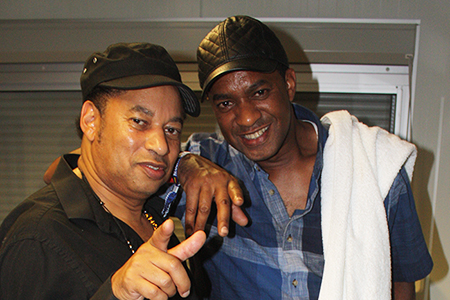
Enkele weken geleden stelden we elders op deze pagina nog 'Saxy Rocksteady' voor, het uitstekende nieuwe instrumentale album van Megumi Mesaku; een langspeler die, niet geheel toevallig zo blijkt, geproduceerd werd door de Brits-Jamaicaanse riddimtandem Mafia & Fluxy. De perfecte gelegenheid om beide broers eens voor onze microfoon te halen!
Mafia, Fluxy, I don't have to start this interview by asking where you met, because the two of you are brothers, but I can ask at which point it became clear to you…
Leroy 'Mafia' Heywood (bass): "That he was my brother? (laughter)"
No, the fact you'd be working together for the rest of your lives?
Leroy 'Mafia' Heywood: "Well, I was 15 when my mom bought me a guitar. I started playing for the school band and at the time a brethren of mine called Chris Mathias was still playing the drums. But when he moved on to play with another band, I asked Fluxy to come in and that's how Fluxy and I started this musical relationship for life!"
How did you switch from the guitar to the bass or why?
Leroy 'Mafia' Heywood: "Well I didn't switch from the guitar to the bass as such… As I just said, my mom bought me a guitar back in 1977, but I kept playing basslines on it."
One of the first things you did together was in a band called The Instigators…
Leroy 'Mafia' Heywood: "Yes, The Instigators basically developed out of our school band when my eldest brother (Dingle Heywood, red.) bought me my first bass guitar."
Was he also in the band?
Leroy 'Mafia' Heywood: He was in the band, as a guitarist, a left handed guitarist as it happens! He had a guitar himself but he had to string it up left handed and gave up after a while."
David 'Fluxy' Heywood (drums): "I still played a homemade drum kit in those days; made up off an odd shaped microphone, a kick drum, the snare drum was a square speaker, and the high hat was a bicycle lamp! I used that homemade drum kit until Dingle bought me a real professional one and Fatman (real name Kenneth Gordon, moved from the Waterhouse area of Kingston to the UK in 196, initially working with Sir Fanso The Tropical Downbeat, selecting music for the sound, but when Sir Fanso packed the sound and left for Jamaica in 1974, Fatman decided to form his own sound system, initially calling it Wild Bells, then Imperial Downbeat, before finally settling on the name Fatman HiFi, red.) became our manager."
Let's dig a little deeper into that relationship with Fatman, because I think he's been quite instrumental in launching your career in the early days.
David 'Fluxy' Heywood: "Yes, he definitely played an instrumental part. If it wasn't for Fatman we wouldn't be here right now! Fatman had the links to the Jamaican connections, like King Jammy, Bunny Lee and so on. It's all a family thing, like a tree with branches, and it all came from Fatman. Fatman played a major part in our career in music!"
I don't have to tell you, you are often called the UK answer to Sly & Robbie
David 'Fluxy' Heywood: "Sly taught me a lot! Sly & Robbie came up with Black Uhuru and they were working at a studio called Easy Street in London and we kind of kidnapped them in my little car, and there's been great mutual respect ever since. Just the other day we were in Jamaica and Mafia didn't have his bass, they rob his bass…"
Leroy 'Mafia' Heywood: "We're like brothers! I just phoned Robbie telling him: "I'm here, do you have a bass that I can use, because I want to do some live sessions...", and he replied: "Yeah man, when do you want to pick it up?", so I picked it up at Anchor Studios and he said: "Just drop it off there when you're finished!". A nice Fender jazz bass he lent me!"
I was also asking because when you guys started your own label, because of that Sly & Robbie connection, you toiled with the idea to give it a name that was a nod at their Taxi label.
David 'Fluxy' Heywood: "Sly & Robbie had the Taxi label and we were going to call our label Mini Cab, which would have been cool with our London connection, but then we thought: "No that's too close… Let's not disrespect these guys, they respect us!". As I just said we're like brothers!"
You've worked on both sides of the ocean, what for you is the difference between the work you have done in the UK and in Jamaica?
David 'Fluxy' Heywood: "We practically live in Jamaica; we have a house in Spanish Town. We go back and forth between Spanish Town and London, so we share the vibe."
Leroy 'Mafia' Heywood: "I would say that the work we do in Jamaica is more on an international scale, it's worldwide and everybody picks up on it. In the UK we mostly work with UK artists and the work is mostly picked up in the UK and Europe."
David 'Fluxy' Heywood: "When it's Jamaica we work with Jamaican producers like King Jammy, Donovan Germain or Bobby Digital, so it becomes more of a worldwide thing. As soon as we land in the Jamaica the word spreads, and our phone starts ringing!"
You guys play anything from roots over lovers rock to dancehall. Is that flexibility or diversity important to you?
Leroy 'Mafia' Heywood: "Well it is! For us it's natural. At the end of the day it's all music. We've done remixes for people like Stevie Wonder, Janet Jackson, R Kelly, Aliyah and they were happy with them. Don't matter where it goes, we play music and we enjoy playing music and the people enjoy and dance to what we do, so what more could one ask for?"
I knew you guys as studio musicians, producers and as a backing band live on stage, but today you were playing sound system style. Is that something that you do regularly?
David 'Fluxy' Heywood: "No, sound system is like "playvertism" for us; just another way to express ourselves. Every time we would be recording with an artist we'd ask them to voice us a special, so over the years we've amassed a lot of those and playing them sound system style is just another way for us to express our love for the music."
I used to be a regular at the annual Brockwell Park festival (in Lambeth, just outside Brixton in South London, red.) where you backed almost every artist. That must take something out of a person, playing that long, hours on end?
Leroy 'Mafia' Heywood: "Well you must remember we come from years back. This is all natural for us. We know their songs from way back. We grew up on their songs. And then you have another set of artists, which are the new artists where we have to rehearse their songs as well. It's not a problem you know, we just make time for rehearsal, get on with it, it's a job, a musician's job. If you're booked for a job you have to do the job. You don't say: "Well I'm just going do it…" and then flop on stage. Your name is on the line, on stage.
David 'Fluxy' Heywood: "The last time we did it we had to learn 57 tunes in two days! Because we've been in it for so long it's possible, but we've never taken it for granted."
Leroy 'Mafia' Heywood: "People come with new songs, we listen to the new songs and we learn them and do our best, to the best of our abilities. We perform the best way we can do the songs. Some people think they can just go on stage and well… Fluxy and I have a special way of working on stage. Everything is a challenge but we've been doing it for a long time, from the days of Little John, Tenor Saw, Super Cat, Josey Wales… It's work, it's a job, and we do it the best we can. If we can manage it, we take it on and deal with it!"
Every time I saw you play at Brockwell the mix was done by Gussie P. What is your relationship with him?
Leroy 'Mafia' Heywood: "Gussie used to be the engineer of our studio in Tottenham. He was the number one engineer in Tottenham. We've done work for him as a producer as well, building riddims and so on. We've always had a good relationship with Gussie; he's like family!"
Where did your nicknames Mafia and Fluxy come from?
Leroy 'Mafia' Heywood: "I man a bad man, you know! Well, musically anyway! (laughs) People used to come to my house, see my guitar and ask: "Can you play? Play something!". So I'd usually play a little something and they would go: "That's bad!", and that's how Mafia eventually came along."
David 'Fluxy' Heywood: "My name came about during a rehearsal in our bedroom… We were working on a track, recording it on tape, when someone suddenly said: "Hey man, that drum roll sounds "fluxy"!", and the name just stuck."
When you've worked with that many people and recorded that many songs, what do you still aspire to?
David 'Fluxy' Heywood: "Well there's one artist that we've never worked with yet and that is Bunny Wailer, one artist in the whole wide world apart from Bob Marley! I've seen him go in studios and that, but never had the time to say: "Hey Bunny, let's do a track together!". We should definitely try to catch him one day and make him do a track with Mafia & Fluxy!"
Professionally you play every style, but on a personal level is there a particular style that you gravitate towards?
Leroy 'Mafia' Heywood: "Rocksteady is my thing, simply because it's the era of the bassline which led to reggae. Even though it lasted but a mere two years, it was such a great musical era, producing classic after classic, so one can't but respect that as these were the people who taught us the way!"
Foto: © Fabrice De Smedt






.Dl7BAwhJ_ZJXLLF.webp)