Any major regrets in your thirty years of Zion Train?
Neil Perch: "Of course in thirty years of life everyone has regrets, but the things that spring to mind in regards to Zion Train, I wouldn't immediately or categorically call regrets. There were a few moments in the history of Zion Train where things weren't really going according to plan, and some members of Zion Train went their own way because they felt they weren't earning enough money. I regret their decisions, but they weren't mine to make.
One thing I personally regret now, is having played in Israel three times, because I now believe a cultural and political boycott of Israel is absolutely imperative, as it is a fascist state. This doesn't make me an anti-Semite, even though I've been called that for speaking out on this issue, but the facts are the facts… Israel is a state founded in 1948 and Judaism is a faith that had its roots long long before that date. Some people have even asked me how I can say such things when in fact I'm living in Germany. Germany had national-socialism for 12 years and is now a nation living in regret of that fact, whilst Britain had Winston Churchill in that same period and still lives in pride, when in my opinion Churchill was as big a fascist as Hitler was. It's not popular to say it - he's not depicted on the new 5£ notes for nothing - but it's a sad fact. If you're of Indian or Pakistani descent, then Churchill is as much of a despot than Hitler was and still is to the Jews."
From your thirty year back catalogue is there a certain tune which still holds a special meaning to you; a track you'll never tire of playing?
Neil Perch: "Yeah, but not really for the reasons other people might think. Some of our tunes are big hits that we get asked to play over and over again. I like the fact that they're popular, but the ones that are dear to me are mostly tunes we made for very specific reasons. One of the biggest reggae journalists in the UK was a guy called Penny Reel, who passed away in August of this year. He was a great personal friend and a fantastic journalist who did lots to popularize reggae and dub in the UK. His daughter passed away in 1999 after suffering from leukemia and as a tribute we wrote a song called 'Ella's Melody', which was on the 'Original Sounds Of The Zion' album, which was released back in 2002. I already liked that tune, but now he's passed away as well the song has even bigger meaning to me, as the start of his personal demise was when his daughter passed away, which is something I can totally understand. Not many people will know who Ella was when we released the song, as we never released it with that intent.
I also wrote a tune for our 'Live As One' album (Universal Egg, 2007), which was an instrumental called 'Audrey And June' that isn't particularly popular or anything, but Audrey and June were the first names of my grandmother and mother, and I've since also named my daughter June. My mother passed away at a very young age, while my grandmother lived a long life and passed away while she was in her eighties. It's a very personal tune, but I'm not really in the habit of shouting that from the rooftops or putting that information in the album notes or something like that.
I particularly like these tunes because they bond me with my reasons for making music in the first place and remind me of certain emotional time moments in my life. There's times, private moments, when I listen to music, sometimes my own, mostly other people's when emotion will just overcome me unexpectedly and I can literally burst into tears, but those are the moments I treasure the most because they are the proof of the power that can hide in music. Even tunes I've produced myself can still do that to me, when I've heard them a thousand times over.
Other tunes I also like are the ones that remind me of great opportunities we've had with the band like mixing Dub Syndicate's 'Bedward The Flying Preacher' with Prince Far I on vocals for Adrian Sherwood. Working for the great Adrian Sherwood, combined with Prince Far I's legendary voice, Style Scott's superb drumming and the historical content of the song (Alexander Bedward was the founder of Bedwardism and one of the most successful preachers of Jamaican Revivalism. On one occasion, he told his followers that they all would fly back to Africa, however to do so they had to climb up into a breadfruit tree in August Town while wearing bed sheets for the liftoff. However, they told him to go first and it resulted in him breaking his legs where he was submitted to the university hospital of the West Indies, hence the nickname Bedward The Flying Preacher, red.) made it an extraordinary experience. Similar is the work I did with some vocals by Malcolm Owen, the lead singer of The Ruts. Both him and Prince Far I had already passed away by the time I got to work with their material and that made the experience extra powerful for me, to a level where I was convinced the spirits of both men were in the room with me when I was working with their voices. Hearing those songs back still empowers me greatly as I feel very privileged to have been given that opportunity.
I've also produced an album for UB40 ('Homegrown', DEP International/Virgin, 2002, red.) which is far more well-known than the songs I've just mentioned, but it just doesn't do the same thing for me on an emotional level. I've now got about 800 published pieces of music to my name, and that's not even including remixes or production credits, so you'll understand it's hard even to remember them all, and that's why an emotional attachment to a composition or a song makes it so much stronger."
Both Shaka's son Young Warrior and Aba Shant-I's son Ashanti Selah have stepped in the footsteps of their respective fathers, as has Mad Professor's son Joe Ariwa. Is there also a Zion Train lineage in the making?
Neil Perch: "My eldest son did a little bit of MCing in the London grime scene when he was still a teenager. He was a bit spoilt for choice really, because he was quite a talented footballer, did some MCing as I just mentioned, but was also getting very good grades in school and, in my opinion, made the intelligent choice of prioritizing his studies. He now works in a pathology laboratory in a hospital in London, which is a nice stable job with good prospects."
Kind of living the life you were supposed to live…
Neil Perch: "Absolutely! He studied biochemistry as did I, even though I have to add I didn't have any input in his decision as we've always had a remote relationship, but we've always maintained a positive and regular relationship. I can only be proud that he's grown into a very able young man capable of making his own decisions. My other children are still in their baby and toddler stages, and even though they love music, I think you can understand it's far too early to tell yet. (laughs)
I like the notion of family businesses in general or having a genealogy that supports a craft or skill that's been passed down through the generations, but I would never exert any pressure on my children to make any choices other than ones I would consider to be not very intelligent ones. We'll see how it goes and being honest, in many ways the music business is also a very ugly world to end up in, so I don't know if I would wish that for any of my children. You also got to be careful, because I know there will be many people out there who will say, or think, that Young Warrior, Ashanti Selah and Joe Ariwa only got where they are now because of who their fathers are. That's just how the world works, but I have to admit I don't really go for nepotism either. It's a difficult one, because on the one side I wouldn't want anyone denying any of my children opportunities because they are the children of Neil Perch, but on the other I wouldn't want them to steal the spots of more talented youths because they are either. I think as long as the young men we've just mentioned realize the advantages they were given by the positions of their fathers, and aren't blind to the talent that surrounds them, it's a positive thing, but it remains a fine line. I can only hope that if one day one of my children decides to go into music, it will be because of love for music and not because their dad was relatively well-known."
In conclusion then… We started this interview by mentioning Zion Train simply started as The Train. Knowing you're absolutely not into Rastafarianism what does the "Zion" part represent for you?
Neil Perch: "For me that has always represented a state of mind, which actually I think religion was originally based on. Not organized religion, but the spirituality that lies underneath. I think organized religion is just a substitute for kleptocracy (a government with corrupt leaders that use their power to exploit the people and natural resources of their own territory in order to extend their personal wealth and political powers, red.), where you had a state where people believed their leaders had an almost godlike status, offering them everything they had including their children if that was required. When they started realizing they weren't gods, those same leaders inserted organized religion so they could continue to rob and enslave anyway. They basically put a guy in the middle who supposedly has a direct telephone line to god, be it the Pope in Rome or the Ayatollah in Iran, but it's all just a big ploy to fool the masses.
I believe in universal human consciousness, something we're all a part of, as the spiritual way forward. Zion is a state of mind where you can be at ease and happy with the existence you're leading, and be independent inside the structures society has created for us to live in, with only one or maybe two rules to guide you. The first inspired by the Dalai Lama: "Know that you are only alive to be happy!", and the second: all you need to do for the other living things around you is respect them and their right to be happy as well, wither they're a blade of grass or your next-door neighbor. When you apply those rules, you're in Zion straight away; it doesn't get any more complicated than that! You don't need a book of rules written by some guy 2000 years ago or longer, you don't a guy with a long beard telling you how to behave, you don't ways of prayer or prescriptions which clothes to wear or not to wear; that's all bullshit to separate, divide and control us. You need a positive, enthusiastic approach to your own life, whilst realizing that everyone else around you ideally is also in that position and you have no more right to anything on this planet then any of those living things surrounding you.
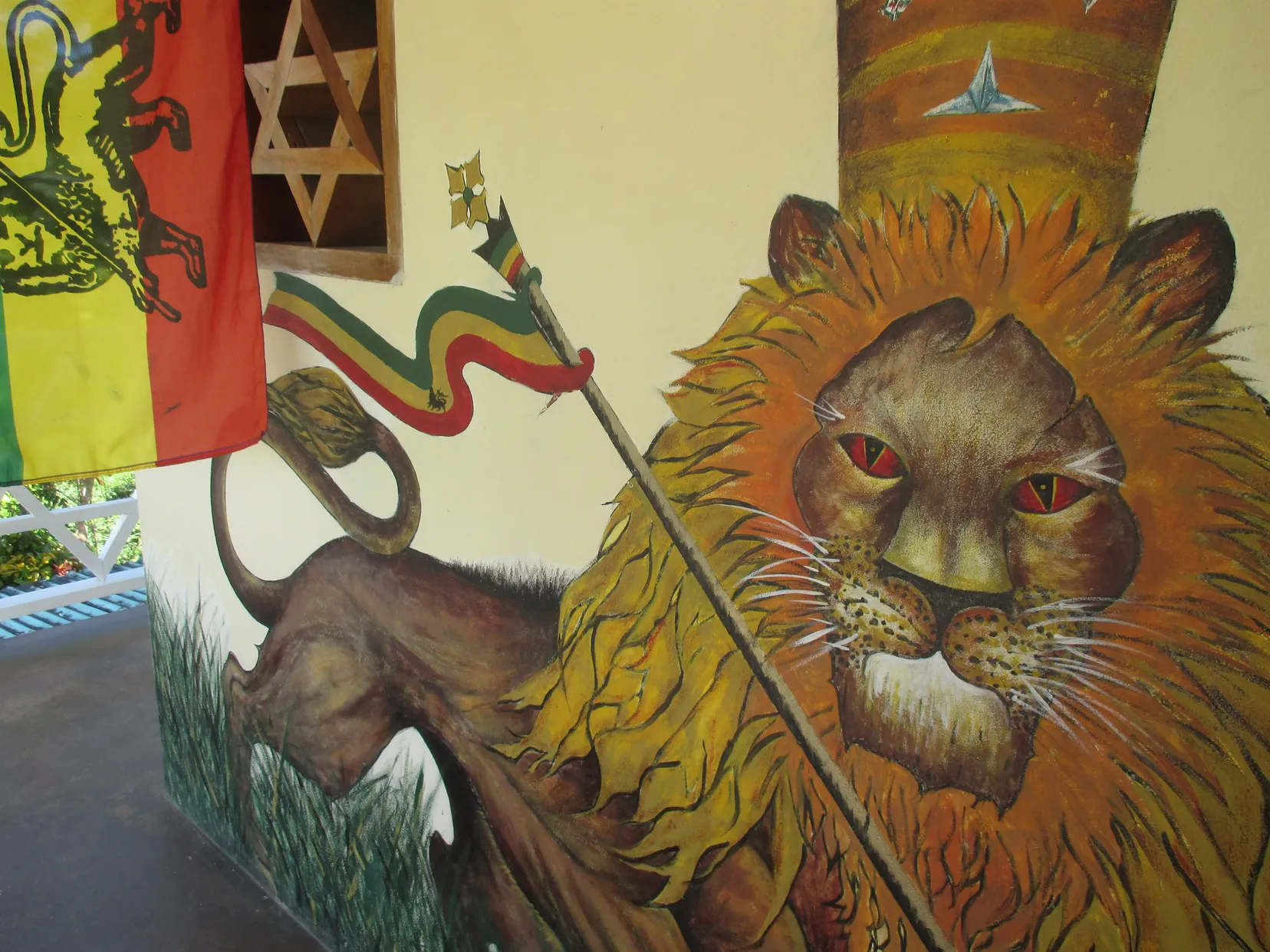
There's also a bit of reclaiming vocabulary going on with us opting for that name, because you'll understand I often get Israeli organizations contacting me, to which I always reply: "I'm sorry, but my Zion is not yours!". When Rastafarians come up to me, telling me it's like this or that, I simply reply: "No it's not, at least not for me!". Most Rastafarians live by rules made up by a bunch of guys living on a rubbish dump in Jamaica in the nineteen thirties. They're not appropriate now, they were only appropriate then and were never appropriate for women at any stage, nor were they intended to be used in a multicultural context. So when I get young white Europeans coming up to me saying: "Rastafari!" or "Hail up!", I can't but think they're fools. I did an interview a couple of years ago where the first question happened to be how important it was that the concert date coincided with the anniversary date of Haile Selassie's coronation, to which I replied: "Listen mate, I'm just happy it's not tomorrow because then Liverpool will be playing!". The guys were really confused, but I was just trying to fuck with them, because to me Haile Selassie was a racist, autocratic emperor of a then backward nation believing his people (the Amharas, red.) were white and his other, black subjects were inferior. So him being crowned emperor doesn't symbolize anything to me. If you think that man's god, go and seek some mental help.
I don't really want to offend anyone's faith, but I can't live in a world where we're frightened to offend people who think stupid things, because it affects the rest of us. Aren't white Europeans or Americans who call themselves Rastafarian really struggling with their own culture and identity, reaching out to something that seems more attractive? Do they know for example that when Haile Selassie arrived in Britain, Marcus Garvey was waiting to greet him at Victory Station, but the emperor completely ignored him? Garvey, who was a real Black Nationalist leader, who spent his whole life in jeopardy from the white power structure trying to advance the lives of black people and who had championed Haile Selassie in his Negro World newspaper! This is historical fact, not something some madman in Jamaica has made up. If you're going to base your own personal beliefs on information from uneducated individuals, then you're a bigger fool then they are. Just because I also wear my hair in dreadlocks, doesn't mean I'll like you more because you do as well. I wear my hair like this for very specific reasons and if you want to talk about it, fine, but it's got nothing to do with Haile Selassie or a bunch of Jamaican guys who can get quite racist when they want to. Dreadlocks were actually introduced in Jamaica by Indian sadhus or holy men who call them jata.
My father was white and my mother was black, I was born and bred in England, even though I've got great knowledge of my Caribbean heritage, and I choose to live in Germany; that's me in a nutshell and what I'm grounded in. As a dual heritage person, growing up in the UK I was heavily abused by white racists, but by black ones as well! Maybe not to the same extent, but it did happen. The power structure of the world we live in is definitely white, but I've always seen racism as a red herring; something that's induced by the leaders of our states to keep normal people divided. The real issue is the distribution of wealth and the ability to live a free life, not being black or white. Of course racism exists, but race as a global problem is a false flag to me."
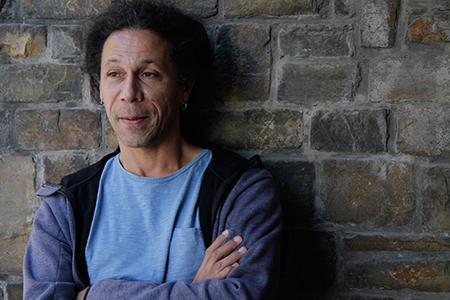
Foto: © Andreas Peeters










.Dl7BAwhJ_ZJXLLF.webp)