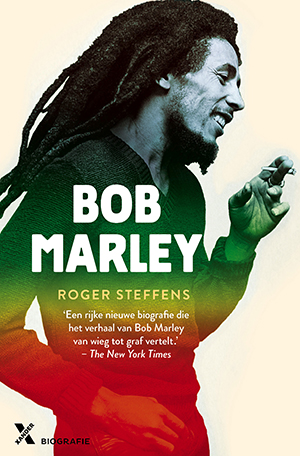
Roger Steffens (75) heeft niet alleen een uitstekende nieuwe biografie geschreven over Bob Marley. Hij is ook de archivaris van de reggae, met een collectie die een museum zou kunnen vullen. Gespreksstof genoeg dus voor een uitgebreid onderhoud in het Antwerpse vegan restaurant Rosenobel.
De ital lunch die de uitgeverij ons aanbood was niet echt aan Roger Steffens (noch Jah Rebel) besteed. Hij is een vleeseter en drinkt graag een biertje. Hij dacht zelf aan een Leffe maar krijgt in de plaats een ambachtelijk gebrouwen bier, wat hem zeer bevalt. Terwijl de rest van het gezelschap (de winnaars van de wedstrijd op Reggae.be) smult van de natuurlijke heerlijkheden die in de Rosenobel buffetgewijs geserveerd worden, vertelt Steffens honderduit over Bob Marley, de reggae business, de Grammy's en zijn liefde voor de muziek die ons allemaal zo na aan het hart ligt.
Roger Steffens is een Vietnamveteraan. Eind jaren '60 bracht hij 26 maanden van zijn leven door in het Amerikaanse leger. Hij heeft sindsdien meer dan 40.000 dia's (!) en meer dan 250000 foto's gemaakt, waarvan een selectie te zien was op tentoonstellingen in New York, Parijs en Bazel. Zijn kinderen hebben ervoor gezorgd dat een deel van de foto's ook toegankelijk is via Instagram, onder de naam The Family Acid.
"The Family Acid presents his often transcendent vision and life as a psychedelic pioneer on the order of Timothy Leary and Hunter S. Thompson," schreef The Blogazine daarover: "…beginning with his work in Vietnam and moving through his ever revolving circle of friends and characters made up of Rasta's, beatniks, musicians, artists, gonzo journalists, his family, and himself. The portraits, scenes, and freewheeling experimentation with the medium of photography coalesce into a body of work that both parallels and defines the countercultural ethos of Steffens' generation."
Roger Steffens: "People used to call our family The Waltons on Acid. My wife and I met on an acid trip in a pigmy forest in Mendecino, California, during a total eclipse of the moon. We've been together ever since. Good trip."
Na zijn legerdienst belandde Steffens in Marrakech en verhuisde daarna naar studeren Berkeley, in die geestverruimende periode van de geschiedenis een vruchtbare voedingsbodem voor reggae, een genre dat nog maar amper zo benoemd was en nog meer underground dan veel zwarte Amerikaanse muziek toen al was. Maar wel perfect compatibel met de revolutionaire spirit onder de studenten, en met hun rookgewoontes natuurlijk. "Ik ben al een fan van het werk van The Wailers sinds ik in 1973 een artikel las in Rolling Stone," schrijft Roger Steffens in zijn nieuwe biografie van Bob Marley: "Michael Thomas schreef dat reggae door je bloedstroom kruipt als een vampierenamoebe uit de spirituele stroomversnellingen van het bewustzijn van het bovengedeelte van de Niger." Steffens ging meteen op zoek naar 'Catch A Fire', het eerste album van The Wailers voor Island Records dat toen pas was uitgebracht, met de supercoole, openklapbare Zippo-hoes. De avond daarna zag hij in een kleine bioscoop in Berkeley 'The Harder They Come', de film met Jimmy Cliff in de hoofdrol. "When the chalice scene came, everybody in the theatre lit up!", ja, je mocht toen nog roken in de cinema, en in Berkeley ook wiet.
Er waren een paar reggaewinkeltjes in California: "I learned immediately that a lot of reggae was just crap. Those 'Tighten Up' albums had maybe 2 or 3 good tracks. But there was a record store on Fillmore Street in San Francisco called Trench Town Records, run by Ruel Mills, a friend of Bob Marley in Kingston. He had Count Ossie & Mystic Revelation of Rastafari. He had Ras Michael. He had The Techniques, Slim Smith..."
In die winkeltjes raakte Steffens definitief verslingerd aan reggae. Je had toen ook de eerste reggaeshows op de radio. "White as a ghost but dreader than most," was het motto van een DJ uit die tijd.
Roger Steffens: "The first time I went to Jamaica, in 1976, they declared the state of emergency when we arrived. Tanks on the streets, I tought I was back in Saigon. I had saved 400 dollars to buy records in Jamaica. We were dropped in a back street where Bob Marley had his little shop, Tuff Gong. There was a kid with shorts and no shoes and I asked him to show me all the Bob Marley records. "We don't got nuttin". "Well, let me see your Peter Tosh then." "Don't got nuttin". "Bunny Wailer?" He pulled out 'Arab Oil Weapon' and 'Search For Love'. I got a bit agitated. Didn't they have signs of Tuff Gong and Intel/Diplo? Suddenly I feel a hand in my pocket, and it's not mine. I had the 400 dollars cash in my pocket so I grabbed this guy so hard that I probably stopped his blood circulation. He had to let go of the money and pulled his hand out. It was 40° Celsius but this guy was wearing a black three piece suit. He reaches in his pocket and pulls out a 45. A record, not a gun. Title: 'Jah Jah'. He said: "Buy my record." I said: "That's you on the record?" "Yes!" "So this is a record to God? But you're picking my pocket!" Turned out to be Leroy Smart. If I tell this story in Jamaica, everybody immediately knows who I'm talking about. A year later Leroy Smart went to London and was arrested for pickpocketing in Brixton. He went to jail and when he got out - the shameless fuck - he made an album 'In London Clinker'. On the cover you see him behind bars, big smile."
Na dat eerste bezoek heeft Steffens nooit meer teruggekeken. Hij schreef een stuk voor Rolling Stone, startte een radioprogramma, werkte jarenlang als fotograaf en journalist voor het magazine Beat International en begon alles te verzamelen wat van ver of dicht met reggae te maken had. Vandaag omvat zijn collectie naast een kleine 10.000 platen 4 kubieke meter knipsels, 14.000 uur cassetteopnames, 4000 boeken en magazines, 4000 buttons, 30.000 flyers en nog veel meer parafernalia. Dat zijn in het huis van Steffens 7 kamers vol, van vloer tot plafond. 6000 stuks zitten sinds 2001 in een opslagruimte, na een tentoonstelling op het cruiseschip Queen Mary.
Roger Steffens: "I've been trying to get my stuff to Jamaica for 30 years, on two conditions: the collection has to be kept intact and it has to be made available to the public while respecting all the author rights. So far, nobody has been willing to do that. It's a shame. Jamaica should have its own reggae history museum. Last time I tried was in 2014, at the University of the West-Indies. They were very interested but I haven't heard from them since. Although they are now establishing a museum of Prime Ministers, or as Peter Tosh would call them: crime ministers. You know, a lot of people that have passed away left me their archives, so that makes my burden even heavier. I told them I would take care of it, and get it in some proper museum. I can't give up my quest yet."
Bob Marley en aanverwanten maken maar 10% uit van de verzameling. De familie heeft die specifieke stukken drie keer proberen te kopen maar daar had Steffens geen oren naar: "To understand Bob Marley, you have to tell the whole story, and that also features Joe Higgs, Dennis Brown and all those other great artists."
Maar Bob Marley was natuurlijk wel de artiest die Roger Steffens landelijke bekendheid heeft gegeven, de enige naam waarmee hij als fotograaf en journalist kon uitpakken in de mainstream muziekwereld en journalistiek. Bij ons geniet hij vooral bekendheid om zijn mooie fotoboek 'Spirit Dancer', en in mindere mate het fantastische 'Reggae Scrap Book', een klein museum in boekvorm, met toegevoegde facsimile's van tickets, posters, handtekeningen en promomateriaal. In Los Angeles maakte hij tot diep in de jaren '80 het radioprogramma 'Reggae Beat', waar zowat alle reggaeartiesten uit de seventies wel eens te gast zijn geweest en dat op 136 stations werd uitgezonden. In 1979 toerde Steffens een week met Bob Marley & The Wailers door California. Bob noemde hem Ras Rojah, omdat hij Roger niet kon uitspreken. In 1984 introduceerde de NARAS (National Academy of Recording Artists and Sciences) een nieuwe Grammy voor reggae, en vroeg Steffens om een commissie samen te stellen. Die heeft hij ook 27 jaar voorgezeten, wat ons onvermijdelijk bij de geloofwaardigheid van de reggae-Grammy's brengt. Hoe komt het toch dat de nominaties zelden representatief zijn voor wat er echt leeft in de reggaewereld? En dat de Marley's wel een abonnement lijken te hebben op de onderscheiding?
Roger Steffens: "I founded the Reggae Grammy Committee at the request of the leader of the National Academy of Recording Arts and Sciences but I hated that I had to defend it all the time. It's a joke! Every year I get calls from JBC and RJR for an explanation but I've said it again and again: I do not choose the winners. Burning Spear didn't talk to me for nine years because he was convinced that I was personally keeping him from winning. I never even voted! The Committee was actually a screening program. We only had to check if 50% of the album was reggae. Then there were two sets of voting: one for the members of NARAS, which resulted in a top 5 of nominees, and a second ballot for people in the general music business. I wanted to maintain my neutrality so I've never voted for either one of them. And also I don't know who the voters are, nor how many. They presume that you vote for a category that you have some knowledge of but the major labels would just tell their employers which artists were nominated, so you just had to check out the boxes. The Reggae Grammy has nothing to do with quality, and nothing to do with sales. Last year I was interviewed by The Observer and I told them that it's time for Ziggy to withdraw his name from the competition. Because every time the names of Marley or The Wailers pop up, you know it's over. Although I can live with Damian."
Er zijn wereldwijd naar schatting een 500-tal boeken verschenen over Bob Marley. En toch pakt Steffens nu uit met een nieuwe biografie. Niet in de traditionele vorm, een verhaal over de artiest, maar een oral history, een lange aaneenschakeling van gesproken getuigenissen. Steffens heeft duizenden uren aan interviews samengebald in 400 pagina's, en slaat zelf de nodige bruggetjes tussen de fragmenten.
Roger Steffens: "I wanted to fill out the blanks, and also wanted to go much deeper into the controversial issues. There's four chapters on the Smile Jamaica concert, one of which tells the story of Carl Colby, the son of the former head of the CIA who was accused of setting up the hit. Virtually nobody ever interviewed him but I found him in the Beverley Hills phone book. I just called him and he came over, actually on the exact anniversary of the shooting. When I presented him the stories and conspiracy theories that went around he was flabbergasted. Carl Colby landed on the night that Bob was shot. Marlon James (in his massive novel 'A History Of 7 Murders', red.) has him there for weeks, getting all the gangsters together. In truth Carl never loved his father but he loved Bob, and as a film maker he happened to work for the small film company that Chris Blackwell hired to film the concert."
En zo staan er natuurlijk honderden onthullingen, uitspraken en weetjes in het boek. Volgens Bunny Wailer heeft Lee Perry geen enkel nummer geschreven voor The Wailers, in tegenstelling tot wat Scratch zelf altijd beweert. In de jaren '60 heeft Rita twee keer proberen te scheiden van Bob: "She was fooling around, he was fooling around." In een nooit uitgebrachte documentaire van Jonathan Demme (de Marleys vonden hem "too black") zegt een neef van Bob Marley in Nine Mile dat Bob in totaal 19 kinderen verwekt heeft. "Not for nothing that he's called the father of reggae," lacht Roger Steffens.
Minstens even fascinerend zijn de verhalen achter bepaalde songs. Toen Chris Blackwell Bob Marley, Peter Tosh en Bunny Wailer vroeg wat er gebeurd was met de 100.000en pond die Coxsone Dodd van hem had gekregen, konden ze alleen maar zeggen dat nooit met the boss mochten praten. "How many rivers do we have to cross/Before we can talk to the boss/It seems that that all we have got is lost/We must have really paid the cost." (Burnin' And Lootin'')
Of neem 'Kinky Reggae'. U dacht dat die song iets te maken had met de brown sugar van de Rolling Stones? In Jamaica staat "bruine suiker" voor de restanten die overblijven na het rietkappen. Het werkvolk droeg vroeger vaak canvasschoenen, bugga-wugga's. "She had brown sugar all over her bugga-wugga": "Als je zo'n meisje ziet, weet je dat ze in de rietvelden werkt en waarschijnlijk van het land komt."
De ital lunch loopt ten einde. Plots doet iemand een Mama Appelsapje, een foute interpretatie van een bekende tekstregel. Zijn vriendin heeft jaren gedacht dat Bob in 'Waiting In Vain' (volgens Linton Kwesi Johnson de mooiste love song ooit geschreven en niet toevallig de favoriete Marley tune van Jah Rebel) niet "Tears in my eyes burn…" zong maar wel "Keeping my sperm…". Zo kent Roger Steffens er nog wel een paar: '"Heavin' pancakes on the wall…" ('Heathen'), "Send the cactus free…" ('Exodus'), "Taxibus, movement of Jah people…", "Your onion and your onion away…".
Steffens wuift ons uit met een droom. Enkele jaren geleden werd hem gevraagd om een fictief interview te schrijven met Bob Marley, mocht de zanger nog geleefd hebben dus.
Roger Steffens: "It's fascinating to contemplate what would have happened to reggae in the eighties if Bob had stayed alive. He was such an incredible force and influence on every form of music. I once wrote an interview with Bob on his 65th birthday. I went to an alternate universe where Bob wouldn't have died to talk with him about all the things that he could have done. Play at Obama's inauguration, together with Aretha Franklin. The Queen of Soul meets The King of Reggae. Greet Mandela when he got out of prison. Tour Africa with Stevie Wonder. Found a new town called Selassieville in Ghana. Headline the Amnesty International World Tour in 1986, singing 'One love' with Sting, Bruce Springsteen en Tracey Chapman. 72 grand children..."
Bob Marley zou vandaag 72 jaar zijn, dubbel zo oud als hij ooit geworden is.


.Dl7BAwhJ_ZJXLLF.webp)