





.Dl7BAwhJ_ZJXLLF.webp)
By Noémie Ntoto
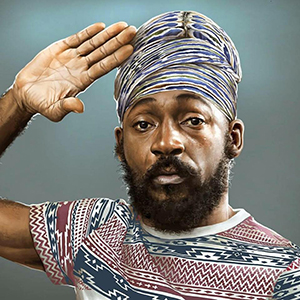
Het was alweer een hele poos geleden dat we Lutan Fyah nog eens voor onze microfoon kregen, dus toen we hoorden dat hij in Antwerpen zou passeren, lieten we die kans natuurlijk niet schieten!
Lutan, in December you travelled to Gambia to celebrate you birthday. How was that experience?
Lutan Fyah: "I've been to Gambia twice before this last trip. Gambia is like a home away from home. It's the same vibe like in Jamaica. Last year December was the time where I did my annual birthday show. As to the logistics of how I put together my show in Jamaica, it couldn't work so I decided to do it on the continent of Africa. I chose Gambia because it's a place where I feel like I'm home. The Gambian people are fans of Lutan Fyah music so we decided with a team in Brikama, to throw a party at a venue with a capacity of about 4000 people. The proceedings went to the community. The people love Lutan Fyah so wherever we went it was like a pandemonium. They were glad I was there and appreciated that I decided to celebrate my birthday there. They also gave me a name: Amadou Jalloh. They told me of my ethnic group, which is Fulani, and that the name Amadou Jalloh belonged to an ancient marabou, priest."
Do you identify with that name?
Lutan Fyah: "I do. I also identify with that ethnic group. I met with a few elders who really saw me as one of them. I give thanks."
You've been to Africa but you've also travelled the rest of the world. Would you say that, depending on where you are, people react differently to you and your music?
Lutan Fyah: "Differently, but similarly as well. It's a different vibe because people react differently because of their culture but it's the same for me. I always see it as brand new when people approach me. It feels like I'm just starting to do music. Tonight feels like my first show ever. I always pray deep within that I give a good show. That way I can appreciate what I do."
Do you make music for the people or more so for yourself?
Lutan Fyah: "No, my music is for the people, as the inspiration I get to do my music, I get it from them. I use this music to educate the people about themselves. We use what we learn and gain for the music. We use it to bring out in them all that is obsolete."
Being in the music industry for more than 10 years, how would you say you and your music have evolved?
Lutan Fyah: "I have grown from stage to stage. I've become more professional, I know how to treat myself. I know how to be a representative of the music. Also my instrument is my voice. I think I've improved a lot with my voice compared to where I'm coming from to where I'm now and to where I am heading. I appreciate what I'm doing and I always work hard to improve what I'm doing."
If you had to describe yourself in two words now, how would you do it?
Lutan Fyah: "Grown up; I'm grown and I'm up."
Taking a step back as an artist and looking at the state of reggae music, how would you say it has evolved from when you were growing up till now?
Lutan Fyah: "With the evolving of the music, we have better singers today. But I think the music is not how it was before. It's not the raw reggae as it was before. But as for younger reggae artists, they are more professional now, more on point with how they want their carrier to go. With the young new talents emerging from Jamaica and across the world there is a renaissance of what was. The next 300 years, reggae music has to be in the mind of the people, for the liberation of the people. Without reggae a lot of people who are free today would still be in bondage. The music breaks down all barriers; between man and woman, son and daughter, mother and child, father and child. It is essential music; it's lifetime music."
So as long there's oppression, there will be reggae music?
Lutan Fyah: "Yes, reggae music is for the oppressed. For all oppressed people. It's for people who are used and abused by the system. It's here to free their minds. You can't change the past but you can always make a brighter future."
What made it possible for you to stay relevant in reggae music for so long?
Lutan Fyah: "To know what I have to do. And what I have to do is reggae. What I want to do is to make music that continuously inspires people. I want to bring a positive vibe but most importantly to spread a message from my music, so I work hard. I came up in a time where reggae economy, sales and shows have gone down. Vinyl isn't being made anymore. So as a man who chooses to make music for the upliftment of the people and not for the money, my work becomes twice as hard. To keep myself in people meditation, I keep making music consistently because this music is not being promoted by the mainstream. That being said you may go to Eastern Europe and hear songs you may not have heard here. Cause mainstream did not give me a chance to express myself on their platform. There are parts of the world where reggae music is brand new and songs that have come out 40 years ago are still new to certain areas. So every time I sing it's brand new to someone."
Would you advise the same work ethic to younger artists?
Lutan Fyah: "As for now I think younger artists should be more professional. In that time you could do that, but now artists should make sure to promote their songs to get the mileage from that song. My music is lifetime music, there's mileage forever. So I don't think I have to be stressing about promoting a song."
Before you were a reggae artist, you were a football player. Could you explain this unusual transition?
Lutan Fyah: "For me, it is not an unusual transition. I was born singing and playing football. When I got to certain age, I could play for up to 10 more years so I decided to choose for a greater passion, which is music. Coming from a cultural background, which is Rastafari, there are a lot of things I've learned. In my learning I saw people being oppressed. With my voice and knowledge I create melodies that turn into songs. Making music is more important than playing football as an African. Now I just watch football, which is good enough for me. As a Jamaican, there was no place for me to be a big footballer at that time. But my voice could be heard. This commitment is more rooted than being committed as an athlete."
You've mentioned being an African. Do you think it was meant to be as it is known that Africans have a special connection with music?
Lutan Fyah: "Yes, my Africanness brought me to do what I'm doing. African people suffer the most in the world even though the continent is the richest continent. I want to be a part of the transformation process of Africans to be proud again. This is what my music is about. Saving Africa means to save the world. It is the world's bread basket. Africa and Africans are aligned with the sun, so we must realize that we share the same sentiment of the creation itself. Me being born in Jamaican, being an African man, I stand up for Africa, from the East, West, North and South."
You're trying make Africa a better place but you do this as well in Jamaica. Could you tell me how?
Lutan Fyah: "We have a saying: "Dance a yard before you dance abroad!" and we have to repatriate mentally first. Whatever we want to do in Africa, we have to start doing in Jamaica. So I came up with a Youth Upliftment Foundation. The youths in Jamaica miss a family structure. A lot of young men and women are having children without giving them a proper foundation. So they do what society teaches them. Sometimes it is kind of immoral and it leads them to decadence. We try to be mentors as artist. We go to schools to sing and reason with them. We create workshops and give them some guidance. We show them that there is a way out of the poverty through a growth process and hard work."
What can we expect more from Lutan Fyah in the near future?
Lutan Fyah: "I'm in the studio now completing my 14th album to be released later this year. I intend to create a more musical sound that is appealing to all people; pure music with the message of Rastafari. Some of the tracks will be like that, but for the most part it will be reggae."