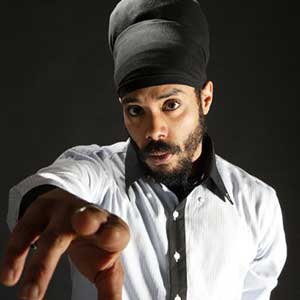
De Italiaans-Nigeriaanse singjay Lion D presenteert eind deze maand 'Heartical Love', zijn indrukwekkende tweede langspeler, die hij opnam in samenwerking met Alborosie. Hoog tijd voor een nadere kennismaking dachten wij zo!
Lion D, you grew up in Italy and you also have African roots. Do you feel that those roots are reflected in your music?
Lion D: "Yeah, of course, a lot! My mother is from Italy, my father is from Nigeria. I was born in London and then I moved to Italy with my mother when I was just a little baby. So I grew up in Italy and I never knew my father. The music helped me to carry on and to get to know myself in terms of my origins. Africa is always here, it's always present inside my heart and that reflects in my music of course."
How did you discover reggae music?
Lion D: "Just through Bob Marley and Peter Tosh, like most other artists. I think most people who start playing reggae music discovered it through listening to Bob Marley.".
Who would you say are your main musical influences?
Lion D: "I had a lot of influences, from roots reggae to rub-a-dub, ragamuffin and dancehall, but in my music I always try to remain myself. I have my own style that's been developed through the amount of music I've listened to. That music helped me to create my own style. I love to listen to all types of reggae and dancehall. Jamaican music, we love it, straight up!"
Would you consider yourself as a part of the whole reggae revival movement, or at least influenced by it?
Lion D: "Yeah definitely, I consider myself as one of them because that's what I'm trying to do, same way. My previous album was called 'Bring Back The Vibes'. The purpose of that album was to bring back the right vibes, strictly reggae music. It's very important to keep the connection between reggae music from the past and present-day reggae music."
Do you consider yourself a Rastafarian?
Lion D: "Yeah, I definitely consider myself a Rastafarian. Being a Rastaman is more of a spiritual thing for me than a religion. That's what I mean when I say that I'm a Rastaman. Rastafari is Rastafari, we don't need to divide it like Babylon always divides and rules. Rastafari to me just means keeping the people together, no matter the difference, no matter if you are a nyahbinghi or a twelve tribe or a bobo Ashanti. Rasta is just a way of life, life to the fullest."
You've been touring in Europe and in the US. Did you also perform in Jamaica already?
Lion D: "No. I've been to Jamaica three times. The first time in 2006, then again in 2010 and 2011. However, I have never performed there. When I go to Jamaica, I go there to learn. Jamaica is like my school, you know? So that's where I get my inspiration from. Whenever I go there, I go to learn. But the next time I visit Jamaica, I'm going to link with some producer and start to work on my next album. A lot of things are in the pipeline, you know."
Why did you choose to sing in Jamaican patois?
Lion D: "To me it was just a natural thing, you know. In my vision music has to be natural, so you have to feel the vibe and when you start to feel it, you just follow along with it. The first time I listened to reggae music I found out that the Jamaican patois is the best way to sing reggae music. I can speak Italian or English but I definitely prefer patois because patois is straighter, live and direct, you know. And that's what I like about it."
Your style is very versatile. You've done dancehall, roots and you also have some hip-hop influences. Is there one particular style that you prefer?
Lion D: "Of course. I prefer reggae, new roots music. But I understand the importance to entertain the people and to be versatile. Anytime I sing, whether it's a dancehall tune or hip hop or reggae, it's basically the same thing because I always keep my message clean and am focused on the same thing. Nothing changes except the musical style. It's always Lion D."
This is a tough question: if you could choose any artist, alive or dead, to do a collaboration with, who would it be?
Lion D: "That is a very tough question for real. There's so many of them: Bob Marley, Peter Tosh, Dennis Brown, Jacob Miller… I love to feature with artists in general, but it's not an easy question to answer."
Your music is very positive as opposed to the grimmer atmosphere in some current dancehall. Do you think it's important to have conscious lyrics and deliver a positive message with your songs?
Lion D: "Of course! I believe music should always be positive and conscious. That's what reggae music means to me, positivity and consciousness. You have to make sure that your music makes people want to dance and have fun, but you should also try to make them meditate. With reggae music, there is a time to dance and have fun and there is a time to meditate. As a performer you have to be able to entertain the people in a way that's fun, but at the same time make them reason as well. That ability is crucial." Foto: Bizzarri Records

.Dl7BAwhJ_ZJXLLF.webp)