Na zijn recente passage in de AB hadden we de gelegenheid om met Ziggy Marley te praten, de oudste zoon van Bob, hitmaker in de jaren 90, meervoudig Grammy-winnaar en sinds de eeuwwisseling zonder twijfel de meest eigenzinnige en 'minst Jamaicaanse' van alle broers Marley. Zijn nieuwe album 'Fly Rasta' wordt verdeeld onthaald maar dat laat Ziggy niet aan zijn hart komen: 'Let's not forget critics were very critical about my father's music too.'
The most prominent guest on your new album is U-Roy. Why he? I wanted to surround myself with musical greatness, and U-Roy is a great man. I only wanted to work with the best, and he is the best. 'Im represent a history that I want to be closer to. Not only to make good music but also to be close to him.
In the past Stephen used to do the rapping parts. (laughs) He could still do it! If I called him, he would.
For this album you brought your sisters back to the studio, and some other people involved with The Melody Makers (Ziggy's band in the 80ies en 90ies). During the Melody Makers years we were always experimenting and creating new sounds. This album is on the same track, with new sounds and ideas, unique to itself. The voices of my sisters always had a fresh energy. They sing different than anybody else. They also are the best.
On 'Fly Rasta', not all tracks are straight reggae tracks. We already knew that you don't play strictly reggae music anymore but can you imagine yourself making an album with no reggae or Carribean influences at all? No man! Impossible, because it's me. I can not run away from myself. I can not who I am not. Reggae is my roots. But reggae is also just a name, like christianity is a name, and islam. Just letters. If we would have no names or titles, what would we be? We would be all musicians.
Singers and players of instruments. Yeah man. If you like the sound, you like the sound, whatever it is called. We try to break away from the world of labels. I embrace the roots of reggae music but for people trying to hold me within the borders of what they think I should be, I can not allow that. I'm a free man and I will make my own roots, my own borders. while still I respect where I'm coming from. I don't want to be held within anybody's walls. Let me do my thing and check it out. I think we're pushing reggae forward, to different areas and different regions. We have to. Reggae can not be a stagnant force. Reggae can not live in the past, it must live in the future too. We haffi be the catalyst for that.
You've tried that before, with albums like 'Kosmic' and 'Fallen is Babylon', but these sounds didn't really make it to mainstream reggae in Jamaica, on the contrary. My father is the poster child of reggae music. Bob Marley is reggae music. But let's not forget critics were very critical about his music too. It wasn't Jamaican music as we knew it.
The roots audience didn't like it in the beginning. There you go. He was not roots enough...
Selling out. I close my argument. (laughs loud)
You made high quality albums that could have been as influential as those of your father. My father is such a big figure, it's really different to look beyond that. He's the role model, Miles David, Fela Kuti, artists who push the limits of their sound and never live within the borders of their sound. That's why my father is also my role model. I'm not in competition with anyone, I'm not in competition with the music that's going on in Jamaica, I'm not following the trend, I'm not trying to be Jamaican. I'm just trying to be Ziggy, trying to be me, who I am, not representing what's going on here or there. And the music represent that.
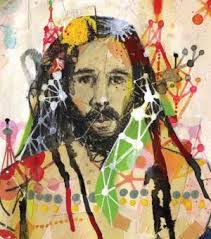
The art work of your album, by an artist called Souther Salazar, is wonderful, as it usually is when you release a new album. Is art a passion of yours? Yeah, I love art. And for every album I try to come up with a nice piece of original cover art. Just like the music is art, also this cover is art. What draw me to Souther's work is the Jamaican flag. He didn't do it because he knew I was gonna use it. It was already there, in an existing painting. the album wasn't called 'Fly rasta' at the time, it was called 'Don't want to live on Mars'. The picture looks like a kind of rocket ship, so that fitted right in too. As we made the video for 'Fly rasta', with Jim Mahfood doing the painting, I decided to change the title of the record. But the art work, some of my friends said. No man, it still work with the art work. It represents a new consciousness, a new awareness of spirituality. We're going to a new place. 'Fly rasta' is a title that brings me back to my roots but also brings rasta into the future. I grew up among some of the founders of rasta, my father and his teachers. But when he left I felt they went a whole different way and had a whole different attitude. The developed a more aggressive kind of view. I stick to what I learned from the elders. And 'Fly rasta' is the future of that roots. We have to evolve our thought process. Our thought process can not be imprisoned. People might say: the bible is it. But the bible is only a door that opens. The consciousness have to evolve even beyond the bible en the koran, beyond what we already know. The knowledge is infinite so it can not be held within one book or ideology. 'Fly rasta' reflects the evolution of what I have learned. Love is my religion (title of a previous album): that is what I've learned, that is the real deal. It's not just rasta this and rasta that. We're not disrespecting anything or anybody, we're just evolving. We are growing, we are learning more.
Is that the reason that you don't explicitly sing about rastafari? It became too trendy, too easy. Everybody does it. I'd rather keep it here (hand on his chest) and talk about love, and about the earth, about the actions that represent rasta.
You don't have to explain anymore who His Majesty was for example? No man, it's not important. The important thing is how you live your life. That's the evolution of the message, reaching out to as many people as possible. I don't need to profess my personal faith to anyone. What I have to do is talk about love and how to practice it in daily life. That will embrace everyone. If I say rasta, the christian might say: no, I'm christian. A next man might say: I'm an atheist. That way we loose the people. Love is universal, that is the message.
Your song 'I love you too' became an album, a children's book and now even an app. It seems you want to reach out to whole new audience, to your future fans maybe? (laughs) That too, but after I'd done my children's record it kind of dawned to me that I have to speak to the children. They are one of the most important audiences. If I want to speak about the good things in the world, I have to speak to the children. They are the future and their minds are still like sponges. Their mind is not set yet. If I'm serious about my purpose in life, it is essential to talk to children. That is where the solution lies.
Our time is limited but we have one more question. Visiting your father's house on Hope Road in Kingston, now it's completely been redecorated and restored, must remind you of the seventies. Are the vibes in any way comparable to those of that time? It's different. Very... nice... I don't know how to call it. Very smooth, polished. Back in those days it was the headquarters for the revolution. We used to have all type of people. Tough people. Now it's more like a tourist destination.



.Dl7BAwhJ_ZJXLLF.webp)