









.Dl7BAwhJ_ZJXLLF.webp)
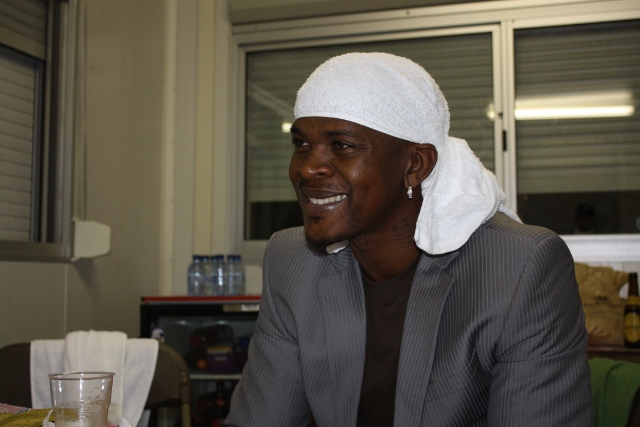
Clifford Smith aka Mr Vegas is volop bezig aan zijn Europese toer; volgend weekend (23/8) staat hij geprogrammeerd op Feest in het Park in Oudenaarde en op 20/8 maakt hij zijn opwachting op Rototom Sunsplash. Een ideale gelegenheid dus om de man hier nog even aan het woord te laten.
Mr Vegas, in your 'Sweet Jamaica' album you went back to the roots of foundation reggae music. Was that something you always wanted to do?
Mr Vegas: "Of course. I grew up from the old school, you know. My style is from the old school. My sound is from the old school. So that is what I enjoy doing, you know. I enjoy dancehall music, but I dedicate that to the fans. What I love is reggae music, I go crazy over reggae music; it is the best thing that can ever be given to me as a present. It's truly something I go crazy over, I go crazy over listening to Barrington Levy songs and Tenor Saw songs and Half Pint songs. And now I'm listening to Bob Marley, because I found my Bob Marley (hesitates)...I fell in love with Bob Marley as the years went by with my career. I was not listening to a lot of Bob Marley growing up. I heard about Bob Marley, but in Jamaica there wasn't a lot of Bob Marley being played. In the eighties, when I was a kid, I heard more Barrington Levy, Tenor Saw, Half Pint, you understand? But when Bob Marley passed away we started hearing a lot of Bob Marley. So, if someone had said to me in 1997-1998 when I came on the scene: "Who inspires you? Does Bob Marley inspire you?", I would have said: "No, Barrington Levy inspires me, or Tenor Saw". But as we get older in the music and start listening to different artists, we come to realize how great of an artist Bob Marley is. I've just started listening to a lot of Bob Marley songs since I saw the documentary (nvdr: dit verwijst naar de documentairefilm 'Marley' uit 2012 geregisseerd door Kevin Macdonald). There is just so much inspiration you can take from that, you know."
It seems like you are not the only dancehall artist who's turning to reggae music. In that respect, you've also started the 'Save Foundation Reggae' Campaign. Can you give your perspective on this evolution?
Mr Vegas: "It's very important for the people in Jamaica and around the world to support Busy Signal's album and Mr Vegas' album, which are two very good albums, so that the youths know that they can do this type of music and still be successful. The problem is that a lot of kids think: "Oh, if I do reggae music, I'm not gonna sell, I'm not gonna be popular, I'm not gonna be famous." So if they see Mr Vegas get a big hit with a song from the reggae disk, they're gonna say: "Ok I wanna try that". If they see Busy Signal's album become a big album, they're gonna wanna try it. But if they don't see that happening or if they go to a concert and they see people standing still, they aren't going to be motivated."
The 'Sweet Jamaica' album allows you a lot of versatility during your live shows. Do you have very different set lists when you perform in Europe, as opposed to Jamaica?
Mr Vegas: "In fact, I haven't performed a long show in Jamaica for quite some time. What I would love to do in Jamaica is to perform an hour on stage, or 45 minutes, where I can do dancehall and where I can do every other style, you know, so people can have a show, a good show, not just me jumping around all the time, or me trying to get a response from the crowd, because that's what it's like in Jamaica. We try to get a response from the crowd; if we don't get that response, people will write: "Mr Vegas did not perform well" and stuff like that so I want to perform for the people, I don't want to perform for the media."
How has the reception of this new musical style been so far?
Mr Vegas: "At a time when music is not selling a lot like before, the reception of this album is really good, because we managed to get into the top ten of the reggae billboards. So, it is very good. And of course we are selling CD's on the road and people are buying a lot of them too. So in a time when music, especially reggae music, is not selling, this result is really, really good."
A lot of your most popular songs have dance moves linked to them. Is that something you anticipate or does it just happen by coincidence?
Mr Vegas: "That's just the inspiration from Michael Jackson, you know. We grew up listening to those hits and it involves a lot of dancing. It's just dancing. People in general love to dance. If you go out to the club and the dance and the stage show, you will see that people are waiting on those songs, they are waiting on 'Hot Wuk' and 'Bruk it Down', you understand? So that is what happens when you perform live, when you perform for the people: people enjoy those songs, you know. And all those songs are just to let the people have a good time. When you look at the people and they're dancing 'Tek weh Yuhself' and all those songs like 'Hot Wuk' and 'Bruk it down', the girls are going crazy."
You just mentioned 'Bruk it down' and you did a version of this together with Alison Hinds, the 'Queen of Soca', from Barbados. There's also a track on the album with Patrice, a Trinidadian artist. Are these pan-caribbean collaborations something you actively want to promote?
Mr Vegas: "Well, I've done music with Machel Montano, I've done music with Destra (nvdr. Machel Montano en Destra zijn twee soca-artiesten uit Trinidad). It is very important for us to do music together as one Caribbean nation. It's just like the West Indies team in cricket! So if I can get Patrice on a song, or Alison Hinds, it brings all of Alison Hinds' fans and Mr Vegas' fans together, you know."
There has been a lot of commotion about Snoop Dogg's transformation into Snoop Lion. What are your thoughts on this matter?
Mr Vegas: (laughs) "I really don't know what to say about that. So far, I kinda like it, you know. I especially like the track he did with Jovi Rockwell. Jovi is my favourite reggae singer."
Ok, thanks a lot for the interview!
Mr Vegas: "No problem, it was my pleasure."
Van jongs af gefascineerd door de Jamaicaanse cultuur. Verzorgde als student het Engelstalig deel van een secundaire bibliografie rond Caribische literatuur, maakte twee MA-theses over dub poetry en deed onderzoek naar geweld en verzet binnen de Jamaicaanse dub poetry en dancehall. Schrijft sinds enkele jaren recensies, verslagen en interviews voor Reggae.be. "Nostalgische lovers rock is stiekem mijn grote liefde.", geeft ze toe.
Aug 13, 2013