

.Dl7BAwhJ_bSbwe.webp)
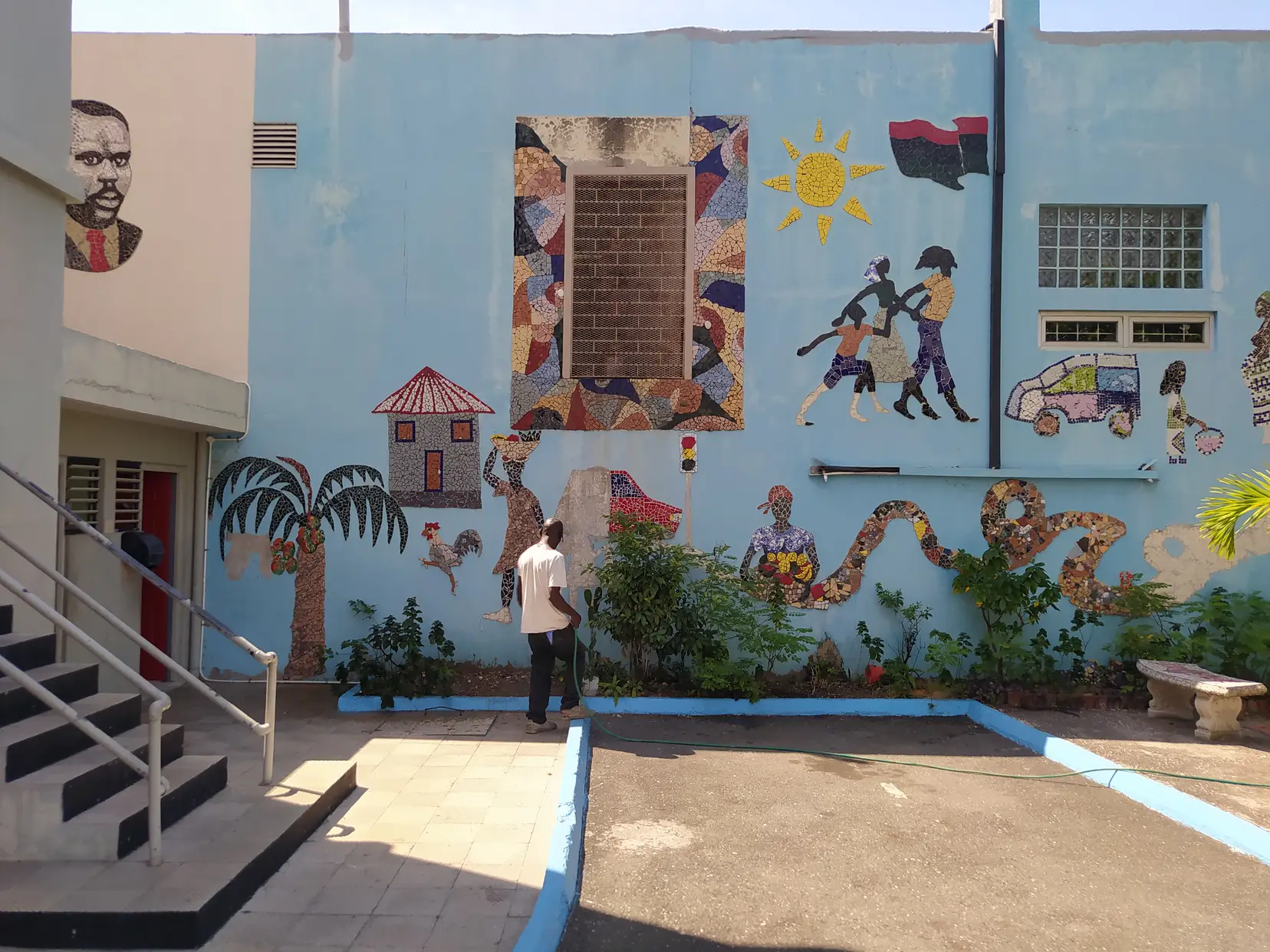
De meeste huizen in de Caribische (Jamaicaanse) wijk van Shashamene zijn omgeven door een met hoge, houten schuttingen afgesloten yard. Er lopen weinig mensen op straat, zeker in vergelijking met de immer druk bevolkte armere Ethiopische buurten. De rasta's die er wonen, lijken net iets welvarender dan de autochtone bevolking, al was het maar omdat ze een stenen woning hebben gebouwd.
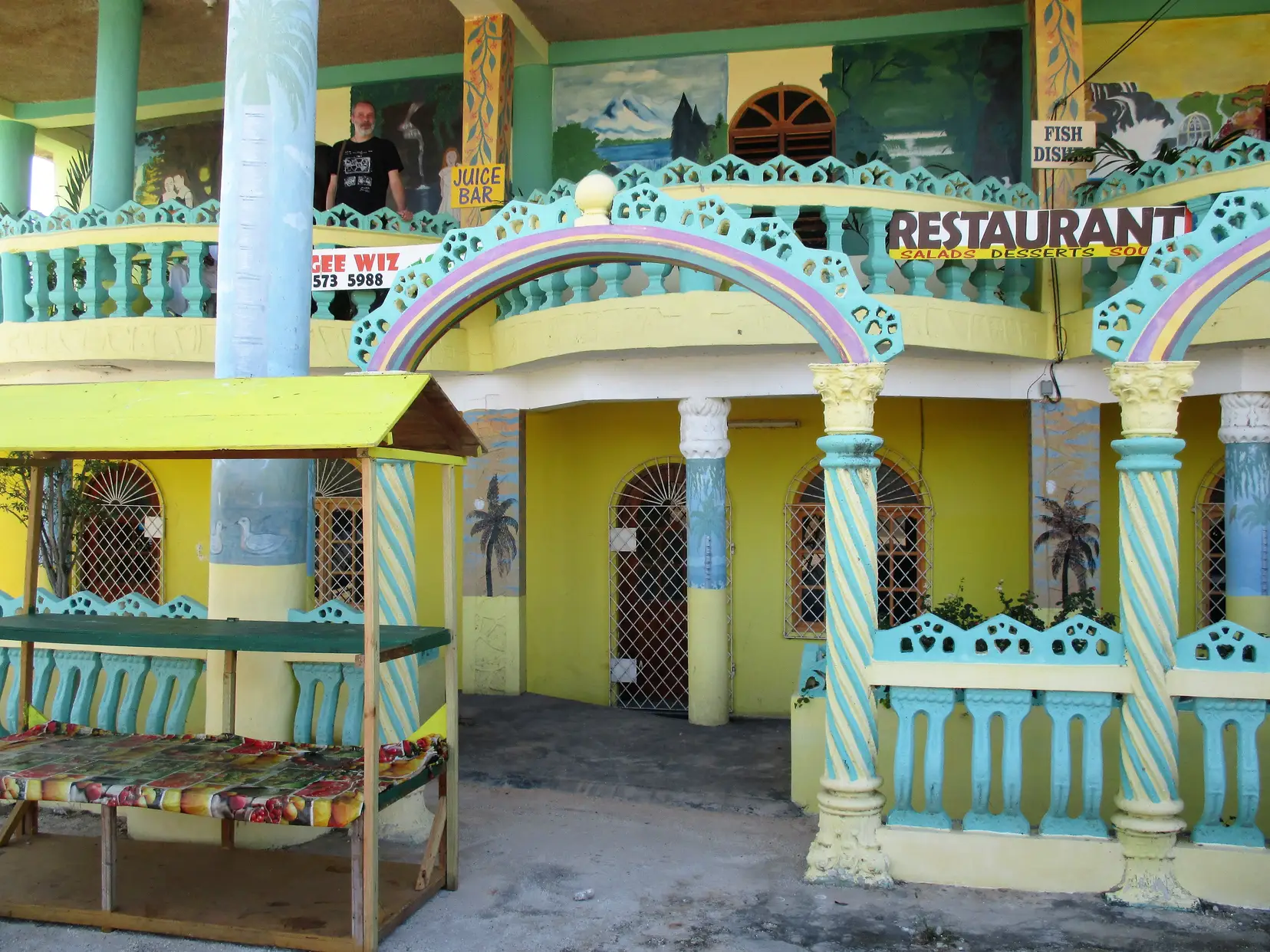
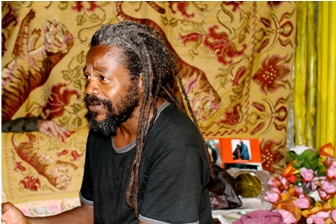
Sommige rasta's leven van het schaarse toerisme. Het zijn niet de meest kapitaalkrachtige mensen die hier op bezoek komen, dus veel inkomsten vallen er niet te rapen. Anderen drijven een handeltje of baten een restaurantje uit. Brother Moses (Anthony Nevers) leeft het leven van de rastaman: ital vital in denken en doen, hard werkend om de droom van het beloofde land waar te maken, of toch op zijn minst om die droom na te streven. Hij doet dat met grassroots community work, vakopleidingen, scholing en medische zorgen. Klaslokalen en ateliers heeft hij zelf gebouwd, in zijn yard, naast de groententuin. Brother Moses spreekt Engels met een zacht Jamaicaans accent, zoals we dat kennen uit de gouden jaren van de reggae, toen Brother Moses besloot om de grote overtocht te wagen.
"I came here as a member of 12 Tribes of Israel, to fulfill an executive post. Seeing the brethren arrive here from Jamaica and other parts of the Carribean we felt the need to have a representation in Shashamene. Our most honorable leader Doctor Vernon Carrington 'Gad' instructed us to find an approach to the government on behalf of our community. In those days, it wasn't even easy to build. We couldn't do anything whatsoever. So we formed the Jamaica Rasta Development Community, an organization that would represent all people in the community."
"In 2007 I formed another organization. His Majesty wanted us to be organized. So at present I also represent the Ethio-Carribean International Friendship Association. We now conduct a training program in woodwork for 20 students. We also give courses in metal work, construction and information technology. We welcome students from all communities. We are only a small number among many Ethiopians. We came here to work for them and with them. You've noticed the name of our organization: Ethiopians come first, Carribeans second, if only in numbers. Carribeans, because there's not only Jamaicans here. There's people from Trinidad, and the Bahamas, St Lucia… It's international friendship that brings us together."
"We have a budget of 296.000 birr (15.000 euro) to run the programs. We are operating from our pockets. Whatever we have, we contribute. We do it for the underprivileged youths. Some of them are drop outs from school, others come from low-income families, so we try to render a service to the local community."
"It was my long standing desire to come here and teach and share the skills I had learned in Jamaica. Wood and metal work, but also ceramics. I was a senior supervisor in a major ceramics company. I resigned that job to come here, at the early age of 21."
"It started even at an earlier age. There was a Carribean activist, Walter Rodney. I was about 11 when I heard at school that this man was coming to visit Jamaica but somehow the government banned him to enter the country. This was what really inspired me. I wrote on my ruler: black power, without really knowing what this man stood for. Then a teacher told us to write a composition about Walter Rodney. I remember being furious. Why was he treated that way? And I started to read more, about our history and where we come from."
"In this same year His Majesty visited Jamaica. I fought with my family to be there. We were given free passes from school to go and see him in the National Stadium but my parents were sitting at home, looking at the television, seeing all these people. 'That is where you want to go?' they asked me. 'Look at the ganja smoke!' 'Yes, that is where I want to go,' I said, but my mother wouldn't let me. So I went crying with my grandfather, who lived down the road, and I asked him 'Please, please, take me with you to this great king. And he did take me, and I did see H.I.M., waving. It was a moment that took me as a youth, and that I remember till this day. This was an awakening for me."
"Later, I joined 12 Tribes of Israel. Each member of the organization made a weekly contribution of 20 cents. With this money we were able to organize the journey and buy the tickets to come to Ethiopia. Our members started to come over from about 1972, but the most active year was 1976, when our beloved prophet Vernon Carrington wanted to set up a 12 Tribes of Israel here in Ethiopia. During that year, dozens of people arrived. We functioned with 12 brothers and one sister. I was the fifth brother, from the tribe of Izzachar. Which tribe do you belong to? What month were you born? "
December.
"So you're Asher. Like Ras Asher. And you?"
"I'm David."
"You 'ave a nickname, like Jah Shakespear? In Jamaica, every person have a nickname, you know."
"My mother called me Didi."
"Didi! That's an Ethiopian nickname. When were you born?"
"September."
"That makes you Zebulon. You're a ruler of the stomach!"
Indeed, he is. He talks about food all the time.
"You see, that's how we work it out at Twelve Tribes. That's how we know about each others characters. And who are you?"
"Jah Rebel."
"Jah Rebel? Wrathed! Tuff one dat! I like that. That's like a direct yard name. Yeah. Which month you born?"
"August."
"Well, that's like me now. Izzachar. Our colour is yellow. I was born 1 August 1955. So, that's how we work. Babylon use the Zodiac but we found 12 Tribes more fitting. It's amazing how we can define personalities and characters with that knowledge."
The younger rasta generation seems to have other priorities. They mostly strike me as very militant, even hateful and agressive.
"The younger generation thought us to be too soft, so they took a radical edge. We rebelled against the system but we did it quietly. Even at school, where we had to wear uniforms. We 'forgot' our belt, or our socks, or our tie or epualettes. Later we start to grow dreadlocks. That was our generation. I used to brush it back every time because I couldn't face my parents with dreadlocks. My mama would cry when she see me. 'You're waxing up your head like dem dutty rasta 'pon the road?' We were a generation that was searching for its roots. Getting back to the roots of things, going back to our own roots in Africa."
"Our generation read more than the younger generation. We had to dig deep into the libraries to find knowledge. Nowadays many good books are of the shelf. You are what you eat, and most youths only 'eat' computer games."
Your generation also used to cultivate ital food.
"Ital means eating proper, eating vegetables that a lot of people don't even know. The younger generation know only Kentucky and McDonalds. Dem don't go the market. We still use the word, you know. Sometimes we cook an ital dinner, because people don't eat meat."
"You know, sometimes they call us the fertilizer generation. The food chain is so messed up that sometimes we don't even know what we eat. And the garbage come to Africa, with the hybrids and the fertilizers that are being banned in Europe. Natural grains and seeds are being monopolized, every time you have to go to the seed bank, and you can't plant these hybrid seeds for another year. They're only good for one crop. Our food is being controlled by those labs. That's really a terrible situation. Food will be a weapon in the future, just like oil and water. Give thanks that we still have the air for free."
Rastafari seems more divided than ever, also here in Shashamene. Why don't you pull the same rope?
"Everything that looks threatening to the western world and our modern governments, they'll infiltrate it and they'll break it. I think even the Rastafarian movement is infiltrated. But still, we try to preserve it the way we got to know it, and the way it should be. We know that God is a spirit, and they that worship him must worship him in spirit and in truth. We have to stay focused on the truth and not listen to street philosophers. We have to research. We have to read. We have to study. And the root of it all is in the bible. Most rastas don't read the bible anymore, because they see it as a book that was written by white people who had no respect for black people whatsoever. They see Jesus as one of the oppressors, one of the men that brought them in slavery to the Carribean. One of the slave ships was called SS Jesus, that's why."
"We read the bible, starting from Genesis, to Revelation. We used to read at random, just opening the book and start from there. But reading from the beginning was like reading a whole new story. It unfolded in a kind of documented way. Reading in this manner brought a new revelation to us. We see and know that Christ was being looked down on. And we asked ourselves: was he really white? Why is God white? Questioning our parents about that, we found out that it was very difficult for them to respond. We know we couldn't rely upon our parents anymore. They told us all that they could but they lacked information."
"One of the things we learned was that since the time of Samuel, God is a spirit. Until then God used to speak through prophets en men like that. But the people revoked the idea of God being a spirit. They asked Samuel why other peoples had kings they could worship, and why God didn't speak to them. They were angry at Samuel and told him to ask God to send them a king. So Samuel asked God and God said: if the people want a king, then give them a king. Samuel was wrathed, because the people already had a king, God himself. But they couldn't see or touch this king. Some people wanted direct contact with God to deal with their personal problems. And so they had their first king, King Saul. Now, Saul didn't do good as a king. David was anointed king. And God made a covenant unto David that from the fruit of his line would rise up Christ, to sit upon his throne, Davids throne. Through the philosophies of Marcus Garvey and the back-to-Africa movement, we catch up with His Majesty. We look at him from that biblical time. The Ethiopian government might see us as a political movement but we are not. Our love for His Majesty is purely religious. We have no aims or ambitions to reinstall the descendants of His Majesty of the Ethiopian throne. Although this is a must. The rasta movement as a whole is semi-political. We are surrounded by politics, so you have to know politics. How else can you deal with it? If there were to be a political party that wants to put the lineage of His Majesty back on the throne, I would support it. But we try to stay out of politics."
Could you imagine a rasta government for Jamaica?
"No other government would support that. Like we don't get any support from the government. If we would be strong and prospering in Shashamene, all Jamaicans would come here. We don't even have a legal representative that speaks for our community. But even if we had, and if we then asked to reinstall a Jamaican ambassador here, would they respond to that? I don't think so."
"You know, His Majesty encouraged us to come here. He even gave this land to the black people in the diaspora who thought it fitting to come back. Over the years the movement was plagued with problems, frequently wrestling with the question whether we should stay or go. Some rasta elders left during the communist period."
Did you never lose faith in all these years?
"Never. That's one thing we can't afford to do. If we would become weak that would send a chain reaction through the whole movement. We know what we are up against, and we know that we are not fighting an easy fight. They expect us to fail. They don't expect the rastaman to become triumphant in what we do. But we have a strong belief, and we try to keep a clear consciousness. Like eat ital food for the mind too, so that the mind don't become polluted too. Slavery was one thing, putting the body in chains. But putting the mind chains would really be the end. Keep the mind active and positive, to progress in the long term. The hotter the battle, the sweeter the victory. We enjoy fighting for the right thing. We don't let disappointments deter us, or break us. And now do you want a glass of tej?"