





.Dl7BAwhJ_ZJXLLF.webp)
By Jah Rebel
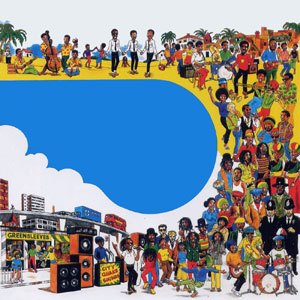
Voor deel 2 van dit drieluik steken we kort over naar het Verenigd Koninkrijk, waar Tony McDermott al zowat drie decennia lang de platenhoezen van Greensleeves verzorgt. Elke reggaeliefhebber is ongetwijfeld vertrouwd met zijn ondertussen legendarische illustratie voor de Greensleeves 12" collectie (zie foto), maar zelf trad de man zelden uit de schaduw. Wij konden hem overhalen voor een zeldzaam interview.
Tony, trying to do some research in preparation for this interview, I quickly noticed there's virtually no information available on your persona. Do you consciously shy away from publicity?
Tony McDermott: "I guess in a way I do, yes. I just don't do many interviews and I've never really looked for that kind of publicity."
Don't you feel that platforms like MySpace or Facebook might be easy ways to present you work to a broader public?
Tony McDermott: "The scope of what I do is pretty diverse. You're here because you are interested in the album sleeve illustrations I do, but that's been but a small part of what I've been doing for the past years. I suppose in a way I've never really looked at it as being a career. (laughs)"
What exactly is your academic background? What did you study?
Tony McDermott: "I did a degree in graphic design and illustration at what was then known as the London College of Printing, which is now the London College of Communication, a part of the London Institute. I was very interested in cartoons and for a couple of years I worked for Black Echoes magazine, which was still a newspaper back in those days. I had become passionate about black music, soul primarily and then reggae off course. I then started doing a weekly cartoon for them and then at one stage – it must have been around 1977 or '78 – Greensleeves came to me asking me to do a couple of cartoons for an album cover. That was for an album called 'Stop Me Loafing' by Jah Thomas. I was still a teenager back then, but from there it started really; they asked me to do some more illustrations and after that also graphic design as well. They still had a shop at that stage, so I also designed the shop display and designed posters and stickers for them, all sorts of stuff really."
And what does your workload entail these days?
Tony McDermott: "I don't do that many illustrations anymore, but the bulk of what I do is still design sleeve covers for reggae albums. Drawn sleeves became unfashionable at one stage. Partly because it took more time to do, but also because the artists themselves didn't want to be drawn anymore. It was a bit of an ego thing. Following American trends in the eighties, they started preferring glossy sleeves with a styled studio shot. Drawings became associated with cheapness."
The invention of the CD has seriously decreased the size of album sleeves; does that limit you in any way?
Tony McDermott: "Well, it limits the appeal of an album sleeve obviously; it doesn't have the same impact on a rack as an LP sleeve did. Digitally we still work on a larger size though, so the designs can also be used for posters for example. You just have to avoid adding details that aren't going to be seen on such a small surface anyway."
What are your concrete influence where your illustrations a concerned?
Tony McDermott: "I read a lot of American comic books, so they were certainly in a influence, but there were also a lot of underground British cartoonists that I admired. I think you could really divide my illustration work into two big categories; some were more serious cartoon-like things and then you had the other more comically intended comic book style stuff. If you take the sleeve of 'Scientist Encounters Pac-Man', that was a rather straight comic book style, whereas something like the 12" cover was more funnily intended, it followed on in the style of the cartoons I did for Black Echoes. That 12" sleeve is still more or less the one that people remember best, but in reality it was only used for about three years."
From a technical point of view, has the way you do your work and have the materials you use changed a lot over the years?
Tony McDermott: "Yes, it has changed hugely. Although my initial approach to designing is still pen and paper, even for photographic designs I still try to do a little visualisation in pen, but the great difference is that, these days, illustrations are coloured digitally. The reason for that is mainly because it saves a lot of time. In the past doing an illustration and colouring it in could take several weeks, but nobody has the time or money anymore to wait for that. Doing things digitally makes it easier to correct mistakes as well. Back in the day, when I still worked in ink and gouache paint, if you made a mistake you had to scrape the paint off again. (laughs)"
When you're asked to do a sleeve, do you confer with the artist or how does that work?
Tony McDermott: "Until recent times, reggae artists rarely had anything to do with the design of the album cover. There were various reasons for that; basically an artist in Jamaica got a flat fee for recording his music and didn't get any royalties. From that point on the record in question became the producer's product; they would present their product to a licensing company in the States or in Europe and most of them didn't even care what the finished album would look like. Some producers, in the Rastafarian community for example, were close to the artists they produced though and often they would have a similar outlook on how they wanted the finished product to be."
How do you start doing a sleeve? Do you listen to the album first?
Tony McDermott: "A lot of the times I do get pre-release versions of the records, yes, and sometimes that does inspire things, but when you've worked in reggae as long as I have, you know the profile of most of the artists you work with. If it's a thematic album I usually listen to all the tracks though and try to let their flavour inspire me. More recently artists have started to arrange their own photographic sessions and they just provide me with a range of shots they deem suitable for use on the sleeve."
With the music business focussing more and more on digital downloads, do you still see a future for sleeve design?
Tony McDermott: "I really don't know. It's a bit of a conundrum isn't it? Obviously even with digital downloads people still seem to want some kind of visual identification to be added. It's probably because they've seen that image on a larger scale somewhere else - on a poster or a CD - that they still want to add the same reduced image to the music they download. As long as these other sources are there – websites, posters, magazines – there will be a demand for a visual image attached to the product, but it's yet to be seen what kind of budgets will still be allocated for that. The music industry hasn't yet come to terms with the changes it's facing."
The sleeve you recently designed for Alborosie's 'Escape From Babylon' album was a return to the old illustration style of back in the day. Alborosie told me he already knew your work and really wanted you to do the sleeve. He's known as a perfectionist, taking control of all aspects of his career, how did that collaboration turn out for you?
Tony McDermott: "Alborosie had the title of the album already and he sent me the tracks to listen to. He's a man who wants his product to have a certain authenticity. He obviously knows the history of the music and I believe he wanted to tap into that and that's how he ended up with me. For this project I did some initial artwork and sent it over to him and that's how we eventually came to the end result."
What kind of reggae do you listen to yourself?
Tony McDermott: "To be honest I don't discriminate too much. Given a choice I'd probably lean towards rocksteady and seventies roots & culture, because that's the music I was listening to when I first got into the business. I listen to dancehall as well and I like it a lot but it's not the kind of music I want to be listening to every hour of the day. Jamaica always reinvents itself and just when you think it's getting boring, they will come up with something new to freshen it all up again and as a graphic artist that always provides me with new ideas."
Lag samen met Jah Shakespear aan de basis van Reggae.be; eerst als recensent en interviewer, en vanaf eind 2014 ook als hoofdredacteur. Verdeelt zijn tijd tussen zijn twee passies: muziek en Haile Selassie.
Oct 05, 2009