
.Dl7BAwhJ_ZJXLLF.webp)
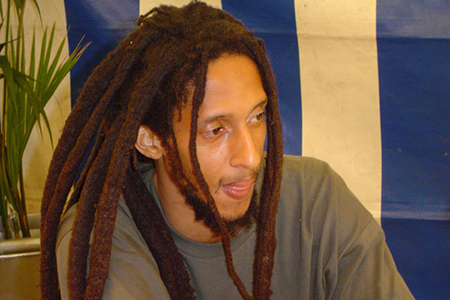
Blessed Julian! I want to take you back to February of this year, the big celebrations for your father's 60th birthday in Addis Abeba, Ethiopia. How was that for you?
Julian Marley: "It was a very positive experience, very special too for all Rastafarians all over the world and for me because it was about my father."
Was it your first time in Ethiopia?
Julian Marley: "It was even my first time in Africa!"
Did you get the chance to visit any of the historical sites? Ethiopia has quite a few.
Julian Marley: "We ventured around a little bit yes. I got a chance to visit Shashamane (piece of land given to the Rastafarian community by Emperor Haile Selassie red.). Just being there you feel the spirituality of the place. It's very different to what we have over here."
How did the Ethiopian people respond to your music? Do they even know reggae music?
Julian Marley: "They know reggae believe me! You have to realize that from the seventies onward a lot of music was illegal in Ethiopia (due to the communist dictatorship of the Mengistu regime red.), but people continued to listen to it in the underground scene. Just the last few years Ethiopia has become more tolerant, so now you see the people really wanting to catch up, learn and enjoy as much as possible."
You were born in London. What is the first memory you have of your father?
Julian Marley: "My first memory... I really couldn't say you know. On a subconscious level it's still there, but the only thing I remember vividly is a concert he did at Crystal Palace in 1980. I remember the huge crowd and I must have been 4 or 5 years old then."
When did you become aware of your heritage then? When did you get that urge to get on stage too? You have to admit you inherited the Marley gift.
Julian Marley: "Well, it's a musical gift. Marley is only a name, but the music in me is a blessing from the Almighty that came through our lineage. I am grateful to my father for taking this music and the conscious message that comes with it right across the globe. As an artist you have to try to keep your heart and mind on one level and not go on stage thinking you are more important or better than the people. We are the people! That's the difference between a star and a musician. It's the message of the people that we bring to the people!"
How do we have to imagine ourselves the Marley family these days? Are you all living in the same place?
Julian Marley: (laughs) "Kind of. We live in the same area. We have a very tight family."
Your brother Damian is going strong as a deejay right now; you chose your path in music as a singer. Was that a conscious choice?
Julian Marley: "It's not really a choice, you are what you are. Every man has a different vibe, but what really matters is that you spread the music."
In the past you did a few shows in the States that featured the whole Marley family. Is there any chance we could expect that kind of show over here in Europe too?
Julian Marley: "Yeah man, that's very possible! I can't tell you exactly when though, but the possibility is definitely there."
To finish of this interview do you have some words of wisdom you could share?
Julian Marley: "Herb is the healing of the nation, but while you are smoking it be sure to be meditating on some uplifting things! We all have to love the life God has given us. To Rasta, to I&I and to Bob Marley herb is a very sacramental thing, so always keep it positive! Rastafari love!"
Lag samen met Jah Shakespear aan de basis van Reggae.be; eerst als recensent en interviewer, en vanaf eind 2014 ook als hoofdredacteur. Verdeelt zijn tijd tussen zijn twee passies: muziek en Haile Selassie.
May 29, 2006