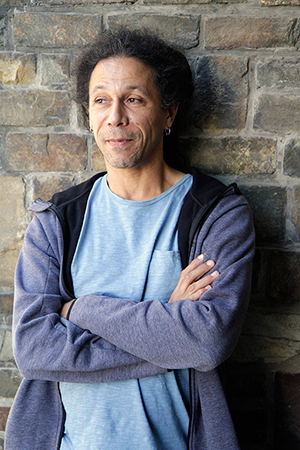
Buy a ticket and jump aboard the Zion Train for part 2 of the the collective's thirty-year history!
Let's just return to the music side of things for a moment. Earlier you mentioned you're quite averse to the commercialization of music, but back in the nineteen nineties Zion Train was on the verge of becoming a pop phenomenon with hits in the charts and video's on MTV.
Neil Perch: "That's an interesting story actually and I look back on that period with great pleasure to be honest, because China Records, who were an independent subsidiary of the Warner Brothers conglomerate, signed Zion Train for a seven album deal and gave us large advances, which we spent on building a studio and shooting videos. For us this was a form of political activity. The founder and CEO of China Records was a very interesting and nice guy called Derek Green, who previously signed The Sex Pistols to A&M. He offered us a lot of money, we went: "Are you sure?", to which his A&R guy replied: "Yeah, we'll just market you as a pop band!". Of course we already knew that wasn't going to happen, but we gladly signed the contract, and as we couldn't make records on our own Universal Egg label as Zion Train while we were under contract with China Records, we continued on making more radical music under various other names like Power Steppers, Tassilli Players and Trancemasters. If you look closely at the imagery we used in the videos we did at the time, they were pretty radical still. We also did a version of 'Homegrown Fantasy' (China Records, 1995, red.) including a CD-ROM, and on it we hid about 3000 pages of anarchist literature! Warner Brothers paid for that, took us all around the world, which basically established us in these countries for the next two decades.
Since we stopped collaborating with the major labels, using the platform they allowed us to build, we managed to stay afloat by ourselves. The money we earned while signed to China Records also allowed us to put out music on Universal Egg by artists like Jah Free, Vibronics and Dub Terror, which otherwise we would never have been able to afford. Without us, these guys wouldn't have had record releases for at least another decade, as they were still handing us cassette tapes with their music on, recorded in their bedroom with a couple of hundred pounds worth of equipment. We were turning their music into records with Warner Brothers' money, and that's what I consider good political action: redistribution the money of a big corporation to small individuals in need of it.
For the launch of 'Homegrown Fantasy' we had a campaign of A1 size posters featuring a big psychedelic marihuana leaf in the middle that went up all over Europe, even resulting in the Bishop of Bia?ystok, a city in the far northeast of Poland, having our concert there cancelled, which wasn't good news for our Polish fans, but made for some great press! (laughs) We never used the money China Records gave us to buy new cars or clothes. I'm a great advocate of general and global drug legalization. All illegal substances should be made legal, information about them made readily available to the general public, and they should be controlled in an appropriate manner. That way we wouldn't be in that stupid mess we're in now, with people being killed all over the world, kids dying because they're taking rubbish no one knows what's in it. Take spice for example (synthetic marihuana, red.), which was legal in the UK up until a few years ago, that has become the scourge of the country with 4 out of 5 prisoners in the UK being locked up for spice related issues. That would certainly not be the case if the drugs that have been tried and tested through humanity for thousands of years were made legal in a controlled and intelligent way. In that perspective putting up posters featuring a big marihuana leaf wasn't just a rebellious act, it was a real socio-political statement and again something we could have never been able to afford ourselves.
At the time we also had a sort of free pamphlet newspaper printed, with half a page dedicated to Zion Train and the rest filled with political information and world facts we thought would widen the general public's perspective on certain issues.
When they finally realized we weren't going to sell enough records to earn them the profit they were hoping for, Derek Green, who was ceasing his collaboration with Warner Brothers, basically signed the contract back over to us, which he absolutely wasn't obliged to do. The only Zion Train albums I still can't reissue are the ones whilst under contract with Warner, so 'Homegrown Fantasy', 'Grow Together' and 'Single Minded & Alive', wich was a double album including a live recording made at the Winter Solstice Bass Odyssey at The Rocket, London in 1996. Even on that event we still spent about 15000 £ and we had Jah Shaka, Twinkle Brothers, The Ruts and others playing in four different rooms at The Rocket on Holloway Road, which is now the Polytechnic of North London, with a very expensive mobile recording studio outside recording the whole thing. As far as I'm concerned good subversive political activism doesn't get any better than this! (laughs) The whole experience also gave me great insight in how to run my own record label. So all in all it was a great experience!"
Apart from this stint with China Records, Zion Train has been a diy operation from the very beginning. How did you adapt to the changes in the music business, going from vinyl to cassette tapes and CDs, then MP3 downloads and now the resurgence of vinyl?
Neil Perch: "We basically just went with the flow! (laughs) The first music we released - this was still in the pre-internet era - was on subscription cassette tapes. Fans would pay us 15 £ a year, and in return would receive four cassette tapes in the mail during the course of that year. Then we switched to vinyl, because that was when CDs were only just starting to become popular, and soon after we started combining both as CDs had suddenly taken off massively and were also easier and cheaper to ship than vinyl records. When the digital online formats started made an appearance, vinyl and CD sales virtually plummeted over night!
I know they're talking about the resurgence of vinyl now, but if you're doing about 3% of what you used to sell, that's not really a rebirth is it? Don't get me wrong, I appreciate the resurfacing of vinyl, but in terms of business it's far from spectacular really. As I said, we've always gone with the flow, so these days I release far less releases per year then I did, and don't have the time or energy anymore to spend on third party releases as we did in the past. To prepare, promote and distribute a musical product, wither it is on vinyl, CD or Mp3, takes a huge amount of work, and I now really only have the time in my life to do that for Zion Train, so release-wise we sort of come full circle. The big difference being that we're in the age of social media now, so that's where we do most of our promotional stuff.
Back in the day the first distribution of our vinyl releases was done by me with a rucksack on my back hopping on and off London buses, going from one specialist record store to another. Most of them didn't even pay though… The fabled Daddy Kool Records for example was a thief! You'd take him a said amount of records, he'd sign for them, but when you returned for the money he pretended he hadn't seen you before in his life. After one of these altercations I even went back to our studio, called the shop, acting as a customer looking for a certain Zion Train record, to which he then replied: "Sure mate, we've got 10 copies in stock!", to which I then replied: "That's strange as half an hour ago I was in your shop and you pretended you'd never heard of it!" (laughs)
I'm sorry but I don't stand on ceremony, so I will come out and say Daddy Kool was a thief, as was Style Scott for example and so many others in the music business! People in our business should have far more respect for one another, especially those who consider themselves to be Rastafarians, because this music is meant to be sufferer's music. A lot of people in the reggae business have simply made a name for themselves by threading on others, and I'm not afraid to call those people out, because that simply isn't ok!
In terms of the movement of the business, you sort of have to follow the current trends. I abhor commercialism in music, but at the end of the day music is my bread and butter, so I can't but take a pragmatic approach. We charge for less for a Zion Train concert then most other bands do, try to keep entry tickets as low as possible and we don't overcharge on our merchandise as we feel that if you come to one of our concerts, you've already invested in a ticket and we don't want to exploit the fact you've come to see us to extort even more money out of you. Basically we try to deal with the commercial side of things on an intelligent, social level, but we still live in a capitalist world, so we do have to deal with it wither we want or not."
Zion Train has always existed both as a live band and a sound system. In terms of the sound system scene, which has really exploded in recent years, what does that side of things represent to you?
Neil Perch: "It depends… I celebrate the expansion of the scene, but with caveats. The scene is autonomous, because it had to be, as it was the expression of black people in poor communities in the UK who weren't allowed into regular nightclubs and music venues. That's why people started building their own speaker sets and blues parties, which were basically small gathering at someone's private residence, emerged. In those early days it was a strictly black scene, and I have no problem whatsoever with that scene become more cosmopolitan, but I do have issues with people forgetting or not caring about how and why it all started.
A lot of the youngsters coming up in the scene don't really get that heritage anymore… They believe being underprivileged is not having enough money to buy another 10000 euro amp! The professional equipment a lot of these guys are now using is not at all representative of what the scene was. The first amplifiers I got were still handmade and were still relatively cheap to purchase. That's no longer the case, because if you want to be a sound system like OBF, King Shiloh or Iration Steppas, you need to be willing to make a 50000 euro investment. It's become big business… People like Blackboard Jungle, the biggest French sound system, or OBF on the Swiss side, will not hesitate to charge seven or eight thousand euro to set up at Dub Camp for three or four days. That's ok, I'm not knocking that price, but the whole economic scale of the sound system business has changed.
People need to recognize that evolution and also the level of cultural appropriation that's going on. Again, culture is something that no one owns, and constantly keeps evolving, so as a black Jamaican in London, you can't really reproach these youngsters for having stolen your culture, but I can understand there's some aggrievement about the lack of recognition by the new successful and mainly white European sound system crews. Today's scene only exists because poor black working class people used their hard earned wages to build the first sound systems out of necessity, but also love and dedication. These days the scene has become a bit like a bubble, a hype, and I'm convinced it won't last, at least not in the form it's taken in the last few years. The energy it brings to people, is something I will always celebrate though, because of the self-determination and DIY-attitude of building your own thing."
What about the evolution of wanting to get bigger and louder all the time?
Neil Perch: "That's rubbish! Music has got nothing to do with volume. It's stupid, arrogant, testosterone based rubbish and I've got no time for it. If someone claims a certain sound system is better because it sounds louder, I'll say: "Listen mate, I don't think we're on the same page there!". I don't necessarily credit myself with a better way, but certainly a different way of thinking.
A lot of people would say I play loud music, and my personal sound system, Abassi High Power, is indeed pretty loud. For a lot of people it might even be too loud, but in comparison to the aforementioned sound systems it's still pretty damn quiet to be honest! (laughs) For me the volume they play at is just too loud, and on top of that a lot of these guys not only play at incredibly loud volume, they also play in distortion, which just ruins the work of the musicians who've spent years composing and recording their music. I often hear sound systems play, where I can't even hear the vocals or the brass section, with hordes of kids wasted out of their minds on booze or drugs going absolutely crazy about that sound. I can get that leaping and jumping around with a bunch of your friends is a great sensation, but there's little difference anymore between that and listening to deafening death metal screams or hardcore techno. To be frank about it, when you get a combination of electronic music, money, events and substance use or abuse, it's only logical the music will get increasingly harder, faster and louder until at the end people can't bear it anymore. It happened with drum & bass, it happened with house and techno, and it's now also happening in the dub scene! I don't like that evolution and avoid the people and the events where the music is played like that.
These new sounds are also splashing cash on equipment they don't even really know how to use. A lot of them are using Powersoft Audio amplifiers, which are around 10000 euro each and really meant for professional PA-systems. It really takes a professional technician to set them up, so they're not exactly plug and play, they've got internal digital setups and if you want to use them well you need master that first. It even takes professional technicians about an hour to do it; great equipment, but miles away from where it all started.
I remember going to the Shaka - Fatman dubclashes, but it wasn't about trying to beat each other with the volume of their sound, it was all about trying to beat your opponent with the quality of the records you had with you. You'd hear things you wouldn't be able to hear anywhere else. For example Shake would put on a personalized dubplate of Ijahman's 'Moulding', and then Fatman would respond with his dubplate of Gregory Isaacs' 'Mr Know It All'. The volume was never too loud, there was no badmouthing each other, just sheer musical quality, and that way everyone was the winner, both the audience and the clashing sounds.
That's also something I never got, the competition side of sound clashes… What's that even doing in music? It should be a celebration intent on enlightening and uplifting the audience. I also celebrate the fact that with Zion Train we do not predominately play at reggae or dub events; we mainly do our own thing and only appearing at these kinds of events very occasionally. People often come up to me saying things like: "Wow, you guys sound so unique!", to which I can only reply: "Thank god for that!" (laughs) I don't aspire to sound like anyone else… I've always been a huge fan of Conscious Sounds, but I don't want to sound like them."
To be continued...
Photo: © Andreas Peeters








.Dl7BAwhJ_ZJXLLF.webp)