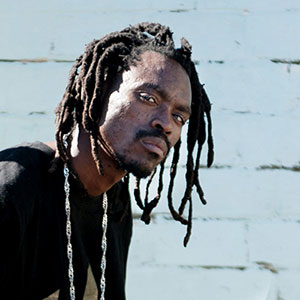
South African artist Crosby spent a week in the French city of Lille for a musical venture with hip-hop crew Scratchattic: reggae meets hip-hop. That's how I got to know Crosby and quickly realized he had great potential and a recently released album of good quality. I really had to speak to him and share this interview with you.
How did you get in contact with Reggae music?
Crosby: "My father was working for the oil rigs at the Harbour of Cape Town. But he also used to go and work abroad like in Scotland. So, as he was a Rasta, he'd pass through London to buy some records and bring them back to South Africa. Then, he would throw parties at home. He would just put up a tent on the side of the house and do a party. At that time, in the '80s, when we were going to a reggae party, as a youth, we used to say that we were 'going to listen to the message'. In those days, it was more about the message than the music.
So I got poisoned with reggae music. My father is a Rasta and I'm a born Rastaman. I've been surrounded by reggae music since birth so my love for this music is a natural thing.
Later on, in was separated from my father's family to go and live with my mother's family, which was almost 1000 kilometers away from Cape Town towards the East. And there I learned to love some other genres of music. My Grandmother was singing in an adult choir. And she taught me a lot of theory about the music: she would know the notes, when somebody would sing in a wrong key and those kinds of things. That shaped me into what I am.
At that time, as I was at school, I started a hip-hop band called Def Boys. We were influenced by Def Squad, Redman, Eric Solomon or Keith Murray. We started that group in '90 and I was the leader of the group. So hip-hop is not a foreign thing to me. I've worked with a lot of rappers, from Switzerland or South Africa. Later on, when I was back in Cape Town, I also was part of a crew called the Chronic Land which was a group more focused on ragamuffin, and fusing other styles of music in it. My musical taste stands from those different experiences."
Your father was a Rastaman, how did it influence you?
Crosby: "I was born in 1982 and my father was already a Rastaman. As you know, in those days, we were living under the apartheid regime, so I was one of the first kids who had dreadlocks in that particular time. And I was also going to a Muslim school which was outside from Gugulethu, the township where I was from. So that's how I got to get a different exposure to life and a different perception of the world than the regular kids who would just see the life of the ghetto. Then my father would be travelling to foreign for work and then come back and hold his parties and move around a lot. So I wasn't seeing him a lot. But I remember that anytime he was around, he was making people happy by playing some wicked roots songs. I'm not talking about Bob Marley or Peter Tosh alone, but also Dennis Brown, Isaacs, Twinkle Brothers, or also Macka B. And these artists inspired me a lot also because his style was linked to hip-hop with his speech and poetic vibe."
The Rasta movement was already strong in South Africa?
Crosby: "Yes, it had been strong since the nineteen seventies. Even though the officials tried to contain it. I know for a fact that, when records would come in at the harbor, the apartheid police would control them. If it was a Bob Marley, or a Peter Tosh or a Bunny Wailer, they would estimate that it contains a message that they didn't want people to hear so they would scratch those discs so that when you'd buy it, you wouldn't be able to listen to it. This is how influential reggae music has been in the times of apartheid."
And was it then forbidden to play those tunes?
Crosby: "Mmmh… It was somehow forbidden. We were being harassed by the police because nuff herbs a burn in our parties. In general, the apartheid system was against Rasta because of the Rasta way of living, for example, where nuff herbs a burn, and because of our philosophy which was pan-Africanist and them thing. So the Rasta community faced a lot of brutality from the police in those times. Reggae music has been instrumental in giving hope to the hopeless. Because the apartheid regime was oppressing the people and making them feel hopeless. Reggae music was there to motivate the people not to give up with the struggle and put a smile on their faces."
Thinking of "reggae" and "South Africa", many people will immediately think of Luky Dube. What influence did he have on you?
Crosby: "In 1987, I was 5 years. My mother was a ganja seller. I was one of the first ones to know that Lucky Dube actually didn't smoke herbs because my Mum brought him some herbs at one of his shows in Cape Town, he refused the herbs. Anyway, what he did at this show, I will always remember. I was there as a little Rasta youth with dreadlocks. Half way through the show, he saw me and pulled me off the crowd, lifted me on the stage and left me there like that facing the crowd. I don't know why he did it. It brought questions to my mind. Maybe he felt like I would take over. In that time, you wouldn't see many Rasta kids around. Maybe he felt like putting me on the stage was for people to learn that this is the future, Rasta is the future."
How do people in South Africa feel about Lucky Dube?
Crosby: "You'll be surprised that, in South Africa, many people are not appreciating Lucky Dube like you appreciate him. First of all, some were saying that he was just using the image of Rasta. Because he wasn't really a Rastafari believer. This is why my father refused to go to the concert I was telling you about earlier. The Rasta's would say that Lucky Dube is the "culture vulture" type of thing. For me, I have a different view about it: I felt like this man was also one of the great messengers. It is said that this man was filling up stadiums outside of South Africa. He was earning more in foreign currency than in South African currency. So it's pretty sad that we only recognize legends when they're gone. The same happened to a great trumpeter called Hugh Masekela. This great musician played with Sly and Robbie and it's told he even played on a Bob Marley song. He was banned in South Africa during the time of Apartheid and had a great international career. It's only when he died, earlier this year that people in my country started to show appreciation."
What are the opportunities for new reggae artists in South Africa?
Crosby: "It is very difficult for South African reggae artists to make a name for themselves. At first there are very few radio stations playing reggae music. And those stations have only one or two hours of reggae programs and this isn't enough to spread the message. But there are a lot of artists who'd deserve to get their name recognized like Jahnett Tafari, my brethren, and also a wicked singer called Daddy Spencer who you should check out. Dillinger obviously, a brethren called Shuga, a cousin also called Zoro, who's a great roots singer. But all of us get more feedbacks and appreciation from outside than from inside. This is why artists have to export themselves to the international market instead of waiting for someone to expose their names around here."
How's the local scene for live shows?
Crosby: "Well it's not so easy, financing is missing. This is why we do much more sound system shows than band shows. There are no sponsors, so live band shows are always a challenge. Those who are organizing festivals, and all people who are pushing the reggae music, are pulling money out of their pocket, taking some financial risks. They're people who really have the heart for it. They're not in it for the money. At present time, the reggae scene is still a very underground thing."
Can you tell us about your first album released in 2017?
Crosby: "It was produced in Germany, recorded in Munich by the Next Generation Family. It's called 'A Better Place' and contains 11 songs plus one remix. Basically, the idea of the album came from the time I went to do my first show in Munich. I was taken to the studio of Fyah T and we really got along well. He was about to release a riddim called the Raspect Riddim with artists like Fantan Mojah, Luciano, Lutan Fyah and more. So I participated to this project and in Germany, the song I recorded on the riddim got quite some success: it was called 'Heart of a Lion'. When I did my second travel to Munich, we decided that we would record an album together. So that first week, we worked out six songs and finalized them. And then we didn't see each other for a year until my next visit. During that second stay we recorded the other six songs and the album was ready. The album was mastered by Ganjaman, who's a big man in Germany. He mixed albums by Gentleman, Seed, and some other big artists. Amongst the tunes, there is only one featuring, with Fyah T. I didn't want to be recording with famous artists; I didn't want to ride on anyone's established career like some others do. No disrespect, but I had to do it on my own. I want my progress to be a graduate progress. This is the first project that came out officially that is only me. I did a lot of collaborations, featurings, singles here and there before. And I really wanted this album to represent me.
Can you tell us about those two songs in Xhosa?
Crosby: "One is called 'Uthando' which means "love". The song is about the fact that we living in a world that is changing and that is ruled by capitalism. People don't respect each other for who they are but for what they have. The message is: "We need to bring back the love!". Because before we had anything like money, cars, or whatever, love was the thing that brought us together. The next song is called 'Hamba' which can be translated as "travelling". Basically, it's about me travelling the world and giving thanks and praised that the Most High is always being by my side: "Lord Almighty, give thanks and praise that on my outstep you're always with me, and on my instep you're always with me, through my travelling travelling travelling, over hills and valleys, over mountains and seas".

.Dl7BAwhJ_ZJXLLF.webp)