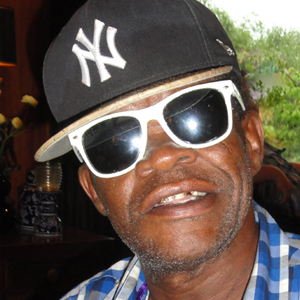
DJ veteran Dillinger has just released a new album. The ideal opportunity to look back on his long career.
Dillinger, how exactly did you get into the whole sound system business, all those years back?
Dillinger: "Well I used to hang around Dennis Alcapone's El Paso sound system, but even before that I used to lend a hand loading the trucks for sound systems like Smith The Weapon and Prince Jackie's Hi-Fi. Fort that last sound I eventually also started to deejay and select. I grew up listening to deejays like U Roy, Count Machuki and King Stitt and wanted nothing more than to become an entertainer like them."
You started out calling yourself Alcapone Junior…
Dillinger: "Yeah, as I just mentioned I used to hang out with El Paso sound system a lot and Dennis Alcapone was a huge inspiration."
It was none other than Lee 'Scratch' Perry who suggested you change your stage name to Dillinger.
Dillinger: "At the time I was doing some recordings for Lee at Dynamic Sound Studios, Byron Lee's place. Now when I entered the studio, Scratch asked me: "Youthman, what's your name?", but when I replied my name was Alcapone Junior, he looked at me and replied: "Youthman, you're definitely gangster, but you're no Alcapone, you're Dillinger!"."
How do you look back on your time spent working with Scratch?
Dillinger: "Well, I can't say I had any problems working with him. He was what we in Jamaica call "gimmicky". I remember I did a song for him called 'Dub Organiser' and when I was going: "King Tubby a no mizer, King Tubby a di dub organizer…", he just started knocking two empty bottles against one another and incorporated that sound into the song. In my view Lee 'Scratch' Perry is a true genius."
Going against the trend of doing a ganja tune, you recorded 'Cokane In My Brain' (Island Records, 1976, red.).
Dillinger: "I certainly recorded my share of ganja tunes, songs like 'Jamaican Collie' for example. But everyone was doing ganja tunes in those days - logically so off course as Jamaica is known for its ganja - so I decided to diversify and do a song about cocaine. That being said, 'Cokane In My Brain' was just as much an ode to New York as it was about cocaine."
The riddim of 'Cokane In My Brain' was based on 'Do It Anyway You Wanna', a 1975 disco song by People's Choice. Did that tune hit the Jamaican charts as well?
Dillinger: "Yeah man, that was a big tune in Jamaica. Back in those days Jamaican music was still heavily influenced by American soul, disco and even funk, cause I remember I also did a tune called 'Funky Punk' (Jamaica Sound/Bellaphon, 1979) around that time. Joseph 'Jo Jo' Hookim presented the riddim to me and I immediately liked it. I proceeded to write the lyrics and the rest is history."
It's said reggae deejays like yourself laid the foundation for hip-hop.
Dillinger: "If you listen to 'Cokane In My Brain', (starts rapping): "A knife, a fork, a bottle and a cork, that's the way we spell New York!", that's pure hip-hop! Not much later you had Grandmaster Flash who released 'The Message' (1982, red.) and before that you already had Sugarhill Gang's 'Rapper's Delight' (1979, red.)."
Another one of you iconic tracks was 'CB 200', also the title of your eponymous 1976 album released by Island Records.
Dillinger: "At that time there was a bit of a motorcycle craze going on in Jamaica. Apart from my 'CB200', you had Big Youth doing 'S.90 Skank', Trinity doing 'Z 90' and Shorty The President did 'Yamaha Skank'. Those were all songs about the imported Japanese motorcycles that were conquering Jamaica at the time. I used to right a CB200 Nighthawk at the time; I had bought it in the US and had it flown over to Jamaica. That's bike also inspired Steely in calling his sound system Silverhawk Sound. I let him ride my bike one day and he liked it so much he decided to use the name for his sound system."
As a foundation deejay, how have you adapted to the dancehall era?
Dillinger: "Well I might drop some lyrics over a dancehall riddim once in a while, but to be honest that doesn't give me the buzz or drive reggae does. Seventies and eighties dancehall were still ok, but these days it's moved too much towards hip-hop and reggaeton; it doesn't feel Jamaican to me anymore."
You've always put a lot of wit and humor in your lyrics.
Dillinger: "I've always enjoyed putting a little humor in my lyrics and giving my performance a bit of a comic twist. I'm not for being serious all the time; I like to enjoy myself and want the people who come to see me to feel the same and give them something to smile about."




.Dl7BAwhJ_ZJXLLF.webp)