




.Dl7BAwhJ_bSbwe.webp)
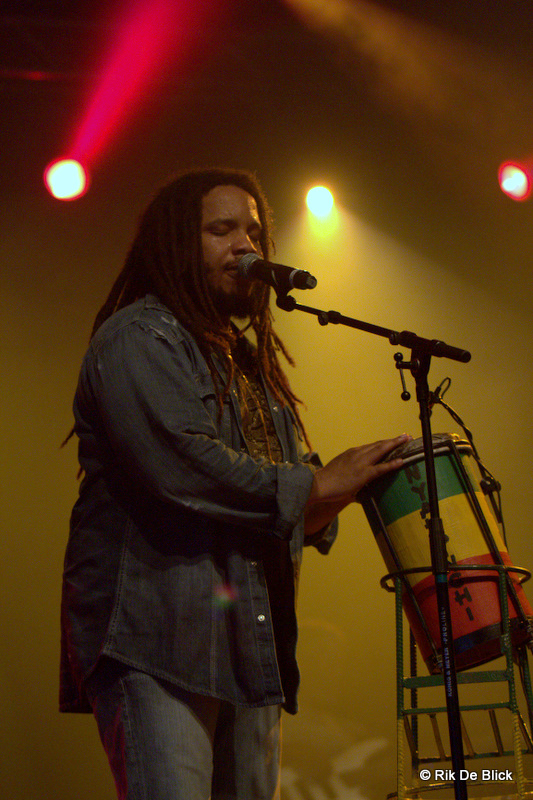
Stephen is without a doubt Bob Marley's most gifted son. He's written and composed some of the best songs on Ziggy's albums in the 80ies and 90ies, he initiated the carreers of Damian and Julian Marley and he's worked with many of the major American hiphop stars. And he's released two solo albums of outstanding quality, arguably the best any Marley has made since Bob passed away in 1981. Read all about it here.
Hearing that I saw his father perform 31 years ago, Stephen shows a big smile. It grows even bigger when I tell him I loved his show and thank him for all the work he's done to get his brothers on the right musical track. Was there actually a plan behind that?
Stephen Marley: 'My father told me. He said to me: "Take care of your brothers." These were his exact words. Ziggy teach us but I'm the one who has to take care of the family. Even if you look at it in a biblical way. I was born in April, which is the month of the tribe of Ruben. And Ruben is the first son. Those attributes are in me, to be able to summon the flock, in lack of a better explanation. Seen?'
So launching the carreers of Julian & Damian in the nineties was mainly your move?
'Yes man. It's like a game of chess. And we are like a tree. We come from the same root.'
Did you also advise Damian to use your father's rhythms?
'If you are an apple tree, you won't grow mangoes. We incorporate the root in our music, which is our father. You can't have a tree without its roots. I'm not taking something from somewhere else. I'm taking something from my own root. If you trace me, you're going to find him, my father. '
Did you know Damian was going to be that successful?
'Yeah man! He was geared. That's his position, to score goals. We work like a team. You are good in this position so we have to train you for this position. Nothing surprises us. We know. But we thank God still for everything that he is has granted to us, for our legacy and the life that we were born into. We take great pride and honor to serve that purpose. 'Cause we are servants, right.'
Whose idea was it to use Sly & Robbies riddim for Welcome to Jamrock?
'It was Damians. He heard it and felt inspired to write some lyrics on it.'
On your new album, there's another Sly & Robbie riddim, Black Uhuru's General Penitentiary.
'I took my sons and Ziggy's son to an open mic, where artists can free style and introduce themselves. There the original tune came by, and I felt like: "Yeaaaah…" So I went to the studio and recorded Jah Army.'
Without asking Sly & Robbie first?
'After. When the tune was going to be released, we had to have their permission.'
You rarely use other people's riddims.
'True. But Sly & Robbie… Oh me, oh my. They are patriarchs, legends, like my father, from the same golden era.'
Another remarkable project of you was the crossover album Chant down Babylon, for which you worked with some big stars.
'It was something that had to be done because it was part of my father's wish, that we work together with black American artists.'
And Steven Tyler of Aerosmith.
'Well, rock'n'roll embrace reggae, you know. I'm not gonna segregate on the basis of a man's skin color. It was about black American music, and hiphop was at the forefront of American music at the time. Tupac just died, than Biggie… It was so necessary to transcend Bobs message to black America. They know about the legends like Che Guevara but they don't really know about their history. Same way with Bob: some people embraced the legend but don't know about his life, about the effect he can have on their lives. And that's what we want to do: to affect people's lives. Not just to be hip, or to be cool but to transcend the message to the next generation. That's why Chant down Babylon was a very important album.'
When you look at the whole of your work, and also Damian's, Africa is a dominant returning theme.
'Even you have your roots in Africa. It's not about us, it's about mankind. Education, you know. Like my father said: emancipate yourself from mental slavery. He said that in 1979. Thirty years later I sing about Mind control. It's the same thing. Physically it's hard to enslave us. We already went through that and we rebelled. But if you can control the way we think… Than your work is done . That's why we have to educate the people about this mental enslavement and the worldly causes that drive us apart and keep us at another's throat.'
'That's why herb is so important. 'Herb is freedom. Herb is an antidote. It kinds of help you to light that flame, that drift, that mental space to incorporate peace and love and humanity. It helps you to remain human in this society that treats you like a computer. Wake up this time, go to work, pay the bills! Where is life? We have to work to achieve but not like a computer, same way everyday. We don't even talk anymore, we text and we e-mail.'
Do you realize you are really a unique family? I can't think of any other famous singer who has had such a fruitful offspring.
(laughs) 'Well, that's good to hear. From someone else. (laughs) Thank you.'
But I don't think you will ever be mainstream.
'I'm above mainstream... We will see. As long as people get a little chance to hear our music, and that's happening now. That's also why we performed on this festival (Feest in het Park), where there's all kinds of music.'
You are still bearing the flag of rastafari, from the heart, with plenty of conviction and devotion. You never get weary?
'Rastafari is a part of me, like part of me is a man. It is an inborn conception that cannot change. There is no still, there is always. Yu' know what I mean? Rastafari is the essence. It is the beginning and the end of our conversation. We do it for God, or the Almighty, or whoever he manifests himself into. That's why we are here. You can't wonder how long it will take before people accept the truth. It has to have that struggle, you always struggle for change. Otherwise it would be like a fad, gone tomorrow. We don't expect the change to come easy. But at the same time you are here to spread my words, so the struggle goes on. It's alive!'
Your father became a member of the Ethiopian Orthodox Church at the end of his life…
'I wouldn't say he became. He was always Ethiopian Orthodox. You see, we have no religion. Man made religion. There's nothing wrong with that but we have chosen for a more personal relationship with God. That's why we don't take a vow onto a church. A church is a temple but if the building of the church goes down, where would you go to pray? You still have to find solitude in yourself, and that place to worship God. This place is inside yourself.'