
.Dl7BAwhJ_ZJXLLF.webp)
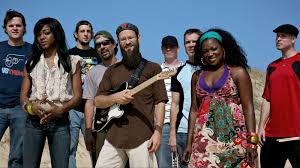
Music is the most high, even when there's no ganja . In a smoke-free Melkweg, Amsterdam we witnessed another great show by America's prime reggae band Groundation in june of this year. A few weeks later they performed at Couleur Café, another great show. Here I am is the name of the tour and of Groundations new album that brings them to Brussels this week.
We first talked about the event that shook the United States, and should change it for good: the election of Barack Obama as president.
Stafford: "Amerika has changed already. The right wing people are afraid for the future, for this crazy liberal government that is taking over the country. While most of the young people are very happy that this government took over the country. Finally get rid of those ways of the past. And also, president Obama himself has an enormous influence. A person that can speak well! It seems that he considers all problems logically, with reason. You can disagree with him but then he asks why. That's better than saying: you're the enemy. Let's be afraid of these people and get some weapons."
Does it influence you in your song writing?
Stafford: "Yes and no. Maybe people are more open now to what I'm saying. They can breathe more easily. But the struggle remains the same. The people who have the money are still running the show. Wars are still being fought. People are still detached from reality. So let's talk some more about this reality. It's still very necessary."
Your new album Here I am has been a well kept secret.
Urani: "We succeeded in keeping it offline. Our previous album, Upon the bridge, was online one month before the official release. The record label, Naive, was very cautious about that because they know there's a lot of interest."
Stafford: "In the States the record is released later, on our own Young Tree label. Naive has a licensing deal with us."
I've got the impression reggae is doing better in the States recently.
Stafford: "I don't know about that."
Urani: "There's a lot of new bands coming up. We met some bands of the Midwest who make reggae-ish music. Nothing spectacular but they're into it..."
Stafford: "For us, it's growing. Actually, it's still beginning in the States, compared to Europe that is. We now play regularly for 2000 people crowds and for this album we will have a substantial promotion campaign. We're really pushing this one, a lot more than we've ever done."
How many people earn a living through Young Tree, band included?
Urani: "Twelve."
Stafford: "For this album we are working with Madison House, a marketing company. We have to try and push the music upward. These people have worked with other bands, Taj Mahal, Los Lobos, and they know about music. They love music. They're not in it for a quick dollar."
Who are the guest singers on your new album?
Stafford: "Pablo Moses returns, and The Congos, all four of them this time."
Urani: "We even have a tune where it's just The Congos singing, without Harrison."
Stafford: "Have you ever heard of a band where it's not the lead singer singing? But we still wrote the song for them."
There's one artist who you've worked with but who rarely performs live. We've seen The Congos come back, Pablo Moses, I Jah Man Levi... Where is Ras Michael (featured on Each one teach one, Groundations 2nd album)?
Stafford: "Ras Michael is doing well, still playing music, but he gets rarely asked. He's not as known. He's more like a cultural, historical personality."
Urani: "I've seen him perform with Lee 'Scratch' Perry. It was great."
A lot of reggae artists live in California, where you come from. How did that reggae scene come about?
Stafford: "After Bob Marley toured the States with Sly & The Family Stone in 1973, some of the people on the road with him settled there, in the north of California. Ricky Bailey, Toni Moses, Ras Michael, even Joe Higgs, who stayed in Los Angeles. Wire Lindo had a compound there, and a guy named Slim opened a record store. That's how it all begun."
On Each one teach one you had Marcia Higgs singing, daughter of Joe.
Stafford: "I've lost touch with her. She's into family life now. But I'm planning to get in contact with her to do some work."
Do you know Sonia Higgs?
Stafford: "I know Angela Higgs. But Sonia? No."
She made an experimental album with Family Man (Aston Barrett, Marley's bass player), Juvenile delinquent.
Urani: "Interesting. I know Family Man is a great arranger and producer too. Did you know he played, also keyboards! and arranged the famous Exodus-intro?"
You played it superbly in the show today.
Urani: "I've got this new Hammond B3, specially built for me, with a few things added. Some reverbs, some extra keys. I've used it on the album since Each one teach one, and in America also live. Now they've built a B3 for me in Europe, so you can have the same fabulous sound over here."
The girls seem to have a more important role in the new songs, or where they singing the parts of your guests?
Harrisson: "They even have two songs on the album where they do lead vocals, one of which is the title track, Here I am. We try to make things whole, to balance it out, to also cultivate the female element in our music."
Who are your favourite female singers in Jamaica?
Stafford: "The usual suspects. Marcia Griffiths, Judy Mowatt, Phyllis Dillon... But there weren't many women in the roots era who really stood out. That's one of the things that stuck me while making our documentary film Holding on to Jah. Where's the girls? Reggae is a man's thing."
Documentary? Should we know about that?
Stafford: "We've been working on it for ten years now. It's the history of Jamaica and of the rastafari movement, Marcus Garvey, Haile Selassie... Right now, it's being edited. I've already shown it to Roger Steffens, and he said: this is the movie we've been waiting for all our lives."
How long is the movie?
Stafford: "One hour, 35 minutes. It's very focused. We've been to Jamaica with a film crew four times, talking to artists who witnessed Haile Selassie's visit to Jamaica in 1966. Ken Boothe, Israel Vibration, Culture, U Roy, Pablo Moses, Ras Michael... That's where the movie begins, people remembering that day."
What does rastafari mean to you, Marcus? Not as much as to Harrison, I guess.
Urani: "It depends on your focus. I connect to rastafari through music. Harrisson has been studying the movement from a very early age. That's a total different perspective."
Harrison, would you say that you know that rastafari is the truth, as a true believer?
Harrison: "Each person has a collection of puzzle pieces that make them a person. Who is to say which puzzle is more beautiful? Who is to say what is the true way? I'm more of a spiritual person who believes. I believe in the power of the word which manifests itself in God. And we are the keepers of the word, talking to each other. Ras Tafari was a manifestation of who are as people, of what we could be. His struggle for Ethiopia was one of trying to gain awareness and respect for his continent and the African people, who have been brutalized for so long. Selassie stood for the love of all people. Claiming the truth, claiming your own way separates people. I'm rasta. Well, I'm not rasta. Okay, than we're different and you are wrong. I can not define myself like that."
Urani: "But we all have music."
Stafford: "The Nyahbinghi order was established to fight all white ànd black oppressors."
Together with Jah Shakespear, one of the founders of Reggae.be, he first started as a critic and a reporter before in the end of 2014 becoming editor in chief. Divides his time between his two passions: music and Haile Selassie.
Oct 24, 2009