







.Dl7BAwhJ_ZJXLLF.webp)
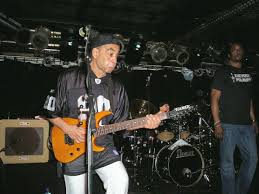
Exclusive interview with Skip McDonald, founder, singer and guitarist of Little Axe, a musical hero for more than 30 years.
Long before Moby started infusing his dance music with old blues samples, Skip McDonald and his band Little Axe had already created bluesdub. Skip who? As prime guitarist McDonald helped co-shape American black music for the last 30 years. Soul, funk, hip-hop: his name is everywhere, while his characteristic guitar playing is almost always instantly recognizable. With Little Axe he makes, since the beginning of the nineties, the music of his dreams, and of his worst nightmares. McDonald sings and plays the blues as raw and authentic as it gets, in the footprints of his great models from the first half of the 20th century, slavery not yet forgotten neither forgiven. The choir also reminds of very old music, a kind of primitive gospel. But the sound, signed Adrian Sherwood, is futuristic, much larger, more colourful, grander and rhythmically surprising than the original blues has ever been. The ingenious weaving into each other of these (at first hearing) two very different musical cultures results in a fascinating musical journey, a potential soundtrack for the dark tv-series 'Carnivale' (which plays in the twenties en thirties) but also for 'Prison Break'.
'Stone Cold Ohio' is Little Axe's first release on Peter Gabriel's Real World Records, where he was introduced by his old buddy Adrian Sherwood, the man who brought him to the UK in the first place. "The contract has been signed in 2004," McDonald says: "But until recently I had met Peter only twice. The first time was a contract meeting, the second time at the Real World party in June. Since then we spend more time together, but actually we're just getting to know each other."
There's more old buddies that Skip McDonald has linked up with lately. In the summer of 2006 he toured with Mark Stewart, the band having the same line up as Little Axe (Doug Wimbish, Keith LeBlanc) but performing under a different name, The Mafia. Mark Stewart & The Mafia released a couple of memorably dark punkdubrecords, superbly mixed and produced by Adrian Sherwood for his On-U Sound label, but it's been at least ten years since we'd heard something about Stewart himself, who has always been quite difficult to approach.
Skip McDonald: "Mark is like a price winning race horse that needs to train. After 3 or 4 concerts, when he's found his sea legs, the pieces fall together. But he truly is a great artist."
Aren't you a bit modest now? Isn't Mark Stewart one of those artists whom we would have never heard about if he hadn't hooked up with you and Adrian Sherwood?
Skip McDonald: "If you want to know the real equation, it worked both ways. In the early days Adrian was influenced by Mark. He was the first one to have a record deal, to have a band, to produce an act, The Pop Group... Mark was also responsible for us coming to London. He heard 'Malcolm X', the Keith Leblanc record, and made Adrian aware of it. Both Keith and Adrian worked with Tommy Boy Records, so that's where they met. In those days, we had a band called Fat's Comet. We played a kind of terrorist doowop. Then, Adrian flew us over to England and we settled in Europe."
So it was Mark who made your and Adrians music sound more extreme?
Skip McDonald: "In terms of perimeters, yes. Mark is not a traditional singer, so he definitely stretched our borders, as we stretched his. We pushed each other into new boundaries."
What actually happened earlier in your career? Your bio states that you backed Grandmaster Flash and even Sugar Hill Gang, which would make you a true pioneer of hiphop.
Skip McDonald: "Do you remember All Platinum Records? The Moments, Shirley & Co, that kind of hit music. This company, that I worked for, was actually owned by Sugar Hill Records, the company that released 'Rapper's Delight' (the very first rap ever to be recorded, released, promoted en become number 1 in the national pop charts, red.). Their house band was called Positive Force, and when the record became a million seller, they asked us, Keith Leblanc, Dough Wimbish and me, to support them on stage. First we had a small gig in Harlem, a month later we did an extended tour as an opening act for Parliament/Funkadelic and also Cameo. Later on Positive Force left the company and we became the Sugar Hill house band. For about two or three years we cut all the tracks that were produced there. So we didn't record 'Rapper's Delight' itself but everything that came after that, until 'Scorpio', on Grandmaster Flash's first album."
Did you make some money out of this records?
Skip McDonald: "No, we had a very bad deal. Otherwise we would have stayed longer and probably would not have come to England. It's funny how life goes."
How did you get to know reggae music? You were raised in the heartland of America where, I suppose, reggae wasn't really mainstream in the seventies.
Skip McDonald: "We knew Bob Marley, Black Uhuru, Third World... The likes of King Tubby, Lee Perry, Observer: never heard of them until 1984, when I came to England. The very first time I ever heard dub music, it was in a studio, it really blew me away. That sound! The space of it! The lack of overdubs! The way they keyed in to certain things. Dub has since become a big part of my own music."
Did you ever meditate on why this influential music was born in Jamaica, and not for example in Ohio?
Skip McDonald: "Necessity is the mother of all inventions, goes the old saying. These people worked with what was available. They didn't have budgets so instead of more and more they did less and less, concentrating on the groove and the intent of the song."
Why did it take so long before dub en reggae got some respect in the United States?
Skip McDonald: "The American music industry is very Top 40-based, even in the genres, country, jazz, soul... But there's a lot more than 40 good records. Here, in Europe, being a much older society, you can hear much more music, through pirate stations, independent labels and so on. Here you hear African music, Asian Music, funk... A truly wide variety."
Dancehall got its breakthrough in the States. How do you explain that?
Skip McDonald: "Because of the growing number of Jamaican immigrants and their descendants. And also: rap originated in Jamaican music. That influence has always been there."
Like you have always been influenced by the blues.
Skip McDonald: "My dad was a blues guitar player. Not professional, he earned his money as an electrician, but we had a very musical family. Every Sunday we used to come together to sing and play music. My sister would sing, my cousin also, I would play, and as top of the bill my dad would play."
Did you go through the whole black music evolution in the sixties and seventies?
Skip McDonald: I've lived it from about 1961 when I was 9, 10 years old. My first encounter was with a gospel group, five man singing and a guitar. From there I went to an r&b band doing Sam & Dave covers, and James Brown. I played for a while with the Ohio Untouchables, which later became Ohio Players. When I was about 17 I played heavy jazz. In 1969 we went on the road. Montreal, Boston, New York, the Carolina's... That led me up to meeting Dough and Keith, and up to today. Apart from that, I sometimes get the chance to play with some of the greats. George Benson, Peewee Ellis..."
How has black music evolved since you started playing?
Skip McDonald: "I would say it has devolved, not evolved. What used to be black and white music is all getting grey now. I see some sparks of joy but I miss the loyalty and the commitment to the music. If you don't get a record deal within a year, the band usually breaks up. You know, music business has changed so much. Their used to be a job called A&R, Artist & Repertoire. Where have these guys gone? They put the writers with the right singers in the right studio with the right producer. But this job doesn't exist anymore. Everything has scaled down. As if you wouldn't need all these people anymore, the producer, the engineer, the writers... Looking back, I think music went out of the window in America from the time Nixon was elected president. 1968. It moved away from live venues, from vinyl, from musical quality... It all comes down to marketing and the way you look now. The other day I talked about a talented young singer to a record producer and the first question he asked was: what does she look like? Next question: how old is she? What's that got to do with music? Obvisouly, they're only looking for a sellable product, not for musical talent."
Who are these sparks of hope you've seen?
Skip McDonald: "I've seen some singers, some players, just recently, who make me hope that it comes back. Everything goes in circles. Dixieland was a renegade music in the beginning. Jazz: renegade music. Rock'n'roll: renegade music. Heavy funk: renegade music. But after a while this music becomes the standard. That will happen again, undoubtedly. Music that sounds far off and underground now will rise and shine in the future."
You're the living example of that statement.
Skip McDonald: "I always seem to play the wrong style at the wrong time, but at the same time it's the right style at the right time. It's just a matter of building your own fan base and letting the people know when you do something. That way it will grow. Slowly but steady. People who buy one Little Axe record will buy all of them. You're right, we've always been a little ahead of our time. We often see other artists pushing up what we do to a more commercial level. But I prefer it this way. Making music is still exciting for me, I still love doing it, because I like to stay ahead. I consider it a big honour that people today try to do what I did 25 years ago. I want people to know when they hear a guitar: that sounds like Skip. That's the recognition I long for."
How about Moby copying your idea to use old blues samples, or at least make them sound like that?
Skip McDonald: "Oddly enough, I didn't pay any attention to it. To this day I've never even played a Moby record. But so many friends called me about this Moby guy that there must be something. Although ideas are universal. It seems that Moby's management at a certain time was interested to manage Little Axe but we never heard anything about it. And that's alright with me. I'm very happy to see that my musical ideas have become popular, whoever forced the breakthrough."
Jah Shakespear has been listening to reggae music since 1977, started writing about the subject in the early nineteen eighties (for De Morgen, De Standaard, P-Magazine, Highlife and a number of other magazines) and founded this website in 2002. He's also the author of 'De Rasta Revelatie' (2008) and 'In Het Spoor Van De Keizer' (2016).
Nov 09, 2006